

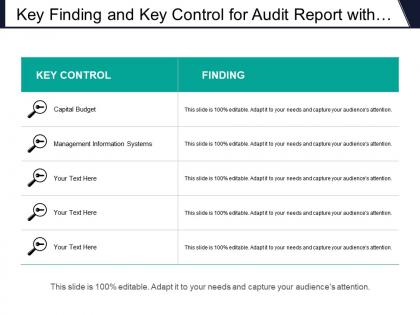
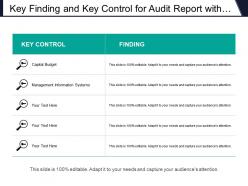
Key finding and key control for audit report with capital budget




Try Before you Buy Download Free Sample Product
 Impress Your
 Audience
 100%
100% Editable
 Save Hours
 of Time


You will never face a dearth of options. Opt for any from our vast array of Key Finding And Key Control For Audit Report With Capital Budget.
People who downloaded this PowerPoint presentation also viewed the following :
Key finding and key control for audit report with capital budget with all 5 slides:
Avert half measures with our Key Finding And Key Control For Audit Report With Capital Budget. They ensure every action is complete.


FAQs for Key finding and key control for audit report
Key components of an effective audit management system include audit planning and scheduling, risk assessment frameworks, documentation management, finding tracking, corrective action monitoring, and comprehensive reporting capabilities. These integrated elements streamline audit processes by automating workflow coordination, enhancing compliance tracking, and ensuring consistent documentation standards, ultimately delivering improved operational transparency and regulatory adherence across organizations.
Technology enhances audit management efficiency by automating data collection, streamlining workflow coordination, and enabling real-time collaboration across audit teams. Through AI-powered analytics and cloud-based platforms, organizations can significantly reduce manual tasks, accelerate report generation, and improve accuracy, with many financial institutions and healthcare organizations finding faster audit cycles and enhanced compliance tracking.
Risk assessment and internal controls serve as foundational pillars in audit management, enabling organizations to identify vulnerabilities, prioritize audit focus areas, and establish systematic oversight mechanisms. Through comprehensive risk evaluation and robust control frameworks, companies in sectors like banking, healthcare, and manufacturing can streamline compliance processes, minimize operational exposures, and enhance audit efficiency, ultimately delivering stronger governance and competitive advantage.
Organizations ensure regulatory compliance through audit management by implementing systematic monitoring processes, maintaining comprehensive documentation trails, and conducting regular internal assessments against specific standards. Through automated audit workflows, companies streamline compliance tracking, identify gaps proactively, and generate real-time reports, with many finding that structured audit programs significantly reduce regulatory risks while enhancing operational transparency.
Essential metrics for measuring audit management program success include audit completion rates, finding resolution times, cost per audit, stakeholder satisfaction scores, and regulatory compliance percentages. These metrics enable organizations to track operational efficiency, resource allocation effectiveness, and audit quality across departments, with many financial services and healthcare institutions finding that comprehensive measurement frameworks ultimately deliver improved risk management and enhanced organizational transparency.
Audit management integrates with organizational strategy by aligning audit priorities with business objectives, risk assessments, and strategic initiatives while providing continuous monitoring of key performance indicators. Through strategic audit planning, organizations streamline compliance processes, enhance operational efficiency, and deliver actionable insights that support decision-making, ultimately enabling competitive advantage and sustainable growth.
Common audit management challenges include resource constraints, data accessibility issues, regulatory compliance complexity, stakeholder coordination difficulties, and technology integration problems. These obstacles can be overcome by implementing automated audit software, establishing clear communication protocols, creating standardized documentation processes, and developing comprehensive training programs, ultimately delivering improved efficiency, reduced costs, and enhanced compliance accuracy across organizations.
Audit frequency depends on risk levels, regulatory requirements, and organizational complexity, with high-risk areas requiring quarterly reviews while standard operations typically need annual assessments. Many organizations implement continuous monitoring systems alongside scheduled audits, enabling real-time compliance tracking and faster issue resolution, ultimately delivering enhanced risk management and regulatory confidence.
Audit management significantly enhances organizational transparency and accountability by establishing systematic processes for risk assessment, compliance monitoring, and performance evaluation. Through comprehensive audit trails and standardized reporting, organizations streamline stakeholder communications, minimize regulatory risks, and demonstrate fiduciary responsibility, ultimately delivering enhanced investor confidence and operational credibility in an increasingly scrutinized business environment.
Audit findings can be effectively communicated through clear, actionable reports with executive summaries, visual dashboards, and structured presentations tailored to each stakeholder group's needs and expertise levels. These communication strategies enhance transparency and accountability by providing prioritized recommendations, implementation timelines, and risk assessments, with many organizations finding that regular follow-up meetings ensure sustained engagement and faster resolution of critical issues.
Best practices for training audit management teams include comprehensive risk assessment methodologies, regulatory compliance updates, advanced data analytics techniques, stakeholder communication skills, and emerging technology integration. These development approaches enhance audit effectiveness by strengthening analytical capabilities, improving report quality, and fostering continuous learning, with many organizations finding that well-trained teams deliver faster audit cycles and more strategic insights.
Continuous auditing enhances audit management by providing real-time monitoring, automated data analysis, and immediate identification of anomalies or compliance issues. This approach enables organizations to detect risks earlier, streamline remediation processes, and maintain ongoing compliance visibility, with many financial institutions and healthcare organizations finding that continuous monitoring ultimately delivers faster issue resolution and improved operational efficiency.
Recommended audit management tools include ACL Analytics, TeamMate+, AuditBoard, MindBridge AI, and Workiva, along with specialized platforms like CaseWare IDEA and Galvanize HighBond. These solutions streamline audit workflows by automating data analysis, enhancing collaboration, and providing real-time reporting capabilities, with many organizations finding that integrated platforms significantly reduce audit timelines while improving accuracy and compliance tracking.
Organizations foster accountability and transparency through audit processes by establishing clear expectations, implementing regular monitoring systems, ensuring open communication channels, and creating comprehensive reporting mechanisms. These practices enable teams to proactively address issues, streamline compliance workflows, and build stakeholder trust, with many financial services and healthcare institutions finding that transparent audit cultures ultimately deliver improved operational efficiency and stronger regulatory relationships.
Audit management serves as a critical component of corporate governance by ensuring transparency, accountability, and regulatory compliance across organizational operations. Through systematic risk assessment, internal controls monitoring, and compliance verification, audit management enables boards and executives to make informed strategic decisions, maintain stakeholder trust, and demonstrate fiduciary responsibility, ultimately strengthening overall governance frameworks.
-
Helpful product design for delivering presentation.
-
Illustrative design with editable content. Exceptional value for money. Highly pleased with the product.