

Key market drivers and opportunities bubbles ppt diagram




Try Before you Buy Download Free Sample Product
 Impress Your
 Audience
 100%
100% Editable
 Save Hours
 of Time


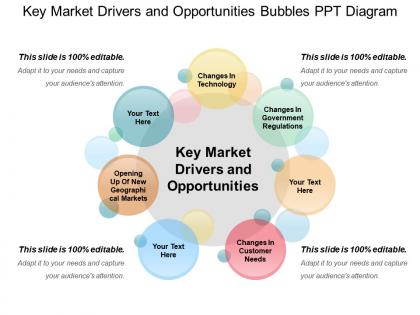
Get a fully professional, modern, business oriented key market drivers and opportunities bubbles PPT diagram template to let you display key market growth drivers using wonderful bubble images. You can use this powerful market analysis template to display various ways to identify market opportunities for business growth for your business. To avoid business failure behind the tough competition, you will need to both be aware of and benefit from the latest market trends, key market drivers of economic growth for your business. This highly versatile PPT template is appropriate to conduct market and competitor analysis which will provide an extra benefit to your firm. The design structure is amazing as it contains an amalgamation of great visuals and bubble diagrams to represent each business growth factors e.g. change in technology, change in government policy, change in customer needs etc. So, don’t wait for it, just download this amazing market analysis template and use in your upcoming presentation to fulfill your business needs. Allow every element to emerge effectively with our Key Market Drivers And Opportunities Bubbles Ppt Diagram. They help break it all down.
People who downloaded this PowerPoint presentation also viewed the following :
Key market drivers and opportunities bubbles ppt diagram with all 5 slides:
Earn their gratitude for your generosity with our Key Market Drivers And Opportunities Bubbles Ppt Diagram. Give them a gift of good advice.


FAQs for Key market drivers and opportunities
**INPUT**: What are the primary factors currently driving market growth in our industry? **OUTPUT**: Primary market growth drivers include digital transformation initiatives, changing consumer expectations, regulatory compliance requirements, competitive pressures, and technological advancement opportunities. These factors accelerate business modernization by streamlining operations, enhancing customer experiences, and enabling data-driven decision making, with many organizations finding that strategic technology adoption delivers significant competitive advantages and operational efficiency gains. [Word count: 58 words]
Consumer preferences drive market dynamics by shaping demand patterns, influencing product development cycles, and determining competitive positioning strategies across industries. Companies increasingly leverage data analytics and consumer insights to anticipate shifting preferences, with retail, technology, and food sectors finding that responsive adaptation to consumer trends delivers enhanced market share, customer loyalty, and sustainable competitive advantage.
Artificial intelligence, machine learning, cloud computing, automation technologies, and data analytics platforms are revolutionizing how organizations operate and compete across industries. These advancements streamline operations, enhance decision-making capabilities, and accelerate innovation cycles, with companies in sectors like financial services, healthcare, and retail finding that early adoption delivers significant competitive advantages and operational efficiency gains.
Businesses leverage data analytics to identify emerging market opportunities through predictive modeling, customer behavior analysis, competitive intelligence gathering, social media sentiment tracking, and demographic trend identification. These analytical approaches enable organizations to spot market gaps, anticipate consumer needs, and optimize resource allocation across sectors like retail and financial services, ultimately delivering competitive advantage and accelerated growth in increasingly dynamic markets.
Economic indicators serve as critical predictive tools for market trends, including GDP growth rates, unemployment levels, inflation rates, consumer confidence indices, and manufacturing data. These indicators enable investors, analysts, and businesses to anticipate market movements, adjust investment strategies, and optimize resource allocation, with many financial institutions finding that combining multiple indicators delivers more accurate forecasting and competitive advantage.
Sustainability significantly influences modern purchasing decisions, with consumers increasingly prioritizing environmentally responsible brands, ethical sourcing practices, transparent supply chains, and carbon-neutral operations. Companies integrating sustainable practices into their value propositions find enhanced customer loyalty, premium pricing opportunities, and competitive differentiation, with many retailers reporting that eco-conscious messaging directly correlates with increased sales conversion rates.
Aging populations, urbanization trends, growing middle classes in emerging markets, and increased digital nativity among younger consumers are reshaping market demands across industries. These demographic shifts enable businesses to develop targeted products, expand into new geographic markets, and leverage technology-driven solutions, with many retailers and financial services companies finding significant growth opportunities through demographic-specific strategies.
Regulatory changes create both compliance challenges and competitive opportunities by establishing new operational standards, opening previously restricted markets, and driving innovation requirements. Financial services, healthcare, and energy sectors often find that early regulatory adaptation enables market differentiation, streamlines customer onboarding processes, and ultimately delivers sustainable competitive advantages in increasingly regulated environments.
Consumers face critical pain points including lengthy service wait times, complex purchasing processes, lack of personalized experiences, inadequate customer support, and limited transparency in transactions. These challenges present significant opportunities for businesses to streamline operations, enhance customer interactions, and deliver faster, more intuitive services, with many organizations finding that addressing these issues directly translates into competitive advantage and increased customer loyalty.
Global competition is reshaping local market strategies by forcing businesses to adopt advanced technologies, embrace digital transformation, and prioritize customer-centric approaches to maintain relevance. Organizations across retail, manufacturing, and financial services are increasingly localizing global best practices, implementing data-driven decision making, and developing agile operational models, ultimately delivering enhanced customer experiences and sustainable competitive advantages.
Strategic partnerships include joint ventures with established local players, technology licensing agreements, distribution partnerships, supplier collaborations, and strategic alliances with complementary businesses. These partnerships enhance market entry by providing immediate market access, shared resources, and reduced operational risks, while enabling faster scaling through established networks, ultimately delivering competitive advantage and accelerated growth in new markets.
Social media trends drive consumer engagement through authentic storytelling, user-generated content, interactive campaigns, real-time conversations, and personalized experiences that resonate with target audiences. These strategies enhance brand loyalty by creating emotional connections, fostering community participation, and delivering consistent value, with retail and lifestyle brands finding that trend-responsive content significantly increases customer retention and advocacy rates.
Innovative product features gaining consumer traction include AI-powered personalization, voice-activated controls, sustainability-focused designs, seamless cross-platform integration, and augmented reality experiences. These features enhance customer engagement by delivering personalized interactions, streamlining user experiences, and meeting environmental expectations, with many retailers and tech companies finding that such innovations drive brand loyalty and competitive differentiation.
Businesses identify untapped market segments through comprehensive market research, customer data analysis, competitive gap identification, demographic trend monitoring, and behavioral pattern assessment. These strategic approaches enable companies to uncover underserved niches, emerging customer needs, and geographic opportunities, with many organizations finding that systematic segmentation analysis delivers significant competitive advantages and accelerated revenue growth.
Pricing strategy significantly influences market positioning by signaling quality, value, and brand prestige, while directly shaping consumer perceptions of exclusivity, accessibility, and competitive advantage. Strategic pricing enables companies to target specific market segments, differentiate from competitors, and build brand equity, with many organizations finding that dynamic pricing approaches ultimately deliver enhanced customer loyalty and sustained market share growth.
-
great job
-
Thanks for all your great templates they have saved me lots of time and accelerate my presentations. Great product, keep them up!
-
Great designs, Easily Editable.