

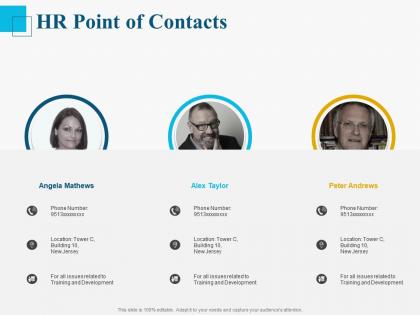
Hr point of contacts ppt powerpoint presentation pictures outfit




Try Before you Buy Download Free Sample Product
 Impress Your
Audience
 100%
Editable
 Save Hours
of Time


Our HR Point Of Contacts Ppt Powerpoint Presentation Pictures Outfit are topically designed to provide an attractive backdrop to any subject. Use them to look like a presentation pro.
People who downloaded this PowerPoint presentation also viewed the following :
Hr point of contacts ppt powerpoint presentation pictures outfit with all 2 slides:
Use our HR Point Of Contacts Ppt Powerpoint Presentation Pictures Outfit to effectively help you save your valuable time. They are readymade to fit into any presentation structure.


FAQs for Hr point of contacts ppt powerpoint
Effective HR points of contact should possess strong communication skills, empathy, confidentiality, problem-solving abilities, and comprehensive knowledge of employment law and company policies. These professionals streamline employee relations by facilitating clear dialogue, resolving workplace conflicts, and ensuring compliance, with many organizations finding that skilled HR contacts significantly enhance employee satisfaction and operational efficiency.
HR points of contact enhance employee engagement and satisfaction by providing personalized support, facilitating open communication channels, addressing concerns promptly, and ensuring consistent policy implementation across departments. Through dedicated relationship management, organizations streamline feedback processes, resolve workplace issues more effectively, and create stronger connections between leadership and staff, with many companies finding that structured HR contact systems significantly improve retention rates and overall workplace culture.
Technology streamlines communication between HR points of contact and employees through automated messaging systems, self-service portals, chatbots, mobile apps, and integrated communication platforms. These digital tools enhance accessibility and response times by enabling instant query resolution, 24/7 support availability, and seamless information sharing, ultimately delivering improved employee experiences and operational efficiency.
HR points of contact should handle sensitive issues through confidential documentation, impartial investigation protocols, and transparent communication with all parties involved. These professionals streamline resolution by establishing clear escalation procedures, maintaining detailed records, and coordinating with legal teams when necessary, ultimately delivering fair outcomes while protecting organizational integrity and employee trust.
HR points of contact excel in remote and hybrid environments through regular virtual check-ins, clear communication protocols, flexible performance metrics, digital collaboration tools, and structured onboarding processes. These practices streamline team coordination by maintaining consistent touchpoints, establishing transparent expectations, and fostering inclusive participation, with many organizations finding that strategic HR facilitation ultimately delivers enhanced productivity and stronger employee engagement across distributed workforces.
HR points of contact ensure consistency in policy communication through standardized messaging frameworks, centralized documentation systems, regular training updates, and unified communication channels across all departments. These approaches streamline information flow by establishing clear protocols, maintaining version control, and providing consistent talking points, ultimately delivering seamless employee experiences and reducing confusion while strengthening organizational alignment.
Key metrics include response time to employee inquiries, resolution rates for HR issues, employee satisfaction scores with HR services, case escalation frequency, and first-contact resolution percentages. These measurements enable organizations to streamline HR operations, enhance employee experiences, and identify process improvements, with many companies finding that tracking these metrics ultimately delivers better workforce engagement and operational efficiency.
HR points of contact foster inclusivity by implementing diverse recruitment strategies, establishing employee resource groups, conducting bias training programs, and creating accessible feedback channels. Through these initiatives, organizations streamline communication across different employee demographics, enhance workplace belonging, and ultimately deliver improved retention rates and innovation, with many companies finding that dedicated HR inclusivity champions significantly accelerate cultural transformation efforts.
Training resources for HR points of contact include online certification programs, professional development workshops, webinar series, mentorship programs, and industry conferences. These learning opportunities enhance skills through role-playing exercises, case study analysis, and peer collaboration, with many organizations finding that structured training significantly improves employee satisfaction, streamlines HR processes, and ultimately delivers better workplace experiences.
HR points of contact should approach workplace conflict resolution through active listening, neutral mediation, and structured problem-solving frameworks that address root causes rather than symptoms. By facilitating open dialogue, documenting agreements, and implementing follow-up protocols, HR professionals enable sustainable resolutions while maintaining workplace relationships, ultimately delivering improved team dynamics and organizational productivity.
HR points of contact can gather employee feedback through anonymous surveys, one-on-one meetings, focus groups, suggestion boxes, and digital feedback platforms. These methods enable organizations to capture honest insights, identify workplace concerns, and measure employee satisfaction across departments, with many companies finding that combining multiple approaches delivers more comprehensive data and ultimately enhances employee engagement strategies.
HR points of contact support career development by providing personalized guidance, identifying skill gaps, facilitating training opportunities, and connecting employees with mentorship programs. Through regular check-ins and performance discussions, they help map career paths, recommend relevant certifications, and advocate for advancement opportunities, ultimately enhancing employee retention and organizational talent pipeline strength.
Common challenges faced by HR points of contact include managing high inquiry volumes, ensuring consistent policy interpretation, handling sensitive employee issues, maintaining confidentiality, and staying updated on regulatory changes. These professionals can overcome obstacles by implementing centralized knowledge management systems, establishing clear escalation protocols, and leveraging HR technology platforms that streamline communication, automate routine inquiries, and provide real-time policy updates, ultimately enhancing employee satisfaction while reducing administrative burden.
HR points of contact ensure compliance with labor laws by monitoring regulatory changes, implementing updated policies, conducting mandatory training, and maintaining accurate documentation. These professionals serve as central resources for legal requirements across hiring, workplace safety, and employee relations, with many organizations finding that dedicated HR contacts significantly reduce compliance risks while streamlining audit processes and regulatory reporting.
HR points of contact can build trust through transparent communication, consistent follow-through on commitments, maintaining confidentiality, and demonstrating genuine empathy during employee interactions. These strategies work by creating psychological safety, establishing reliable support systems, and showing authentic care for employee wellbeing, with many organizations finding that trusted HR relationships ultimately enhance employee engagement, reduce turnover, and strengthen overall workplace culture.
No Reviews