

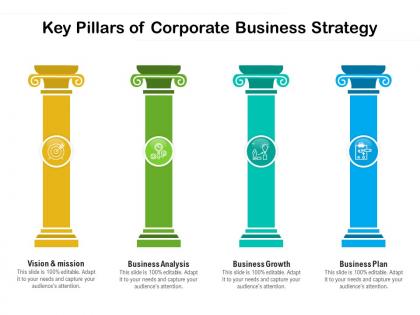
Key pillars of corporate business strategy




Try Before you Buy Download Free Sample Product
 Impress Your
Audience
 100%
Editable
 Save Hours
of Time


Our Key Pillars Of Corporate Business Strategy are topically designed to provide an attractive backdrop to any subject. Use them to look like a presentation pro.
People who downloaded this PowerPoint presentation also viewed the following :
Key pillars of corporate business strategy with all 2 slides:
Use our Key Pillars Of Corporate Business Strategy to effectively help you save your valuable time. They are readymade to fit into any presentation structure.

FAQs for Key pillars of
Key components of an effective corporate business strategy include clear vision and mission statements, comprehensive market analysis, competitive positioning, resource allocation frameworks, and measurable performance metrics. These elements work together by aligning organizational goals with market opportunities, optimizing operational efficiency, and enabling strategic decision-making, with many corporations finding that integrated approaches deliver sustainable competitive advantage.
A company's mission and vision serve as strategic foundations by defining organizational purpose, guiding decision-making frameworks, and establishing long-term directional goals that shape resource allocation and operational priorities. These foundational elements enable businesses to maintain consistent strategic focus across departments, align stakeholder expectations, and differentiate themselves in competitive markets, ultimately delivering sustainable growth and enhanced organizational coherence.
Market analysis serves as the foundation for corporate strategy development by identifying customer needs, competitive landscapes, industry trends, regulatory changes, and emerging opportunities. Through comprehensive market research, companies can strategically position themselves, optimize resource allocation, and anticipate market shifts, ultimately delivering competitive advantages and sustainable growth in an increasingly dynamic business environment.
Businesses align resources and capabilities with strategic goals through strategic resource mapping, capability gap analysis, portfolio optimization, and performance measurement systems. This strategic combination enables organizations to streamline operations, minimize resource waste, and accelerate goal achievement, with many companies finding that systematic alignment delivers enhanced competitive advantage and operational efficiency.
Mergers and acquisitions offer rapid market expansion, immediate access to new technologies, and enhanced competitive positioning, while organic growth provides greater control, cultural preservation, and sustainable development. M&A delivers faster scale and market penetration but presents integration challenges and cultural conflicts, whereas organic growth, though slower, enables companies to maintain strategic alignment and build lasting capabilities, with many organizations finding that combining both approaches delivers optimal results.
Corporate social responsibility and sustainability significantly influence strategic planning by shaping long-term objectives, risk management frameworks, stakeholder engagement approaches, and resource allocation decisions. These considerations enable organizations to enhance brand reputation, attract environmentally conscious consumers, reduce operational costs through efficiency improvements, and ultimately deliver competitive advantages, with many companies finding that sustainable practices increasingly drive profitability and market positioning.
Essential metrics for measuring corporate business strategy success include revenue growth, market share expansion, profitability ratios, customer acquisition costs, and return on investment. These strategic indicators enable organizations to track competitive positioning, operational efficiency, and stakeholder value creation, with many companies finding that combining financial metrics with customer satisfaction and employee engagement data ultimately delivers comprehensive insights into long-term strategic effectiveness.
Businesses foster innovation culture through encouraging experimentation, providing dedicated resources for creative projects, establishing cross-functional collaboration spaces, implementing idea-sharing platforms, and rewarding calculated risk-taking. This strategic combination enables organizations to accelerate product development, enhance customer experiences, and maintain competitive advantage, with many companies finding that empowered employees drive breakthrough solutions that directly support long-term strategic goals.
Corporate business strategy execution involves risks including market volatility, competitive response, resource constraints, operational disruptions, and regulatory changes. These challenges present both obstacles and opportunities, with many organizations finding that strategic risk management, scenario planning, and agile implementation frameworks enable better adaptation, ultimately delivering more resilient operations and sustainable competitive advantage.
Companies adapt strategies through continuous market monitoring, agile decision-making frameworks, diversified revenue streams, strategic partnerships, and flexible resource allocation. Through real-time data analytics and scenario planning, organizations in sectors like retail and technology pivot operations, adjust product offerings, and reallocate investments, while maintaining competitive advantage in increasingly dynamic business environments.
Leadership drives successful corporate strategy implementation by establishing clear vision, allocating resources effectively, fostering organizational alignment, and maintaining stakeholder engagement throughout execution phases. Strong leaders enable seamless communication across departments, adapt strategies based on market feedback, and cultivate accountability cultures, with many organizations finding that executive commitment and strategic communication ultimately determine whether ambitious corporate initiatives deliver sustainable competitive advantage.
Companies effectively communicate strategy to stakeholders through multi-channel approaches including executive presentations, detailed reports, interactive dashboards, regular town halls, and targeted messaging for different audiences. These methods enhance transparency and alignment by providing clear roadmaps, measurable objectives, and progress updates, with many organizations finding that consistent, tailored communication ultimately delivers stronger stakeholder buy-in and strategic execution.
Strategic frameworks commonly used in corporate strategy development include SWOT analysis, Porter's Five Forces, the BCG Matrix, balanced scorecards, and scenario planning models. These frameworks enable organizations to assess competitive positioning, allocate resources strategically, and identify growth opportunities across diverse sectors like technology, healthcare, and financial services, ultimately delivering enhanced operational efficiency and sustainable competitive advantage.
Competitor analysis is crucial for strategic formulation, enabling businesses to identify market gaps, benchmark performance, understand pricing dynamics, and anticipate industry shifts. Through comprehensive competitive intelligence, organizations can differentiate their offerings, optimize resource allocation, and develop sustainable advantages, with many companies finding that regular competitor monitoring directly influences their strategic positioning and market success.
Key implementation challenges include resource constraints, organizational resistance to change, poor communication across departments, inadequate performance monitoring, and misalignment between strategic goals and operational capabilities. These obstacles often manifest in sectors like manufacturing and healthcare, where companies struggle with cross-functional coordination and change management, ultimately requiring structured frameworks and clear accountability measures to deliver successful strategic outcomes.
-
Colors used are bright and distinctive.
-
Thanks for all your great templates they have saved me lots of time and accelerate my presentations. Great product, keep them up!