

Key Stages Of Crisis Management Communication Skills Training Plan For Spokesperson




Try Before you Buy Download Free Sample Product
 Impress Your
 Audience
 100%
100% Editable
 Save Hours
 of Time


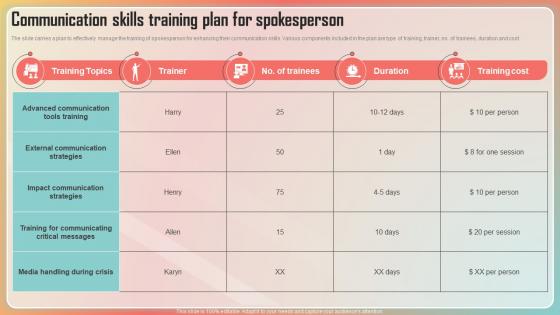
The slide carries a plan to effectively manage the training of spokesperson for enhancing their communication skills. Various components included in the plan are type of training, trainer, no. of trainees, duration and cost
People who downloaded this PowerPoint presentation also viewed the following :
Key Stages Of Crisis Management Communication Skills Training Plan For Spokesperson with all 6 slides:
Use our Key Stages Of Crisis Management Communication Skills Training Plan For Spokesperson to effectively help you save your valuable time. They are readymade to fit into any presentation structure.






FAQs for Key Stages Of Crisis Management Communication Skills Training
Key elements of an effective crisis communication plan include designated response teams, pre-approved messaging templates, stakeholder contact databases, media management protocols, and regular monitoring systems. These components work together by ensuring rapid response coordination, maintaining consistent messaging across channels, and enabling real-time adjustments, with many organizations finding that comprehensive planning significantly reduces reputational damage while preserving stakeholder trust.
Organizations prepare for crises by developing comprehensive response plans, conducting regular risk assessments, establishing clear communication channels, training leadership teams, and creating stakeholder contact databases. Through proactive scenario planning and crisis simulations, companies across industries like healthcare, finance, and manufacturing can respond swiftly when challenges arise, ultimately minimizing damage and maintaining stakeholder trust.
Social media serves as a critical real-time communication channel during crises, enabling organizations to share updates, address concerns, monitor public sentiment, and engage directly with stakeholders. While it allows for immediate response and broad reach, companies must carefully manage messaging consistency and respond quickly to misinformation, with many finding that proactive social engagement significantly enhances crisis recovery outcomes.
Companies should respond to negative inquiries promptly, transparently, and empathetically, acknowledging concerns while providing factual information and clear next steps. Through strategic communication protocols, organizations streamline response times, maintain stakeholder trust, and control narrative direction, with many finding that proactive engagement during crises ultimately strengthens customer relationships and competitive positioning.
Strategies to maintain stakeholder trust during a crisis include transparent communication, proactive updates, consistent messaging across channels, acknowledging responsibility when appropriate, and demonstrating concrete corrective actions. These approaches work by showing accountability, providing regular information flow, and outlining clear recovery plans, with many organizations finding that honest, frequent communication ultimately strengthens stakeholder relationships and preserves long-term credibility.
Organizations measure crisis communication effectiveness through stakeholder sentiment analysis, media coverage assessment, response time tracking, message reach and engagement metrics, and post-crisis reputation surveys. These measurement approaches enable companies to evaluate audience understanding, identify communication gaps, and refine future crisis strategies, with many finding that comprehensive analytics ultimately deliver improved stakeholder trust and organizational resilience.
A designated crisis communication team ensures rapid, coordinated responses during emergencies, maintaining consistent messaging across all stakeholders, channels, and touchpoints. This strategic approach minimizes confusion, preserves brand reputation, and enables faster recovery, with many organizations finding that dedicated teams reduce response time by 60% while delivering clearer stakeholder communication.
Transparency during crises builds trust by demonstrating accountability, providing timely updates, and acknowledging challenges honestly, which helps organizations maintain credibility and stakeholder confidence. While complete openness presents communication challenges, companies that embrace transparent approaches often find that proactive disclosure minimizes speculation, reduces reputational damage, and ultimately strengthens long-term relationships with customers, investors, and communities.
Common mistakes in crisis communication include delayed responses, inconsistent messaging across channels, lack of transparency, defensive or blame-shifting language, and insufficient stakeholder engagement. Organizations often struggle by over-complicating their messages or failing to designate clear spokespeople, with many companies finding that proactive, honest communication during crises ultimately preserves brand trust and accelerates recovery.
Internal messages should be more detailed, transparent, and action-oriented, providing employees with comprehensive information, clear roles, and frequent updates to maintain trust and coordination. External communications must be more carefully crafted and controlled, focusing on key facts, reassurance, and brand protection, with organizations finding that employees who receive thorough internal briefings become more effective ambassadors when addressing external stakeholders.
Best practices for crisis media communication include responding quickly with accurate information, designating a single spokesperson, maintaining transparency while protecting sensitive details, and providing regular updates. These approaches help organizations control their narrative by building media trust, preventing misinformation spread, and demonstrating accountability, with many companies finding that proactive engagement ultimately preserves reputation and stakeholder confidence.
Cultural context significantly influences crisis communication strategies through varying communication styles, authority structures, media preferences, and stakeholder expectations across different regions and communities. Organizations must adapt their messaging tone, channel selection, and response timing to align with local cultural norms, with many multinational companies finding that standardized approaches often fail while culturally-tailored strategies enhance trust and accelerate recovery.
Empathy serves as the foundation of effective crisis communication by demonstrating genuine understanding of stakeholder concerns, acknowledging emotional impact, and fostering trust through authentic responses. Organizations that prioritize empathetic messaging find stronger stakeholder relationships, enhanced credibility during recovery, and improved long-term reputation outcomes, ultimately transforming crisis challenges into opportunities for deeper organizational connection.
Storytelling enables organizations to navigate crises by humanizing their response, building emotional connections with stakeholders, and controlling narrative flow through transparent, authentic messaging. This approach helps companies like airlines during service disruptions or healthcare systems during emergencies maintain trust, demonstrate accountability, and ultimately strengthen stakeholder relationships while minimizing reputational damage.
Technologies enhancing real-time crisis communication include mass notification systems, social media monitoring tools, emergency alert platforms, mobile communication apps, and AI-powered sentiment analysis. These solutions streamline response coordination by automating alerts, tracking public sentiment, and enabling instant stakeholder updates, with organizations like hospitals and financial institutions finding they deliver faster incident resolution and enhanced operational resilience.
-
Easily Editable.
-
Professionally designed slides with color coordinated themes and icons. Perfect for enhancing the style of the presentations.