

Kirkpatrick Training Evaluation Model For Effective Results




Try Before you Buy Download Free Sample Product
 Impress Your
 Audience
 100%
100% Editable
 Save Hours
 of Time


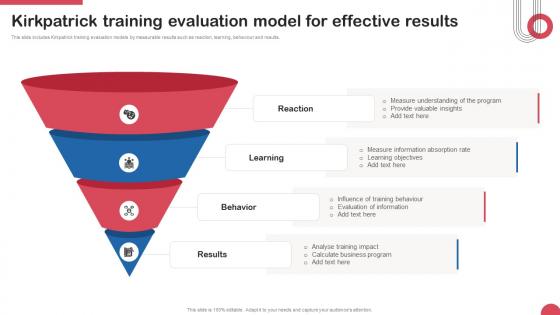
This slide includes Kirkpatrick training evaluation models by measurable results such as reaction, learning, behaviour and results.
People who downloaded this PowerPoint presentation also viewed the following :
Kirkpatrick Training Evaluation Model For Effective Results with all 9 slides:
Use our Kirkpatrick Training Evaluation Model For Effective Results to effectively help you save your valuable time. They are readymade to fit into any presentation structure.








FAQs for Kirkpatrick Training Evaluation Model
So there's four levels: Reaction, Learning, Behavior, Results. Each one builds off the last one. Reaction is just "did people like it?" Learning checks if they actually absorbed anything. Behavior looks at whether they're doing things differently at work. Results measures real business impact - the money stuff, basically. Here's the thing though - they're connected like dominoes. If your training sucks and everyone hates it, they won't learn much. Can't learn? Won't change how they work. No behavior change means zero business results. Start with Level 1 and work up. Don't be that person who jumps straight to ROI without checking if the foundation's solid first.
Yeah, Kirkpatrick totally works for virtual stuff! Just swap your tools. Digital surveys replace paper feedback for reactions. Online quizzes work great for testing what people actually learned. Behavior's the tricky one - can't exactly peek over shoulders anymore, right? But you can track who's using the system, check performance dashboards, or have managers do virtual check-ins. Results stay the same since you're still watching business metrics. The cool part is most learning platforms already collect this data automatically, so you don't have to hunt everything down manually.
So for Level 1, just do post-training surveys and track attendance - pretty straightforward. Learning (Level 2) needs pre/post tests and skill demos to see if they actually absorbed anything. Behavior change is honestly the hardest part and where most training fails miserably. You'll need supervisor observations and 360 feedback to catch it. Results tracking means tying everything back to real business numbers - productivity, costs, revenue, whatever matters to your company. Oh, and definitely collect baseline data first. I learned that the hard way when my boss asked for ROI and I had nothing to compare against.
Honestly, Kirkpatrick's just way easier to wrap your head around than other models. Four simple levels - did they like the training, learn anything, actually apply it, then measure business impact. Phillips ROI gets super into the weeds with financial calculations, and CIPP makes you plan forever before you even start evaluating. With Kirkpatrick you can jump right in without being a data scientist. Those Level 1 reaction surveys are perfect quick wins too - literally just ask people what they thought right after training. I mean, sometimes the simple approach actually works better than all the fancy complicated frameworks everyone's pushing these days.
So feedback is basically what makes the whole Kirkpatrick Model tick. At Level 1, you're getting participant reactions. Level 2 measures if they actually learned anything. Then Level 3 shows whether they're using those skills back at work - this one's tricky because people forget fast. Level 4 tracks the real business results. Here's the thing though - you can't just wing it and hope for good data later. Set up your feedback systems before training even starts, otherwise you'll be scrambling to piece together what actually worked. Trust me, collect it consistently across all four levels or you're flying blind.
Build evaluation right into your training programs from the start - don't just slap it on later. Measure how people felt about it immediately, then test what they actually retained a few weeks out. Here's the thing most companies mess up: they skip tracking whether people actually USE what they learned back at work. That's Level 3, and it's where the real value shows up. Then measure business results like better productivity or fewer mistakes. Honestly, most orgs avoid Levels 3 and 4 because they're trickier to track, but that's how you'll know if you're actually getting ROI. Have managers do regular check-ins on behavior changes.
Honestly, the hardest part is that Level 3 and 4 evaluations cost a fortune and take forever to do right. Most companies just give up and stick with those basic reaction surveys because measuring real behavior change is a pain. Business impact? Even trickier. Good luck separating what training actually did versus everything else affecting performance. Leadership usually wants results yesterday, not some 6-month study. Oh, and you need serious resources most places don't have. Start small with whatever you can actually track consistently. Build from there instead of trying to be perfect right away - trust me on this one.
So the Kirkpatrick Model actually helps you figure out if training is worth the money. It's got four levels - reaction, learning, behavior change, and business results. Most places just do those stupid satisfaction surveys and call it a day, but that tells you nothing about ROI. You want levels 3 and 4 where you can see if people actually changed how they work and if it helped the bottom line. Oh, and grab your baseline numbers before you start training - you'll need them to prove it worked later. That's where the real value shows up.
Honestly, Kirkpatrick's four levels work great for OJT evaluation. Get quick feedback surveys for Level 1 reactions first. Then test if they actually learned the skills through assessments - that's Level 2. Here's where OJT gets awesome though: you can watch them apply everything in real-time for Level 3 behavior changes. Level 4 tracks business results like fewer errors or better productivity. The whole classroom-to-workplace transfer issue? Yeah, you skip that headache entirely. Just make sure you set up your tracking methods beforehand - trust me, you don't want to figure that out mid-training.
Honestly, timing is everything with Level 1 surveys - hit people right after training when it's still fresh. Keep them short though, like 5-7 questions max. Skip the generic satisfaction stuff and ask what actually matters: was the content useful for their job, how was the instructor, would they recommend it to colleagues? Those marathon 20-question surveys are the worst - nobody takes them seriously. I usually throw in one or two open-ended questions with the rating scales. Oh, and if you're doing longer programs? Send quick pulse surveys instead of waiting until the bitter end. Use whatever feedback you get to tweak the next session.
Honestly, tech makes Level 4 measurement so much easier - you can automate most of the heavy lifting. Connect your LMS to performance dashboards and boom, real-time business metrics instead of waiting forever for manual reports. AI tools are getting pretty wild at spotting connections between training completion and productivity changes. Set up automated triggers to grab your KPIs before, during, and after programs run. That way you'll actually know if your training budget is worth it or just burning cash (which happens more than people admit). Start with whatever performance data you've already got in existing systems, then build from there.
Ugh, culture is literally everything when it comes to Kirkpatrick working. No buy-in from leadership? You're screwed from the start. People won't give you real feedback if the company doesn't actually value learning - they'll just tell you what they think you want to hear. I'd honestly start with whoever's already on board with measuring training impact. Get some quick wins there first. Those early successes help you convince the skeptics later. Even the most bulletproof evaluation plan means nothing if your organization treats professional development like a checkbox exercise. It's frustrating but true.
Okay so basically track your reaction scores first - that'll show you if people are actually engaged or just sitting there bored. Then check if they're actually learning the stuff (learning gains). Here's where most people mess up though - you gotta follow up weeks later to see if anyone's doing anything different at work. That's the behavior level and it's honestly a pain but super important. Results take forever to show up but that's your real proof it worked. Most trainers just skip the last two levels which is dumb because that's where you find out if you're wasting everyone's time. Just set up simple surveys for each one and keep tweaking your course based on what you learn.
You know Microsoft's whole cloud shift? They used all four Kirkpatrick levels and actually tracked real business results from their training. Motorola did the same thing with Six Sigma - makes sense since they needed to prove ROI on that massive program. IBM's leadership development stuff used it too, which honestly you'd expect given how much they probably spent. Oh, and McDonald's rolled it out globally for management training. They could literally connect what people learned to how their stores performed, which is pretty cool. My advice? Start small with just one program. Focus on getting that Level 3 behavior change data first - that's where everyone seems to hit a wall.
Start with Level 4 - figure out your business results first, then work backwards. Need to boost sales by 20%? Level 3 should track if people actually changed their sales techniques. Level 2 tests whether they learned those techniques, and Level 1 asks if the training felt relevant to hitting targets. Most people do this completely backwards - they obsess over satisfaction surveys then wonder why nothing moves the needle. I learned this the hard way honestly. Each level has to connect to your real business goals, not just exist because someone said you need four levels of evaluation.
-
Very unique, user-friendly presentation interface.
-
Attractive design and informative presentation.