

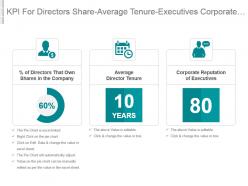
Kpi for directors share average tenure executives corporate reputation powerpoint slide





Try Before you Buy Download Free Sample Product
 Impress Your
Audience
 100%
Editable
 Save Hours
of Time


Delegate better with our Kpi For Directors Share Average Tenure Executives Corporate Reputation Powerpoint Slide. Clearly demarcate each one's authority.
People who downloaded this PowerPoint presentation also viewed the following :
Kpi for directors share average tenure executives corporate reputation powerpoint slide with all 6 slides:
Get everybody immediately aware of the facts with our Kpi For Directors Share Average Tenure Executives Corporate Reputation Powerpoint Slide. It acts as an effective circular.


FAQs for Kpi for directors share average tenure executives corporate
Executives should prioritize KPIs including revenue growth, profit margins, customer acquisition cost, employee retention rates, and operational efficiency metrics. These indicators enable comprehensive organizational assessment by measuring financial performance, customer satisfaction, workforce stability, and process optimization, with many leadership teams finding that balanced scorecards ultimately deliver strategic clarity and competitive advantage.
Executives align KPIs with business strategy by mapping metrics directly to strategic goals, cascading objectives across departments, and ensuring measurable outcomes support long-term vision. Through regular strategy reviews, cross-functional collaboration, and balanced scorecards, organizations create coherent performance frameworks that drive accountability, with many finding that aligned KPIs significantly enhance execution and competitive advantage.
Qualitative KPIs measure intangible factors like employee satisfaction, brand perception, and leadership effectiveness through surveys and feedback, while quantitative KPIs track measurable metrics such as revenue growth, profit margins, and market share through numerical data. Both types complement executive decision-making, with quantitative KPIs providing concrete performance benchmarks and qualitative KPIs delivering strategic insights into organizational health, culture, and stakeholder sentiment that ultimately influence long-term business sustainability.
Executives should review KPIs monthly for operational metrics and quarterly for strategic objectives, with annual comprehensive assessments to ensure alignment with evolving business goals. This balanced approach enables organizations to maintain responsiveness to market changes while avoiding constant disruption, with many companies finding that quarterly strategic reviews coupled with monthly operational monitoring delivers optimal performance tracking and sustained competitive advantage.
Data visualization transforms complex KPI datasets into clear, actionable insights through interactive dashboards, trend charts, heat maps, and real-time scorecards that enable rapid pattern recognition. These visual tools streamline executive decision-making by highlighting performance gaps, identifying emerging opportunities, and presenting comparative analyses across departments, with many C-suite leaders finding that visual KPI reports accelerate strategic responses.
Executives can effectively communicate KPI results through visual dashboards, regular team meetings, contextual storytelling that connects metrics to business outcomes, and transparent progress updates. By presenting data in accessible formats, relating performance to team contributions, and facilitating open discussions about challenges and opportunities, leaders enhance engagement, accountability, and strategic alignment across their organizations.
Customer satisfaction and retention KPIs include Net Promoter Score (NPS), Customer Satisfaction Score (CSAT), Customer Lifetime Value (CLV), churn rate, and repeat purchase rate. These metrics enable executives to streamline customer experience strategies, enhance loyalty programs, and optimize retention efforts, with many organizations finding that combining satisfaction and behavioral data ultimately delivers stronger competitive advantage and sustainable revenue growth.
External market factors significantly influence executive KPI selection by driving focus toward metrics that reflect competitive positioning, regulatory compliance, customer behavior shifts, and economic volatility. Through market analysis, executives prioritize KPIs like market share growth, customer acquisition costs, and operational efficiency ratios, with many organizations finding that adaptive KPI frameworks enable faster responses to industry disruptions, ultimately delivering competitive advantage and strategic resilience.
Executives can implement automated data collection systems, establish regular reporting protocols from department heads, utilize business intelligence dashboards, conduct systematic audits, and integrate cross-functional data sources. These strategies enhance accuracy by minimizing manual errors, ensuring real-time updates, and providing comprehensive visibility, with many organizations finding that standardized metrics and validation processes ultimately deliver more reliable performance insights and strategic decision-making capabilities.
Technology enhances executive KPI tracking through automated data collection, real-time dashboards, predictive analytics, and integrated reporting systems that streamline performance monitoring across multiple business functions. These solutions enable executives to access comprehensive insights instantly, identify trends proactively, and make data-driven decisions faster, while reducing manual reporting overhead and improving strategic agility.
Executives should avoid setting too many KPIs, choosing metrics that don't align with strategic objectives, focusing solely on lagging indicators, and creating overly complex measurement systems. These pitfalls often result in decision paralysis, misaligned priorities, and reactive management approaches, with many organizations finding that streamlined, forward-looking KPI frameworks ultimately deliver clearer insights and more agile strategic responses.
Executives can ensure middle management engagement through clear KPI ownership assignments, regular performance discussions, transparent reporting systems, and direct involvement in target-setting processes. By connecting individual KPI achievements to career advancement opportunities, providing necessary resources and training, and recognizing successful performance publicly, organizations create accountability while empowering managers to drive results effectively.
KPIs significantly influence executive motivation by creating clear accountability frameworks, aligning leadership behavior with strategic objectives, and establishing measurable performance benchmarks that directly tie to organizational success. When properly implemented, executive KPIs drive focused decision-making, enhance cross-functional collaboration, and foster competitive performance cultures, with many organizations finding that well-designed metrics ultimately deliver improved operational efficiency and stronger financial outcomes.
Benchmarking against industry standards enhances executive KPIs by providing external validation, identifying performance gaps, and establishing realistic yet ambitious targets based on market leaders' achievements. This strategic comparison enables organizations to calibrate their metrics appropriately, prioritize improvement initiatives effectively, and ultimately deliver competitive positioning while ensuring their executive performance measures reflect industry best practices and drive sustainable growth.
Innovative sustainability KPIs for executives include carbon footprint reduction rates, circular economy metrics, sustainable supply chain scores, employee sustainability engagement levels, and green revenue percentages. These metrics enable organizations to track environmental impact, resource efficiency, and stakeholder value simultaneously, with many companies finding that comprehensive sustainability measurement drives both competitive advantage and long-term profitability.
-
Content of slide is easy to understand and edit.
-
Easy to edit slides with easy to understand instructions.