

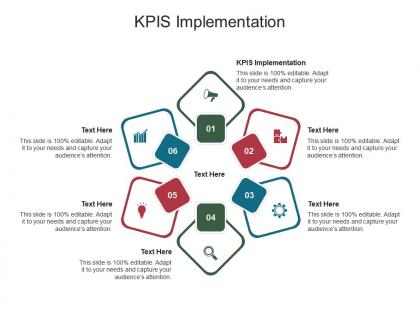
Kpis implementation ppt powerpoint presentation model smartart cpb




Try Before you Buy Download Free Sample Product
 Impress Your
Audience
 100%
Editable
 Save Hours
of Time


Our Kpis Implementation Ppt Powerpoint Presentation Model Smartart Cpb are topically designed to provide an attractive backdrop to any subject. Use them to look like a presentation pro.
People who downloaded this PowerPoint presentation also viewed the following :
Kpis implementation ppt powerpoint presentation model smartart cpb with all 2 slides:
Use our Kpis Implementation Ppt Powerpoint Presentation Model Smartart Cpb to effectively help you save your valuable time. They are readymade to fit into any presentation structure.


FAQs for Kpis implementation ppt powerpoint presentation
Effective KPI implementation involves defining clear objectives aligned with business strategy, selecting measurable and relevant metrics, establishing baseline measurements, and creating robust data collection systems. Organizations typically find success by engaging stakeholders early, providing comprehensive training on KPI usage, and establishing regular review cycles, ultimately delivering improved accountability, data-driven decision-making, and enhanced performance tracking across departments.
**INPUT**: How do you determine which KPIs are most relevant for your specific business objectives? **OUTPUT**: Determining relevant KPIs requires aligning metrics directly with strategic goals, analyzing customer journey touchpoints, evaluating operational priorities, and identifying revenue-driving activities. Through strategic assessment frameworks, organizations streamline performance measurement by focusing on actionable metrics that drive decision-making, enhance accountability, and deliver measurable outcomes, ultimately enabling competitive advantage.
Stakeholder engagement ensures KPI alignment with organizational objectives, secures buy-in from key decision-makers, and facilitates accurate data collection across departments. Through collaborative involvement, organizations streamline implementation processes, enhance accountability, and minimize resistance to performance measurement initiatives, with many finding that engaged stakeholders ultimately deliver more accurate reporting and sustained commitment to strategic goals.
Technology streamlines KPI tracking through automated data collection, real-time dashboards, cloud-based analytics platforms, and integrated reporting systems that eliminate manual processes. These solutions enable organizations across manufacturing, retail, and financial services to monitor performance continuously, reduce reporting errors, and accelerate decision-making cycles, ultimately delivering enhanced operational efficiency and competitive advantage.
Common KPI implementation pitfalls include selecting too many metrics, choosing vanity metrics over actionable ones, lacking stakeholder buy-in, setting unrealistic targets, and failing to align KPIs with strategic objectives. These challenges often result in data overload, missed opportunities for meaningful insights, and reduced team motivation, with many organizations finding that focusing on fewer, well-defined metrics ultimately delivers greater operational clarity and measurable business outcomes.
KPIs can be aligned with business strategy through cascading organizational objectives, linking metrics to strategic priorities, establishing clear cause-and-effect relationships between activities and outcomes, and ensuring measurable targets support long-term goals. This strategic alignment enables organizations to track progress systematically, optimize resource allocation, and maintain operational focus, ultimately delivering enhanced performance visibility and competitive advantage across all business functions.
KPIs should be reviewed monthly for operational metrics and quarterly for strategic indicators, with annual comprehensive assessments ensuring alignment with evolving business objectives. Many organizations find that regular review cycles enable proactive adjustments to market changes, competitive pressures, and organizational growth, ultimately delivering more accurate performance insights and sustained competitive advantage.
Metrics for assessing KPI implementation effectiveness include adoption rates, data accuracy levels, reporting frequency consistency, stakeholder engagement scores, and decision-making speed improvements. Through dashboard utilization analytics and user feedback systems, organizations can measure whether teams are actively using KPIs for strategic decisions, ultimately delivering enhanced operational efficiency and more data-driven organizational culture across departments.
Communicating KPIs effectively requires clear explanation of metrics, regular training sessions, visual dashboards, and connecting individual roles to organizational goals. Through interactive presentations and consistent updates, teams understand how their performance directly impacts company success, while transparent reporting and feedback loops ensure ongoing engagement, ultimately creating accountability and alignment across departments.
SMART criteria ensure KPIs are Specific, Measurable, Achievable, Relevant, and Time-bound, creating clear performance benchmarks that drive accountability and focus. This structured approach enables organizations to track progress effectively, align team efforts with strategic objectives, and make data-driven decisions, with many companies finding that SMART KPIs significantly enhance operational efficiency and goal achievement.
Businesses measure long-term KPI impact through trend analysis, comparative performance benchmarking, and correlation studies linking metrics to strategic outcomes. By tracking performance patterns over multiple quarters, organizations identify sustainable improvements in productivity, revenue growth, and operational efficiency, with many companies finding that consistent KPI monitoring ultimately delivers measurable competitive advantages and enhanced decision-making capabilities.
Organizations can foster KPI accountability by establishing clear ownership for each metric, implementing regular review cycles, connecting KPIs to individual performance evaluations, and ensuring transparent reporting across all levels. Through consistent communication, training programs, and recognition systems, companies in sectors like retail and manufacturing create environments where employees understand their impact, take ownership of results, and drive continuous improvement, ultimately delivering enhanced performance and competitive advantage.
Qualitative data enhances quantitative KPIs by providing context, explaining underlying causes, and revealing employee sentiment behind the numbers. Through customer feedback surveys, employee interviews, and stakeholder assessments, organizations uncover why metrics fluctuate, identify process improvements, and understand cultural factors affecting performance, ultimately delivering more comprehensive insights for strategic decision-making.
KPI visualization methods include dashboards, scorecards, heat maps, trend charts, and gauge displays that transform complex data into intuitive formats. These visual tools enhance decision-making by enabling real-time monitoring, pattern recognition, and performance comparisons, with many organizations finding that strategic visual presentation ultimately delivers faster insights and improved operational efficiency.
KPIs drive continuous improvement by establishing clear performance baselines, identifying improvement opportunities, and enabling data-driven decision making across teams and departments. Through regular monitoring and analysis, organizations can pinpoint inefficiencies, adjust strategies, and track progress, with many finding that well-implemented KPI systems enhance accountability, streamline workflows, and ultimately deliver sustained competitive advantage.
-
Unique design & color.
-
Graphics are very appealing to eyes.
-
Informative presentations that are easily editable.
-
Commendable slides with attractive designs. Extremely pleased with the fact that they are easy to modify. Great work!
-
Great quality product.