

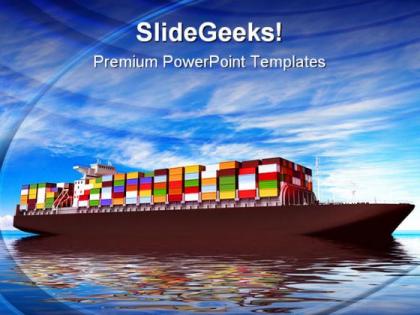
Large container ship transportation powerpoint templates and powerpoint backgrounds 0411




Try Before you Buy Download Free Sample Product
 Impress Your
 Audience
 100%
100% Editable
 Save Hours
 of Time


It is carnival time for your ideas. Feast upon our Large Container Ship Transportation PowerPoint Templates And PowerPoint Backgrounds 0411.
People who downloaded this PowerPoint presentation also viewed the following :
Large container ship transportation powerpoint templates and powerpoint backgrounds 0411 with all 3 slides:
Say cheerio to doubts with our Large Container Ship Transportation PowerPoint Templates And PowerPoint Backgrounds 0411. Treat your audience to your decisive thoughts.



FAQs for Large container ship transportation powerpoint templates and
Large container ships offer significant economies of scale, reduced per-unit shipping costs, enhanced fuel efficiency, increased cargo capacity, and streamlined port operations. These vessels enable global retailers and manufacturers to transport goods more cost-effectively across major trade routes, with many shipping companies finding that larger ships ultimately deliver lower operational expenses and improved competitive positioning in international markets.
Large container ships significantly reduce shipping costs compared to smaller vessels by achieving economies of scale, lower fuel consumption per container, and reduced crew costs per unit transported. Through these efficiencies, major shipping lines like Maersk and COSCO deliver cost savings of 15-20% on transpacific routes, ultimately enabling more competitive pricing for retailers and manufacturers while streamlining global supply chains.
**INPUT**: What environmental regulations are influencing the design of large container ships? **OUTPUT**: Environmental regulations influencing large container ship design include IMO sulfur emission limits, carbon intensity reduction targets, ballast water treatment standards, and regional emission control areas. These regulations drive innovations in cleaner fuel systems, energy-efficient hull designs, and advanced propulsion technologies, with many shipping companies finding that compliance ultimately delivers operational cost savings, enhanced market access, and competitive advantage in increasingly sustainability-focused global trade. **Word count: 60 words**
Larger container ships require deeper berths, advanced crane systems, and expanded storage facilities to accommodate increased cargo volumes and vessel dimensions. Major ports like Rotterdam and Singapore have invested billions in infrastructure upgrades, including deeper channels and automated handling equipment, ultimately enabling faster turnaround times and reduced per-container costs for shipping operations.
Latest technological advancements include automated cargo handling systems, fuel-efficient hull designs, hybrid propulsion technologies, advanced navigation software, and smart container tracking solutions. These innovations streamline operations by reducing fuel consumption, minimizing loading times, and enhancing route optimization, with many shipping companies finding that automated systems deliver significantly lower operational costs and faster port turnarounds.
Large container ships navigate congested shipping lanes through advanced radar systems, GPS tracking, automated identification systems, electronic chart displays, and coordinated traffic management protocols. These technologies enable precise route planning, real-time collision avoidance, and seamless communication with port authorities, while many shipping companies find that integrated navigation systems ultimately deliver safer passages, reduced delays, and enhanced operational efficiency in increasingly busy maritime corridors.
Large container ships play a crucial role in perishable goods supply chains by providing refrigerated container capacity, connecting major agricultural regions with global markets, and enabling cost-effective bulk transportation of frozen and fresh products. These vessels facilitate international trade in fruits, vegetables, meat, and dairy products, with shipping lines increasingly investing in advanced cold chain technologies, ultimately delivering fresher products to consumers while reducing per-unit transportation costs for exporters.
Larger container ships have significantly affected shipping schedules by reducing frequency but increasing capacity per voyage, while creating both efficiency gains and vulnerability concerns. While these mega-vessels enable carriers to optimize fuel costs and operational efficiency through economies of scale, they also concentrate cargo risk and can cause substantial delays when mechanical issues or port congestion occurs, with many shipping lines finding that strategic route planning becomes increasingly critical for maintaining reliability.
Large container ships face safety challenges including structural stress from massive cargo loads, navigation complexity in congested ports, crew fatigue on extended voyages, fire risks in cargo holds, and severe weather vulnerability. These vessels require advanced monitoring systems, enhanced crew training protocols, and comprehensive emergency response procedures, with many shipping companies finding that proactive safety investments ultimately reduce operational costs while ensuring reliable global supply chain operations.
Large container ships contribute to carbon emissions through heavy fuel oil combustion, diesel engine operations, and auxiliary power systems during loading and port operations. While these vessels transport approximately 90% of global trade, their emissions present both environmental challenges and optimization opportunities, with many shipping companies finding that newer, more efficient vessels and alternative fuels significantly reduce their carbon footprint per container transported.
The future of large container ship transportation centers on sustainable technologies including alternative fuels like ammonia and hydrogen, wind-assisted propulsion systems, electric shore power connections, and AI-optimized routing for fuel efficiency. These innovations enable shipping companies to significantly reduce emissions, lower operational costs, and meet increasingly stringent environmental regulations, with many maritime organizations finding that strategic sustainability investments ultimately deliver both competitive advantage and regulatory compliance in an increasingly eco-conscious global trade environment.
Geopolitical tensions significantly impact container shipping through route diversions, increased insurance costs, port access restrictions, and supply chain disruptions. Major carriers like Maersk and CMA CGM frequently reroute vessels around conflict zones, avoiding critical chokepoints like the Suez Canal or Strait of Hormuz, ultimately increasing transit times and operational expenses while requiring strategic fleet reallocation.
Automation and AI in large container ship management enable predictive maintenance, optimized fuel consumption, enhanced navigation safety, automated cargo handling, and real-time route optimization. These technologies streamline operations by reducing human error, minimizing operational costs, and accelerating port turnaround times, with many shipping companies finding that AI-driven systems ultimately deliver significant competitive advantages in global logistics efficiency.
Shipping alliances among carriers enable shared vessel capacity, coordinated route networks, and optimized port scheduling, significantly enhancing operational efficiency for large container ships. Through strategic partnerships, carriers achieve better vessel utilization, reduced operational costs, and expanded global reach, with major alliances like 2M and Ocean Alliance delivering improved service reliability and competitive advantage in international trade.
Measures include ballast water treatment systems, hull cleaning protocols, biofouling management programs, cargo container inspections, and international regulatory compliance frameworks. Through advanced filtration technologies and coordinated port monitoring, shipping companies streamline environmental protection while maintaining operational efficiency, with many maritime organizations finding that proactive species prevention ultimately delivers reduced compliance costs and enhanced regulatory standing.
-
Innovative and Colorful designs.
-
Great quality slides in rapid time.