

Leadership competencies model





Try Before you Buy Download Free Sample Product
 Impress Your
Audience
 100%
Editable
 Save Hours
of Time


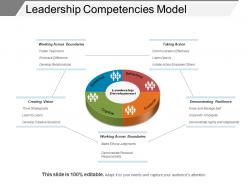
Utilize this Leadership Competencies Model PowerPoint presentation for your company to stay competitive in the market. The importance of your organization’s ability to adapt to a rapidly changing environment can be illustrated using this performance management PPT theme. The enormous opportunities for improving everyone’s performance can be highlighted using this managerial PowerPoint layout. The four elements of leadership namely relational, behavioral, emotional and cognitive can be described using leadership strategies PPT template. Using this human resource management PowerPoint theme, you can strengthen the connection between the individual leaders and the systems. The factors that can influence organizational operations can also be showcased using the management expertise model PPT layout. The significance of the right assessment and its methodologies can be suggested using this company administration PowerPoint theme. Hence download this leadership competency model PowerPoint template to clearly describe the competencies required to be strong leaders of your enterprise.
People who downloaded this PowerPoint presentation also viewed the following :
Leadership competencies model with all 5 slides:
Generate a flow of information with our Leadership Competencies Model. Ensure awareness continues to build.




FAQs for
Key leadership competencies include strategic thinking, emotional intelligence, adaptability, effective communication, and decision-making under pressure. These competencies enable leaders to navigate complex organizational challenges, inspire high-performing teams, and drive sustainable growth, with many successful executives finding that combining these skills delivers enhanced employee engagement, improved operational efficiency, and sustained competitive advantage.
Emotional intelligence and empathy shape effective leadership by enhancing communication, building stronger team relationships, and improving decision-making through deeper understanding of stakeholder perspectives. Leaders with high emotional intelligence navigate organizational challenges more effectively, foster collaborative environments, and drive employee engagement, with many companies finding that empathetic leadership ultimately delivers better retention rates and increased productivity.
Leaders can develop decision-making and problem-solving skills through scenario planning, data analysis training, cross-functional collaboration, mentorship programs, and structured decision frameworks. These approaches enhance critical thinking by exposing leaders to diverse perspectives, real-world case studies, and analytical tools, ultimately delivering faster problem resolution and more strategic outcomes across organizations.
Adaptability is critically important as modern leaders navigate rapid technological changes, shifting market conditions, evolving customer expectations, and unexpected disruptions like economic downturns or global crises. Organizations with adaptable leaders demonstrate greater resilience, faster pivot capabilities, and enhanced competitive positioning, with many companies finding that adaptive leadership directly correlates with sustained growth and market relevance.
Communication serves as the foundation for leadership effectiveness by enabling clear vision articulation, building trust through transparency, facilitating informed decision-making, and fostering team alignment across organizational levels. Effective leaders leverage strategic communication to inspire action, resolve conflicts, and drive change initiatives, with many organizations finding that leaders who excel in communication deliver significantly higher employee engagement, operational efficiency, and ultimately sustainable competitive advantage.
Leaders cultivate collaborative cultures by establishing clear shared goals, promoting open communication, recognizing team achievements, and breaking down departmental silos through cross-functional projects. Through strategic team-building initiatives and inclusive decision-making processes, organizations in sectors like healthcare and technology enhance innovation, accelerate problem-solving, and ultimately deliver improved operational efficiency and employee engagement.
Leaders can foster innovation by creating psychological safety for risk-taking, implementing structured brainstorming sessions, providing dedicated time for creative projects, encouraging cross-functional collaboration, and recognizing experimental efforts regardless of outcomes. These approaches enable teams to generate breakthrough solutions, explore unconventional ideas, and drive competitive advantage, with many organizations finding that empowered creative environments ultimately deliver faster product development and enhanced market responsiveness.
Strategic thinking and visioning enable leaders to anticipate market trends, identify emerging opportunities, and align resources toward sustainable competitive advantages. These competencies help organizations navigate uncertainty, make informed decisions about resource allocation, and maintain focus on long-term objectives, with many companies finding that visionary leadership ultimately delivers enhanced market positioning and operational resilience.
Ethical leadership and integrity significantly enhance team morale by fostering psychological safety, transparent communication, and consistent decision-making that aligns with stated values. Organizations with ethical leaders experience higher employee engagement, reduced turnover, and stronger collaboration, with many teams finding that trust-based environments ultimately deliver improved performance, innovation, and long-term competitive advantage.
Leaders can assess their leadership competencies through 360-degree feedback, self-assessment tools, performance metrics analysis, and regular stakeholder conversations with team members, peers, and supervisors. These evaluation methods enable targeted development through executive coaching, leadership training programs, and structured mentoring relationships, with many organizations finding that continuous competency assessment ultimately delivers stronger team performance and enhanced organizational effectiveness.
Mentoring and coaching enhance leadership competencies by providing personalized guidance, real-time feedback, strategic thinking development, and experiential learning opportunities that accelerate professional growth. Through structured relationships with experienced leaders, emerging professionals develop critical skills like decision-making, communication, and team management, while building confidence and expanding their networks, ultimately delivering stronger organizational leadership capabilities and improved succession planning outcomes.
Essential leadership competencies for remote and hybrid teams include digital communication proficiency, emotional intelligence, results-oriented performance management, virtual collaboration facilitation, and cultural sensitivity across time zones. These competencies enable leaders to maintain team cohesion, drive productivity through clear expectations and regular check-ins, while fostering trust and engagement in distributed work environments, ultimately delivering enhanced flexibility and operational efficiency.
Cultural competence enhances leadership effectiveness by enabling better communication across diverse teams, fostering inclusive decision-making, and building trust through understanding different perspectives and values. Leaders with cultural awareness navigate multicultural dynamics more successfully, reduce workplace conflicts, and unlock diverse talent potential, ultimately delivering higher employee engagement, improved innovation, and stronger organizational performance in increasingly global markets.
Organizations can use 360-degree feedback assessments, employee engagement scores, team performance metrics, retention rates, and leadership competency scorecards to evaluate their leaders effectively. These measurement tools streamline evaluation processes by tracking communication skills, decision-making effectiveness, and team development outcomes, with many companies finding that comprehensive assessment approaches ultimately deliver stronger leadership pipelines and improved organizational performance.
Leadership competencies evolve through continuous adaptation to digital transformation, remote team management, data-driven decision making, and agile methodologies. Modern leaders increasingly develop skills in emotional intelligence, technological fluency, and cross-functional collaboration, with organizations finding that successful executives combine traditional strategic thinking with digital literacy, ultimately delivering enhanced organizational resilience and competitive advantage.
-
Unique and attractive product design.
-
Innovative and Colorful designs.