

Leadership Training And Development Four Es Of Leadership Development Plan Ppt Icon Deck




Try Before you Buy Download Free Sample Product
 Impress Your
Audience
 100%
Editable
 Save Hours
of Time


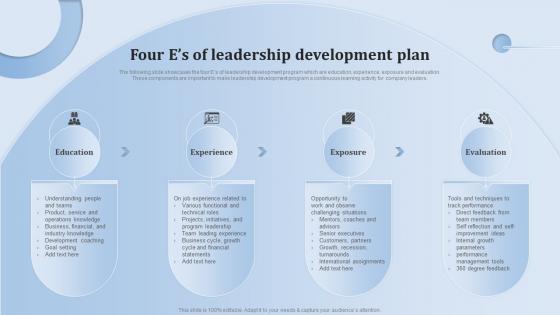
The following slide showcases the four Es of leadership development program which are education, experience, exposure and evaluation. These components are important to make leadership development program a continuous learning activity for company leaders.
People who downloaded this PowerPoint presentation also viewed the following :
Leadership Training And Development Four Es Of Leadership Development Plan Ppt Icon Deck with all 6 slides:
Use our Leadership Training And Development Four Es Of Leadership Development Plan Ppt Icon Deck to effectively help you save your valuable time. They are readymade to fit into any presentation structure.






FAQs for Leadership Training And Development Four Es Of Leadership Development Plan
Effective leaders embody vision, integrity, communication, and adaptability, alongside a commitment to empowering their teams. These qualities streamline decision-making by fostering trust, enhancing collaboration, and accelerating innovation, with many organizations finding that emotionally intelligent leaders deliver significantly improved employee engagement and ultimately, stronger financial performance.
Leaders can cultivate a growth mindset within their teams by fostering psychological safety, encouraging continuous learning, and providing constructive feedback, while recognizing effort and progress over solely focusing on outcomes. These approaches streamline innovation across industries like healthcare and finance, enabling enhanced problem-solving and ultimately delivering increased adaptability and competitive advantage.
Emotional intelligence plays a crucial role in leadership development, encompassing self-awareness, self-regulation, motivation, empathy, and social skills. These competencies enhance communication, facilitate stronger team cohesion, and enable leaders to navigate complex interpersonal dynamics, with many organizations finding that emotionally intelligent leaders foster greater innovation. Ultimately delivering improved employee engagement and enhanced organizational performance across sectors like healthcare and financial services.
Aspiring leaders can identify their style through self-assessment, 360-degree feedback, and observing effective leaders, considering approaches like transformational, servant, or autocratic leadership. While understanding these frameworks helps, it also requires analyzing personal strengths, values, and how one naturally influences teams, with many organizations finding that adaptable leaders thrive. Ultimately, this self-awareness enhances communication, builds trust, and delivers improved team performance and strategic advantage.
Mentorship contributes to leadership development by fostering skill enhancement, providing constructive feedback, and offering valuable networking opportunities, ultimately accelerating professional growth. While formal training delivers foundational knowledge, mentorship enables personalized guidance—with many organizations finding that paired leaders experience increased engagement and retention, streamlining succession planning and delivering a competitive advantage.
Conflict resolution strategies include active listening, mediation, collaboration, and clear communication, often requiring nuanced approaches. These techniques enhance team cohesion by fostering understanding, minimizing disruptions, and streamlining workflows, with many organizations finding that proactive intervention delivers improved employee engagement and ultimately, increased operational efficiency.
Leadership development fosters innovation by encouraging experimentation, embracing calculated risk-taking, and promoting cross-functional collaboration. These approaches streamline idea generation through workshops, hackathons, and dedicated innovation teams, with many financial services and healthcare institutions finding that employee-led initiatives deliver significant competitive advantage. Ultimately, this enables faster adaptation and sustained growth in an increasingly dynamic landscape.
Diversity and inclusion significantly enhance leadership effectiveness by fostering innovation, improving decision-making, and boosting employee engagement. These initiatives broaden perspectives, enabling leaders to better understand diverse customer bases and global markets, with many organizations finding that inclusive teams demonstrate greater agility. Ultimately delivering enhanced problem-solving and a competitive advantage in an increasingly interconnected landscape.
Leadership development success is measured through enhanced employee performance, increased engagement scores, and improved retention rates, alongside quantifiable metrics like promotion velocity. These initiatives streamline talent pipelines by fostering skills in areas such as strategic thinking, emotional intelligence, and cross-functional collaboration, ultimately delivering a more agile and competitive organization with many institutions finding that sustained leadership growth directly correlates to increased profitability.
Leadership development programs often stumble with a lack of clear objectives, insufficient executive buy-in, and a failure to measure tangible results. While these programs aim to enhance skills, they can also fall short by neglecting individualized coaching, relevant industry context, and consistent reinforcement. With many organizations finding that sustained impact requires ongoing mentorship and application-based learning, ultimately delivering improved employee engagement and stronger succession pipelines.
Technology enhances leadership training and development by leveraging virtual reality, AI-powered coaching, and data analytics for personalized learning paths. While traditional methods remain valuable, these tools streamline skill assessment, deliver immersive experiences, and provide real-time feedback, with many organizations finding that engagement and retention significantly increase, ultimately delivering improved performance and stronger leadership pipelines.
Transactional leadership focuses on exchange—rewards for compliance—while transformational leadership inspires and motivates through a shared vision, fostering innovation and growth. These approaches present both challenges and opportunities, with transactional styles excelling in stable environments and transformational styles thriving in increasingly dynamic landscapes, ultimately delivering enhanced employee engagement and organizational agility.
Leaders can develop resilience by fostering self-awareness, encouraging open communication, and promoting a growth mindset within their teams. While challenging times present both challenges and opportunities, these approaches enhance adaptability through proactive problem-solving, stress management, and continuous learning, ultimately delivering improved performance and sustained organizational health.
Identifying and cultivating future leaders involves succession planning, mentorship programs, cross-functional assignments, and leadership training initiatives. These approaches enhance skillsets by fostering strategic thinking, emotional intelligence, and effective communication, with many financial services institutions finding that early identification delivers a robust leadership pipeline.
External factors, like market shifts and technological advancements, significantly influence leadership development strategies by demanding agility, innovation, and data literacy. While traditional skills remain valuable, organizations increasingly prioritize adaptive thinking, digital fluency, and change management capabilities. With many institutions finding that proactive leadership development enhances resilience, ultimately delivering competitive advantage and streamlined operational efficiency in an increasingly dynamic landscape.
-
My team has been relying on SlideTeam’s professional PPT designs for a while now. It has greatly sped up quality work at my organization. So thanks!
-
I looked at their huge selection of themes and designs. They appeared to be ideal for my profession. I'm sure I'll grab a few of them.