

Learning Management System Lms Talent Management Tool Leveraging Technologies To Enhance Hr Services





Try Before you Buy Download Free Sample Product
 Impress Your
Audience
 100%
Editable
 Save Hours
of Time


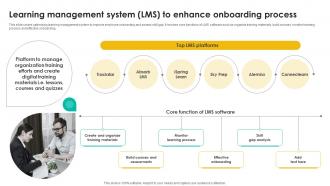
This slide covers optimizing learning management system to improve employee onboarding and assess skill gap. It involves core functions of LMS software such as organize training materials, build courses, monitor learning process and effective onboarding.
People who downloaded this PowerPoint presentation also viewed the following :
Learning Management System Lms Talent Management Tool Leveraging Technologies To Enhance Hr Services with all 9 slides:
Use our Learning Management System Lms Talent Management Tool Leveraging Technologies To Enhance Hr Services to effectively help you save your valuable time. They are readymade to fit into any presentation structure.








FAQs for Learning Management System Lms Talent Management Tool Leveraging Technologies To
Key LMS features include user-friendly interface, mobile compatibility, comprehensive reporting analytics, integration capabilities with existing systems, and robust content management tools. These features streamline training delivery, track learner progress effectively, and enable seamless course creation, with many organizations finding that strategic LMS selection enhances employee development while reducing administrative overhead and training costs.
An LMS enhances learning experiences by providing centralized content management, real-time progress tracking, interactive assessment tools, and seamless communication channels between instructors and students. Through automated grading, personalized learning paths, and mobile accessibility, educational institutions streamline course delivery while enabling students to learn at their own pace, ultimately delivering improved engagement and better academic outcomes.
Mobile compatibility drives Learning Management System adoption by enabling flexible learning access, accommodating remote workforces, and supporting diverse learning preferences across organizations. With employees increasingly expecting seamless mobile experiences, companies find that mobile-optimized LMS platforms enhance engagement rates, reduce training completion times, and deliver competitive advantage through accessible, scalable learning solutions.
Yes, modern LMS platforms can seamlessly integrate with existing educational technologies through APIs, single sign-on capabilities, and standardized protocols like SCORM and xAPI. These integrations enable institutions to connect video conferencing tools, student information systems, assessment platforms, and content libraries, ultimately creating a unified digital ecosystem that enhances learning experiences while maximizing existing technology investments.
Organizations face implementation challenges including user resistance to change, technical integration complexities, content migration difficulties, inadequate training resources, and budget constraints. While these obstacles require strategic planning, many companies find that phased rollouts, comprehensive staff training, and selecting scalable platforms ultimately streamline operations and enhance learning outcomes across departments.
Data analytics within an LMS contributes to personalized learning pathways by tracking individual performance patterns, identifying knowledge gaps, and analyzing learning preferences through comprehensive data collection. These insights enable automated content recommendations, adaptive assessments, and customized pacing, with educational institutions and corporate training programs finding that learners achieve significantly better outcomes while reducing time-to-competency.
User-friendly interfaces in LMS design are crucial for maximizing engagement, reducing training time, and ensuring seamless adoption across educational institutions and corporate environments. These intuitive designs enhance learning outcomes by streamlining navigation, minimizing technical barriers, and enabling educators to focus on content delivery rather than platform complexity, ultimately delivering improved completion rates and better educational experiences.
Learning Management Systems support corporate training by centralizing content delivery, tracking employee progress, automating compliance training, and providing detailed analytics on learning outcomes. Through scalable platforms, organizations streamline onboarding processes, deliver personalized learning paths, and ensure consistent training across multiple locations, ultimately reducing training costs while enhancing employee skill development and regulatory compliance.
LMS facilitates collaboration through discussion forums, group projects, peer review tools, real-time messaging, and shared workspaces that connect learners across different locations and time zones. These features streamline communication by enabling instant feedback, collaborative document editing, and virtual study groups, with many educational institutions finding that students achieve better learning outcomes and stronger professional networks through enhanced peer interaction.
LMS content creation best practices include structured course design, interactive multimedia elements, mobile-responsive formats, regular content updates, and clear learning pathways. These approaches enhance learner engagement by delivering bite-sized modules, assessment integration, and personalized learning experiences, with many educational institutions and corporate training programs finding significantly improved completion rates and knowledge retention.
Gamification enhances LMS engagement through points systems, badges, leaderboards, progress tracking, and interactive challenges that transform learning into competitive experiences. Educational institutions and corporate training programs increasingly find that these elements boost completion rates, knowledge retention, and learner motivation, while delivering measurable improvements in performance outcomes and sustained participation across diverse learning modules.
LMS security measures include data encryption, multi-factor authentication, role-based access controls, regular security audits, and GDPR compliance protocols. These technologies streamline protection by securing data transmission, verifying user identities, and controlling information access, with many educational institutions and corporations finding that comprehensive security frameworks ultimately deliver enhanced user trust and regulatory compliance.
The choice of LMS significantly impacts compliance tracking through automated certification monitoring, regulatory reporting capabilities, audit trail documentation, and deadline management systems. A robust LMS enables organizations to streamline professional development requirements by tracking employee progress, generating compliance reports, and ensuring certifications remain current, ultimately reducing administrative burden while maintaining regulatory standards across industries like healthcare and finance.
Key trends shaping LMS evolution include AI-powered personalization, microlearning modules, mobile-first design, social learning integration, and advanced analytics capabilities. These technologies streamline content delivery, enhance learner engagement, and provide data-driven insights, with educational institutions and corporations finding that adaptive learning paths ultimately deliver improved knowledge retention and measurable training outcomes.
Institutions can measure LMS effectiveness through learner completion rates, assessment scores, engagement metrics, time-to-competency, and cost-per-learner analytics. These measurements enable organizations to track training ROI by comparing reduced onboarding costs, improved performance outcomes, and decreased instructor expenses against system investment, with many finding that streamlined delivery ultimately delivers significant operational savings.
-
Editable templates with innovative design and color combination.
-
My team has been relying on SlideTeam’s professional PPT designs for a while now. It has greatly sped up quality work at my organization. So thanks!