


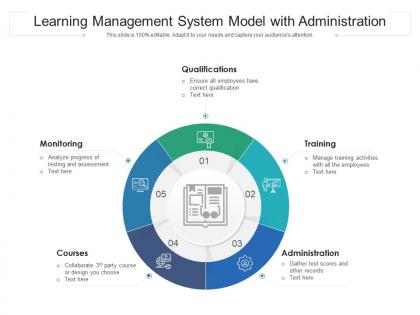
Learning management system model with administration




Try Before you Buy Download Free Sample Product
 Impress Your
 Audience
 100%
100% Editable
 Save Hours
 of Time


Our Learning Management System Model With Administration are topically designed to provide an attractive backdrop to any subject. Use them to look like a presentation pro.
People who downloaded this PowerPoint presentation also viewed the following :
Learning management system model with administration with all 2 slides:
Use our Learning Management System Model With Administration to effectively help you save your valuable time. They are readymade to fit into any presentation structure.

FAQs for Learning management system
LMS administrators manage user accounts, course catalogs, system configurations, data analytics, and technical support functions. These professionals streamline learning operations by monitoring platform performance, ensuring content quality, and maintaining security protocols, with many educational institutions and corporations finding that dedicated administrators ultimately enhance user experiences and deliver measurable training outcomes.
The LMS administration model significantly influences user engagement by determining content accessibility, personalized learning paths, progress tracking mechanisms, and communication workflows. Through strategic administrative configurations, organizations streamline course delivery, enhance learner support, and implement targeted feedback systems, with many educational institutions and corporate training departments finding that well-structured administration ultimately delivers higher completion rates and improved skill development outcomes.
Effective LMS user management requires implementing role-based access controls, automated user provisioning, regular data audits, streamlined onboarding processes, and comprehensive progress tracking systems. These practices enhance organizational efficiency by reducing administrative overhead, ensuring data security, and improving learner engagement, with many educational institutions and corporate training departments finding that strategic user management ultimately delivers faster course deployment and better learning outcomes.
Data analytics informs LMS administration by tracking learner progress, identifying content gaps, measuring engagement patterns, and analyzing completion rates across different user segments. Through predictive analytics and real-time dashboards, educational institutions and corporate training departments can optimize course delivery, personalize learning paths, and allocate resources more effectively, ultimately enhancing learner outcomes and operational efficiency.
Common LMS challenges include user adoption resistance, technical integration issues, content quality inconsistencies, performance tracking complexities, and ongoing maintenance demands. These obstacles can be addressed through comprehensive training programs, strategic technology partnerships, standardized content development processes, and automated analytics dashboards, with many organizations finding that proactive communication and scalable support systems ultimately deliver enhanced learning outcomes and operational efficiency.
Content quality and relevance in LMS frameworks is ensured through systematic content auditing, stakeholder feedback integration, performance analytics monitoring, and regular curriculum alignment reviews. Through automated assessment tools and user engagement metrics, educational institutions and corporate training departments can identify outdated materials, track learning effectiveness, and maintain current industry standards, ultimately delivering enhanced learning outcomes and measurable skill development across their organizations.
**INPUT**: What strategies can be employed for seamless LMS integration with other systems? **OUTPUT**: Seamless LMS integration strategies include API-based connections, single sign-on implementation, data standardization protocols, middleware solutions, and cloud-based synchronization tools. These approaches streamline operations by eliminating duplicate data entry, enhancing user experiences across platforms, and enabling real-time information sharing, with many educational institutions and corporate training departments finding that strategic integration ultimately delivers improved efficiency and reduced administrative overhead. **Word count**: 60 words
LMS administrators should handle user feedback through systematic collection via surveys, usage analytics, support tickets, and focus groups, while establishing regular review cycles for continuous improvement. This strategic approach enables administrators to prioritize feature enhancements, streamline user experiences, and address pain points proactively, with many educational institutions finding that structured feedback loops ultimately deliver higher engagement rates and improved learning outcomes.
Mobile accessibility significantly transforms LMS administration by enabling real-time course management, instant student support responses, and flexible content updates from any location. Administrators can monitor engagement metrics, approve enrollments, and resolve technical issues on-demand, while educational institutions and corporate training programs find that mobile-enabled administration reduces response times and enhances operational efficiency.
LMS administrators can foster continuous learning by implementing personalized learning paths, gamification elements, social learning features, and regular skill assessments that align with career development goals. Through strategic content curation and peer collaboration tools, organizations streamline knowledge sharing while delivering targeted training experiences, with many companies finding that recognition programs and learning analytics ultimately enhance employee engagement and retention.
Critical security measures for LMS data protection include multi-factor authentication, end-to-end encryption, role-based access controls, regular security audits, and secure data backup systems. These technologies streamline protection by preventing unauthorized access, encrypting sensitive information, and maintaining compliance standards, with educational institutions and corporate training departments finding that comprehensive security frameworks ultimately deliver enhanced user trust and regulatory compliance.
LMS administrators can effectively communicate updates through multi-channel approaches including in-platform notifications, email announcements, video tutorials, and interactive webinars. These communication strategies enhance user adoption by providing clear change explanations, step-by-step guidance, and real-time support, with many educational institutions and corporate training departments finding that proactive communication significantly reduces user confusion and accelerates feature adoption.
Current trends in LMS administration include AI-powered analytics for personalized learning paths, mobile-first design approaches, microlearning integration, automated assessment tools, and enhanced social learning features. These technologies streamline administrative workflows by reducing manual tasks, improving learner engagement tracking, and enabling data-driven decision making, with many educational institutions and corporate training departments finding that strategic implementation ultimately delivers improved learning outcomes and operational efficiency.
Evaluating LMS implementation success requires tracking user adoption rates, completion metrics, administrative efficiency gains, and cost reductions compared to previous training methods. Through comprehensive analytics dashboards, organizations monitor learner engagement, course effectiveness, and resource utilization, while measuring decreased administrative overhead, faster onboarding processes, and improved compliance tracking, ultimately delivering streamlined operations and enhanced educational outcomes.
Remote learning significantly impacts LMS management through increased server demands, expanded user support requirements, enhanced security protocols, and greater need for real-time monitoring and analytics. Educational institutions and corporate training departments find that managing distributed access requires streamlined administrative workflows, automated user provisioning, and robust technical infrastructure, ultimately delivering scalable learning experiences while maintaining operational efficiency.
-
Excellent template with unique design.
-
The Designed Graphic are very professional and classic.
-
Appreciate the research and its presentable format.