

Levels Of Market Segmentation For Similar Groups Micromarketing Guide To Target MKT SS





Try Before you Buy Download Free Sample Product
 Impress Your
Audience
 100%
Editable
 Save Hours
of Time


Our Levels Of Market Segmentation For Similar Groups Micromarketing Guide To Target MKT SS are topically designed to provide an attractive backdrop to any subject. Use them to look like a presentation pro.
People who downloaded this PowerPoint presentation also viewed the following :
Levels Of Market Segmentation For Similar Groups Micromarketing Guide To Target MKT SS with all 6 slides:
Use our Levels Of Market Segmentation For Similar Groups Micromarketing Guide To Target MKT SS to effectively help you save your valuable time. They are readymade to fit into any presentation structure.





FAQs for Levels Of Market Segmentation For Similar Groups Micromarketing Guide To
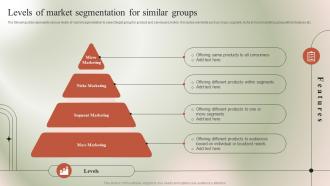
The primary levels of market segmentation include mass marketing, segment marketing, niche marketing, and micro-marketing, each differing in scope and targeting precision. These approaches enable organizations to streamline their marketing strategies by moving from broad audience reach to increasingly focused customer groups, with many companies finding that combining multiple levels delivers enhanced customer experiences, improved resource allocation, and ultimately stronger competitive advantage in today's diverse marketplace.
Demographic segmentation enables targeted marketing by categorizing consumers based on age, income, gender, education, and lifestyle factors, allowing businesses to tailor messaging and product offerings precisely. Companies across retail, financial services, and healthcare leverage these insights to create personalized campaigns, optimize resource allocation, and enhance customer experiences, ultimately delivering higher conversion rates and stronger brand loyalty.
Psychographic segmentation analyzes consumer lifestyles, values, attitudes, interests, and personality traits to reveal deeper motivations behind purchasing decisions. Through psychographic insights, companies identify emotional triggers, brand affinity patterns, and lifestyle preferences that demographics alone cannot capture, enabling more personalized messaging and product positioning that resonates with specific consumer mindsets and values.
Geographic segmentation significantly influences product availability by enabling companies to tailor inventory, distribution channels, and supply chain logistics to regional demands, climate considerations, and local preferences. Through location-based strategies, businesses optimize marketing messages for cultural relevance, adjust pricing for regional economic conditions, and customize product features, ultimately delivering more targeted customer experiences and competitive advantage in diverse markets.
Behavioral segmentation delivers precise campaign targeting by analyzing customer purchase patterns, usage frequency, brand loyalty, and response behaviors. This approach enables marketers to create personalized messaging, optimize timing strategies, and allocate resources more efficiently, with retail and e-commerce companies finding significantly higher conversion rates and customer engagement through behaviorally-targeted campaigns.
Businesses can determine effective market segmentation by analyzing customer data, conducting market research, evaluating competitive positioning, and testing different segmentation variables like demographics, psychographics, and behavioral patterns. Companies across industries, from retail to financial services, often find success combining multiple approaches, ultimately enabling more targeted marketing campaigns, improved customer satisfaction, and enhanced competitive advantage.
Data collection for market segmentation employs surveys, focus groups, customer interviews, social media analytics, website behavior tracking, and transactional data analysis. These techniques enable businesses to identify distinct customer patterns, preferences, and purchasing behaviors across different segments, with many organizations finding that combining multiple data sources delivers deeper insights and more accurate targeting strategies.
Consumer trends significantly shape market segmentation strategies by revealing evolving preferences, behaviors, and purchasing patterns that require businesses to refine their targeting approaches. Companies increasingly analyze trend data to identify emerging segments, adapt messaging for different demographics, and develop products that align with shifting consumer values, ultimately enabling more precise targeting, enhanced customer engagement, and competitive advantage in dynamic markets.
Companies implementing multi-segment strategies face resource allocation complexities, brand message dilution, increased operational costs, competitive positioning difficulties, and customer confusion risks. These challenges require strategic coordination across marketing channels, product development, and customer service teams, with many organizations finding that successful multi-segment approaches ultimately deliver competitive advantage through diversified revenue streams and enhanced market coverage.
B2B companies apply segmentation through firmographics, technographics, buying committee structures, and longer decision cycles, while B2C focuses on demographics and individual behaviors. B2B segmentation requires understanding organizational hierarchies, procurement processes, and relationship-based selling, with many enterprises finding that account-based approaches deliver higher conversion rates and strategic partnerships than traditional volume-based B2C methods.
Key metrics include customer acquisition cost, lifetime value, conversion rates, segment profitability, and retention rates across different segments. These measurements enable businesses to assess segmentation effectiveness by comparing performance variations between segments, optimizing resource allocation, and identifying high-value customer groups, ultimately delivering improved targeting precision and enhanced competitive advantage.
Technology enhances segmentation through advanced data analytics, machine learning algorithms, predictive modeling, real-time customer tracking, and automated behavioral analysis. These AI-powered tools enable businesses to identify micro-segments, predict customer lifetime value, and personalize campaigns with unprecedented precision, with companies in retail and financial services finding significantly improved conversion rates and customer engagement.
Businesses should prioritize data privacy, avoid discriminatory practices, ensure transparent communication, respect consumer consent, and maintain fairness in pricing and access. While effective segmentation enables personalized experiences and competitive advantage, companies must balance commercial objectives with social responsibility, particularly when targeting vulnerable populations, ultimately building trust and long-term customer relationships.
Niche marketing strategies benefit from effective segmentation by enabling precise customer targeting, optimized resource allocation, and enhanced message personalization. Through detailed demographic and psychographic analysis, businesses in specialized sectors like organic skincare or boutique fitness can deliver highly relevant offerings, reduce marketing costs, and build stronger customer loyalty, ultimately achieving sustainable competitive advantage in focused market spaces.
Market segmentation enables precise brand positioning by identifying distinct customer groups with specific needs, preferences, demographics, and behaviors, allowing companies to craft targeted messaging that resonates deeply. Through segmented approaches, brands can develop differentiated value propositions, tailor communication channels, and create personalized experiences across various customer segments, ultimately delivering stronger market relevance and competitive advantage.
-
Crisp and neat slides. Makes it fun and easier to curate presentations.
-
Great templates that you can use in your next keynote or conference. They are perfect for quick and visually-engaging delivery.