

Linked Open Data Powerpoint Presentation Slides




Try Before you Buy Download Free Sample Product
 Impress Your
 Audience
 100%
100% Editable
 Save Hours
 of Time


This PowerPoint presentation briefly explains the linked data, its principles, benefits, and critical terms. In this Linked Open Data PowerPoint Presentation, we have covered the introduction to linked data by covering its overview, the role of linked data on the web, and the importance of linked data. Moreover, this deck shows linked data principles, their benefits, data quality in linked data by covering dataset quality in the linked web data, and the importance of publishing five-star data. In addition, this PPT talks about the things that linked data cant do and critical terms in linked data, such as linked open data, its principles and advantages, and resource description framework RDF. Furthermore, this Linked Data template includes the overview of schema in linked data, triples in linked data, an overview of the semantic web, the relationship between the semantic web and linked data, turtles in linked data, and the role of uniform resource identifier URI. Lastly, the module comprises a data structure timeline, a roadmap, and a dashboard. Download our 100 percent editable and customizable template, which is also compatible with Google Slides.
People who downloaded this PowerPoint presentation also viewed the following :
Content of this Powerpoint Presentation
Slide 1: This slide displays the title LINKED OPEN DATA.
Slide 2: This slide displays the title AGENDA.
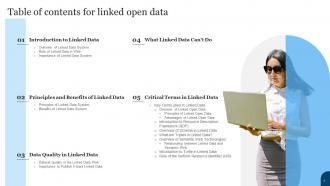
Slide 3: This slide exhibit table of content.
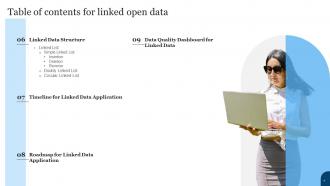
Slide 4: This slide exhibit table of content.
Slide 5: This slide exhibit table of content- Introduction to Linked Data.
Slide 6: This slide represents the overview of linked data, a process of linking and publishing data from heterogeneous resources to share over the internet.
Slide 7: This slide depicts the role of linked data in the internet that helps computer systems to read information.
Slide 8: This slide represents the importance of linked data that helps web apps make them independent of specific back-ends.
Slide 9: This slide exhibit table of content- Principles and Benefits of Linked Data.
Slide 10: This slide represents the principles of linked data.
Slide 11: This slide describes the principles of linked data.
Slide 12: This slide represents the benefits of linked data.
Slide 13: This slide exhibit table of content- Data Quality in Linked Data.
Slide 14: This slide depicts the dataset quality in the linked data web, which is necessary since open data is growing in popularity worldwide.
Slide 15: This slide describes the importance of publishing five stars-linked data.
Slide 16: This slide exhibit table of content- What Linked Data Can't Do.
Slide 17: This slide depicts the tasks that linked data cannot do.
Slide 18: This slide exhibit table of content- Critical Terms in Linked Data.
Slide 19: This slide shows the key terms used in linked data systems.
Slide 20: This slide shows the overview of linked open data, which is structured data in a machine-readable format.
Slide 21: This slide describes the principles of linked open data.
Slide 22: This slide represents the benefits of linked open data.
Slide 23: This slide represents the overview of the resource description framework.
Slide 24: This slide depicts the schema overview in linked data, a group of elements used to organize information in the database.
Slide 25: This slide represents the overview of triples in linked data and how it connects scattered data sets.
Slide 26: This slide describes the overview of the semantic web that is considered the next stage of evolution after the world wide web.
Slide 27: This slide describes the relationship between linked data and the semantic web, which is an expansion of the present web.
Slide 28: This slide represents the introduction to Turtle in linked data, which is a syntax and format for storing and expressing information.
Slide 29: This slide represents the role of a uniform resource identifier.
Slide 30: This slide exhibit table of content- Linked Data Structure.
Slide 31: This slide depicts the linked list that is data structure in linked data.
Slide 32: This slide represents the simple linked list data structure of linked data.
Slide 33: This slide demonstrates the step-by-step procedure to insert an element in the linked list, including the syntax for this operation.
Slide 34: This slide shows the step-by-step process of deleting a node from the linked list, including the syntax.
Slide 35: This slide demonstrates the thorough five-step reverse operation performed on the linked list.
Slide 36: This slide depicts the doubly linked list in the linked data structure.
Slide 37: This slide represents the circular linked list in the data structure.
Slide 38: This slide exhibit table of content- Timeline for Linked Data Application.
Slide 39: This slide describes the timeline for linked data.
Slide 40: This slide exhibit table of content- Roadmap for Linked Data Application.
Slide 41: This slide represents the roadmap for linked data application in the organization.
Slide 42: This slide exhibit table of content- Data Quality Dashboard for Linked Data.
Slide 43: This slide describes the data quality dashboard for linked data by covering details of account information quality, contact details quality etc.
Slide 44: This is the icons slide.
Slide 45: This slide presents title for additional slides.
Slide 46: This slide display the title About Us.
Slide 47: This slide display the title Target Audience.
Slide 48: This slide depicts posts for past experiences of clients.
Slide 49: This slide display Venn Diagram.
Slide 50: This slide display Comparison of facebook & twitter user.
Slide 51: This slide depicts 30-60-90 days plan for projects.
Slide 52: This slide shows puzzle for displaying elements of company.
Slide 53: This is thank you slide & contains contact details of company like office address, phone no., etc.
Linked Open Data Powerpoint Presentation Slides with all 58 slides:
Use our Linked Open Data Powerpoint Presentation Slides to effectively help you save your valuable time. They are readymade to fit into any presentation structure.








FAQs for Linked Open Data
Linked Open Data operates on four core principles: using URIs for resource identification, providing HTTP access, offering standardized information through RDF, and including links to related datasets. These principles differentiate LOD from traditional formats by enabling semantic interoperability, automated discovery, and cross-platform integration, with organizations in healthcare, finance, and government finding that linked datasets streamline data sharing and enhance analytical capabilities.
Organizations ensure Linked Open Data quality through comprehensive validation frameworks, automated consistency checking, provenance tracking, and regular auditing processes. Financial institutions and healthcare systems increasingly implement multi-layered verification protocols, cross-referencing multiple authoritative sources, and establishing clear data governance standards, ultimately delivering more reliable insights and enhanced decision-making capabilities across their operations.
Linked Open Data enhances interoperability by establishing standardized vocabularies, enabling seamless data integration across platforms, providing universal resource identifiers, and creating machine-readable relationships between datasets. Through these frameworks, organizations in healthcare, finance, and government streamline cross-domain collaborations, reduce data silos, and accelerate decision-making processes, ultimately delivering enhanced operational efficiency and strategic competitive advantage.
URIs serve as unique identifiers that enable global data linking, deduplication, and semantic interoperability across distributed datasets in Linked Open Data ecosystems. These identifiers streamline data integration by providing standardized reference points, enhancing discoverability through consistent naming conventions, and facilitating automated data linking, with organizations across healthcare, government, and research finding that URI-based approaches ultimately deliver improved data quality and operational efficiency.
Businesses can leverage Linked Open Data by integrating external datasets with internal systems, enhancing data analytics capabilities, and accessing real-time market intelligence for comprehensive insights. Through semantic web technologies, organizations in retail, finance, and healthcare streamline data discovery, reduce research costs, and accelerate strategic planning, ultimately delivering more informed decisions and competitive advantage.
Linked Open Data applications in healthcare include patient record interoperability, drug interaction databases, medical research integration, clinical trial data sharing, and disease outbreak tracking. In education, universities leverage linked datasets for academic resource discovery, student performance analytics, and research collaboration platforms, with many institutions finding that these interconnected data sources streamline information access, enhance decision-making processes, and ultimately deliver more personalized services while reducing operational costs.
Linked Open Data enhances governance and transparency by standardizing data formats, enabling cross-platform integration, and creating audit trails that track data lineage and usage. Through semantic web technologies, organizations can establish clear data ownership, automate compliance reporting, and provide stakeholders with accessible insights, with many government agencies and financial institutions finding that open linking ultimately delivers greater accountability and regulatory compliance.
Organizations face challenges including data quality inconsistencies, complex technical integration requirements, skills gaps in semantic web technologies, interoperability issues across different systems, and substantial initial infrastructure investments. While these obstacles present legitimate concerns, many enterprises in healthcare, finance, and government sectors find that strategic implementation ultimately delivers enhanced data discoverability, improved analytics capabilities, and competitive advantages through better connected information ecosystems.
Machine learning and AI benefit from Linked Open Data by accessing vast, interconnected datasets that enhance training accuracy, enable better feature extraction, and provide rich contextual relationships between entities. Through standardized RDF formats and semantic connections, AI systems can leverage diverse knowledge graphs, cross-reference multiple data sources seamlessly, and ultimately deliver more intelligent predictions and insights across various domains.
Public institutions can use Linked Open Data to foster citizen engagement through transparent budget visualizations, interactive policy dashboards, real-time service tracking, participatory decision-making platforms, and accessible government performance metrics. These approaches enable citizens to meaningfully interact with public information, while municipalities and agencies find that data transparency builds trust, encourages civic participation, and ultimately delivers more responsive governance and stronger community relationships.
The Semantic Web provides the foundational framework for Linked Open Data through standardized protocols like RDF, SPARQL, and HTTP URIs, enabling machines to understand and process interconnected data meaningfully. This relationship revolutionizes data publishing by allowing organizations across healthcare, government, and research sectors to create discoverable, reusable datasets that enhance interoperability, reduce integration costs, and ultimately deliver richer insights for evidence-based decision-making.
Common metadata standards in Linked Open Data publishing include Dublin Core for basic resource description, FOAF for people and organizations, SKOS for controlled vocabularies, DCAT for dataset catalogs, and VoID for dataset statistics. These standards enable seamless data integration across platforms, enhance discoverability through search engines, and facilitate interoperability between organizations, ultimately delivering more comprehensive insights and reducing data silos for enterprises.
Linked Open Data accelerates open science by enabling seamless data sharing, interoperability across research platforms, standardized metadata formats, and automated discovery of relevant datasets. Through these capabilities, research institutions streamline collaboration, enhance reproducibility of studies, and facilitate cross-disciplinary discoveries, with many universities finding that interconnected data ecosystems significantly reduce research silos while accelerating innovation timelines.
Publishing Linked Open Data requires careful consideration of data sensitivity, access controls, privacy regulations like GDPR, and potential misuse through data linking across sources. Organizations must implement robust authentication mechanisms, data anonymization techniques, and regular security audits, with many government agencies and healthcare institutions finding that structured governance frameworks ultimately deliver transparency while maintaining regulatory compliance and user trust.
Linked Open Data transforms smart cities by integrating transportation, utilities, environmental, and demographic datasets into unified systems that enable real-time decision making. Through interconnected data platforms, urban planners streamline traffic management, optimize energy distribution, and enhance citizen services, with cities like Barcelona and Amsterdam finding that open data accessibility accelerates sustainable development while reducing operational costs.
-
A fantastic collection of templates. I'll likely use this as my go-to resource for future templates and support.
-
Amazing product with appealing content and design.