

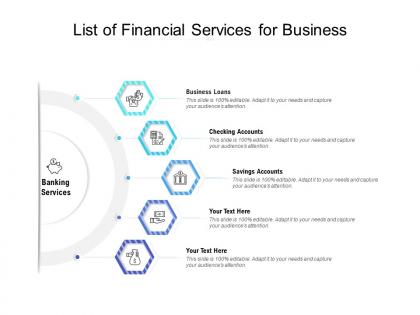
List of financial services for business





Try Before you Buy Download Free Sample Product
 Impress Your
 Audience
 100%
100% Editable
 Save Hours
 of Time


Act in their interest with our List Of Financial Services For Business. Intercede on their behalf to improve conditions.
People who downloaded this PowerPoint presentation also viewed the following :
List of financial services for business with all 2 slides:
Intercede on their behalf to improve conditions with our List Of Financial Services For Business. Be able to act in their interest.

FAQs for List of financial
Small businesses typically require banking and cash management, business loans and lines of credit, payment processing solutions, accounting and bookkeeping services, and insurance coverage. These services streamline operations by enabling efficient cash flow management, facilitating growth investments, and automating financial processes, with many small enterprises finding that integrated financial solutions ultimately deliver cost savings and enhanced competitive positioning.
Businesses should evaluate financial service providers based on service range, technology capabilities, regulatory compliance, customer support quality, and pricing transparency. Through comprehensive needs assessments, companies can compare providers across loan products, payment processing, treasury management, and digital banking features, with many finding that partnering with institutions offering integrated solutions ultimately delivers operational efficiency and competitive advantage.
Fintech companies revolutionize business financial services by offering digital payment solutions, automated lending platforms, expense management tools, and real-time analytics dashboards. These innovations streamline traditional banking processes, reduce operational costs, and enhance customer experiences, with many businesses finding that fintech partnerships enable faster loan approvals, seamless transactions, and improved cash flow management.
Cloud-based accounting services offer businesses real-time financial visibility, automated data backup, seamless multi-device access, enhanced collaboration capabilities, and reduced IT infrastructure costs. These solutions streamline financial operations by eliminating manual processes, enabling instant reporting, and facilitating remote team coordination, with many organizations finding that cloud platforms ultimately deliver greater operational efficiency and competitive advantage in today's digital marketplace.
Businesses can effectively manage cash flow through financial services like automated payment processing, invoice factoring, credit lines, cash flow forecasting tools, and treasury management solutions. These services streamline operations by accelerating receivables collection, providing immediate working capital access, and optimizing payment timing, with many organizations finding that strategic financial partnerships ultimately deliver enhanced liquidity and competitive operational advantages.
Best practices for financial audit preparation include maintaining organized records, implementing robust internal controls, conducting regular reconciliations, ensuring compliance documentation, and performing pre-audit reviews. These strategic approaches streamline the audit process by minimizing discrepancies, accelerating verification procedures, and demonstrating operational transparency, with many financial institutions and corporations finding that proactive preparation ultimately delivers reduced audit costs and enhanced stakeholder confidence.
Payment processing solutions enhance customer satisfaction by delivering faster transactions, seamless checkout experiences, and multiple payment options, while simultaneously improving business efficiency through automated reconciliation, reduced manual errors, and streamlined cash flow management. Banks and retail businesses increasingly find that modern payment systems minimize transaction times, lower operational costs, and provide real-time analytics, ultimately enabling better customer experiences and competitive advantage in today's digital marketplace.
Traditional banks offer lower interest rates, established relationships, and comprehensive services, while alternative lenders provide faster approval processes, flexible criteria, and accessibility for newer businesses. Banks typically require extensive documentation and collateral, whereas alternative lenders streamline applications through technology, with many businesses finding that combining both options delivers optimal financing strategies and competitive advantage.
Financial services support businesses through comprehensive risk assessment tools, regulatory compliance monitoring, insurance products, audit services, and automated reporting systems. These solutions enable organizations to identify potential threats early, maintain regulatory standards across multiple jurisdictions, and streamline compliance processes, with many financial institutions finding that integrated risk management ultimately reduces operational costs while enhancing business credibility.
Businesses can leverage financial data analytics for growth by identifying revenue patterns, optimizing cash flow management, predicting market trends, assessing customer profitability, and streamlining operational costs. Through advanced analytics, companies in retail, manufacturing, and healthcare enhance decision-making accuracy, reduce financial risks, and ultimately deliver improved resource allocation and competitive advantage in increasingly data-driven markets.
Businesses should consider the service provider's track record, fee structure, investment philosophy, regulatory compliance, and technology platform capabilities. Financial institutions, from manufacturing companies to retail chains, increasingly prioritize providers offering transparent reporting, risk management expertise, and scalable solutions that align with their growth objectives, ultimately delivering enhanced portfolio performance and strategic financial guidance.
Financial services assist startups through venture capital connections, angel investor networks, crowdfunding platforms, business loan facilitation, and investment readiness consulting. These services streamline funding processes by providing financial modeling expertise, pitch deck development, and investor matching algorithms, with many fintech platforms finding that automated screening and digital applications reduce funding timelines while enhancing startup-investor compatibility.
Emerging trends include digital banking platforms, embedded finance solutions, AI-powered risk assessment, blockchain-based payments, and real-time treasury management systems. These technologies streamline operations by automating loan approvals, enhancing fraud detection, and enabling instant cross-border transactions, with many financial institutions finding that early adoption delivers significant competitive advantages and improved customer experiences.
Businesses can enhance financial literacy through employee training programs, financial management workshops, executive education courses, and partnerships with financial advisors or consultants. These initiatives streamline decision-making by improving cash flow analysis, investment evaluation, and risk assessment capabilities, with many organizations finding that enhanced financial literacy ultimately delivers better resource allocation, reduced costs, and stronger competitive positioning in increasingly complex markets.
Regulatory changes significantly impact business financial services by reshaping compliance requirements, altering lending criteria, and introducing new reporting standards that affect accessibility and costs. While stricter regulations can increase operational complexity, they also enhance transparency and risk management, with many banks and financial institutions finding that updated frameworks ultimately deliver improved customer protection and more sustainable lending practices.
No Reviews