

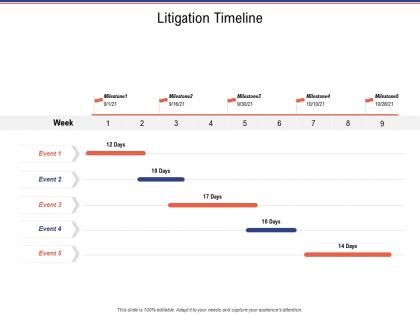
Litigation timeline business investigation




Try Before you Buy Download Free Sample Product
 Impress Your
 Audience
 100%
100% Editable
 Save Hours
 of Time


Our Litigation Timeline Business Investigation are topically designed to provide an attractive backdrop to any subject. Use them to look like a presentation pro.
People who downloaded this PowerPoint presentation also viewed the following :
Litigation timeline business investigation with all 2 slides:
Use our Litigation Timeline Business Investigation to effectively help you save your valuable time. They are readymade to fit into any presentation structure.

FAQs for Litigation
Key litigation phases include case initiation, discovery, pre-trial motions, trial preparation, trial proceedings, and post-trial activities. These phases streamline legal processes by establishing clear procedural frameworks, facilitating evidence gathering, and ensuring systematic case resolution, with many law firms finding that structured timelines enhance client communication and operational efficiency.
The pre-litigation stage significantly impacts timeline by determining case strength, gathering evidence, and exploring settlement opportunities before formal filing. Through thorough preparation, legal teams streamline subsequent proceedings, reduce discovery time, and often achieve faster resolutions, with many law firms finding that comprehensive pre-litigation work ultimately delivers cost savings and stronger negotiating positions.
Court rules and local procedures significantly influence litigation timelines by establishing mandatory deadlines for filings, discovery periods, motion practices, and trial scheduling requirements. These procedural frameworks vary considerably between jurisdictions, with some courts implementing fast-track systems for expedited resolution while others follow traditional schedules, ultimately determining whether cases resolve in months or extend across multiple years.
Common factors that cause litigation delays include discovery disputes, scheduling conflicts, motion practice, settlement negotiations, court calendar congestion, and witness availability issues. These challenges can extend cases significantly, with many law firms finding that proactive case management, early discovery planning, and strategic settlement discussions help streamline timelines while ultimately delivering more efficient client outcomes.
Effective case management streamlines litigation by establishing clear timelines, standardizing document workflows, and coordinating communication between all parties. Through digital case management systems, law firms automate scheduling, track discovery deadlines, and maintain centralized case files, while reducing administrative overhead and minimizing delays, ultimately delivering faster case resolution and improved client satisfaction.
Discovery serves as the foundation of litigation strategy, enabling parties to gather evidence, identify witnesses, assess case strength, and uncover opposing arguments through depositions, document requests, and interrogatories. This critical phase significantly influences settlement negotiations and trial preparation, with many legal teams finding that thorough discovery work ultimately determines case outcomes and strategic positioning.
The scheduling order establishes mandatory deadlines for discovery, expert witness disclosure, depositions, and motions, creating a structured framework that directly controls litigation duration and progression. This judicial roadmap enables legal teams to allocate resources strategically, coordinate case preparation efficiently, and anticipate key milestones, while ensuring all parties maintain momentum toward resolution, ultimately delivering predictable timelines and controlled litigation costs.
Filing deadlines significantly impact litigation strategy, case viability, and procedural compliance, determining whether claims can proceed, evidence remains admissible, and parties maintain their legal standing. Missing critical deadlines can result in case dismissal, sanctions, or waived rights, while strategic deadline management enables attorneys to control case pace, maximize preparation time, and leverage procedural advantages, ultimately delivering stronger legal positions.
Settlement discussions can significantly pause or extend litigation timelines, as courts often stay proceedings while parties negotiate, and discovery may be suspended during active talks. These negotiations typically occur at strategic points throughout the case, with many law firms finding that early settlement discussions streamline costs and reduce uncertainties, while late-stage negotiations can delay final resolution but ultimately deliver more informed agreements.
Litigation timeline tools include Clio, CaseFleet, TimeMap, LexisNexis CaseMap, and specialized project management platforms like Microsoft Project. These technologies streamline case organization by automating deadline tracking, visualizing complex chronologies, and centralizing document management, with many law firms finding that integrated timeline software reduces administrative overhead, enhances client communication, and ultimately delivers faster case resolution.
**INPUT**: How do appellate processes alter the initial litigation timeline? **OUTPUT**: Appellate processes significantly extend litigation timelines by adding 12-24 months or more, depending on court schedules, brief preparation requirements, and case complexity. Through mandatory waiting periods, extensive document preparation, and oral argument scheduling, organizations find that appeals can double their initial time projections, while potentially delivering favorable precedents that ultimately enhance their strategic legal positioning.
Civil cases typically span 1-3 years due to extensive discovery phases, while criminal cases move faster at 6-18 months under constitutional speedy trial requirements, and family law cases vary widely from months to years depending on custody complexities and asset divisions. These timeline differences reflect distinct procedural demands and legal priorities, with criminal matters prioritized for swift resolution, civil litigation allowing thorough evidence gathering, and family cases balancing emotional sensitivity with comprehensive financial analysis, ultimately requiring specialized case management strategies.
Best practices for documenting and monitoring litigation timelines include establishing centralized case management systems, implementing automated deadline tracking, maintaining detailed chronological records, conducting regular milestone reviews, and ensuring multi-stakeholder visibility across legal teams. These systematic approaches streamline case preparation by reducing missed deadlines, enhancing collaboration between attorneys and support staff, and ultimately delivering improved case outcomes while minimizing risks in increasingly complex legal environments.
Attorneys can anticipate timeline disruptions by conducting thorough case assessments, maintaining contingency schedules, establishing clear communication protocols with all parties, and monitoring court calendars regularly. Through proactive case management software and strategic resource allocation, law firms streamline workflow coordination, minimize scheduling conflicts, and enhance client communication, ultimately delivering more predictable legal services and competitive advantage.
Typical trial stages include jury selection, opening statements, plaintiff's case presentation, defendant's case presentation, closing arguments, and verdict delivery. These stages occur after extensive pre-trial phases like discovery and motions, with many complex cases finding that trials represent only 10-15% of the total litigation timeline, ultimately delivering resolution through structured advocacy and evidence presentation.
-
The content is very helpful from business point of view.
-
The content is very helpful from business point of view.
-
I discovered this website through a google search, the services matched my needs perfectly and the pricing was very reasonable. I was thrilled with the product and the customer service. I will definitely use their slides again for my presentations and recommend them to other colleagues.
-
Great product with effective design. Helped a lot in our corporate presentations. Easy to edit and stunning visuals.