

Logical Components Of Zero Trust Architecture Zero Trust Security Model




Try Before you Buy Download Free Sample Product
 Impress Your
Audience
 100%
Editable
 Save Hours
of Time


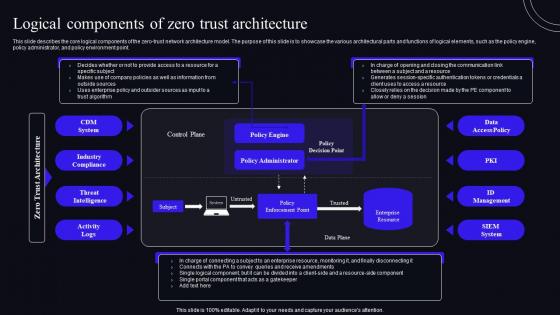
This slide describes the core logical components of the zero-trust network architecture model. The purpose of this slide is to showcase the various architectural parts and functions of logical elements, such as the policy engine, policy administrator, and policy environment point.
People who downloaded this PowerPoint presentation also viewed the following :
Logical Components Of Zero Trust Architecture Zero Trust Security Model with all 9 slides:
Use our Logical Components Of Zero Trust Architecture Zero Trust Security Model to effectively help you save your valuable time. They are readymade to fit into any presentation structure.









FAQs for Logical Components Of Zero Trust Architecture Zero
Zero Trust Architecture operates on principles including "never trust, always verify," least privilege access, micro-segmentation, continuous monitoring, and explicit verification of every user and device. These security frameworks enhance organizational protection by eliminating implicit trust, restricting access permissions, and creating granular network boundaries, with many financial institutions and healthcare organizations finding that continuous authentication significantly reduces breach risks while streamlining compliance requirements.
Zero Trust eliminates the traditional perimeter-based approach by requiring continuous verification of every user, device, and transaction, regardless of location. Unlike conventional models that trust internal network traffic, Zero Trust assumes breach scenarios, implementing granular access controls and real-time monitoring, ultimately delivering enhanced security posture and reduced attack surfaces for modern distributed organizations.
Identity verification serves as the foundational pillar of Zero Trust by continuously authenticating users, devices, and applications through multi-factor authentication, behavioral analytics, and risk-based assessments. This comprehensive verification enables organizations to minimize security breaches, streamline access management, and enhance operational efficiency, with many financial institutions and healthcare providers finding that robust identity controls ultimately deliver faster secure access and reduced compliance costs.
Organizations implement Zero Trust access controls through continuous identity verification, least-privilege principles, micro-segmentation, and real-time risk assessment across all network endpoints. These frameworks enhance security by authenticating every user and device, restricting access to essential resources only, and monitoring behavioral patterns, with many financial institutions and healthcare providers finding that such comprehensive controls significantly reduce breach risks while maintaining operational efficiency.
Common challenges include legacy system integration complexities, cultural resistance to stricter access controls, budget constraints for comprehensive infrastructure overhauls, skill gaps in specialized security technologies, and potential user experience disruptions. While these obstacles initially slow implementation, organizations increasingly find that phased approaches enable smoother transitions, ultimately delivering enhanced security posture and reduced breach risks across enterprise environments.
Zero Trust enhances data protection by implementing continuous verification, least-privilege access controls, network micro-segmentation, and real-time threat monitoring across all digital touchpoints. Through encrypted data flows and identity-based authentication, organizations in healthcare, financial services, and retail can minimize breach risks, prevent lateral threat movement, and maintain granular visibility, ultimately delivering stronger compliance posture and reduced security vulnerabilities.
Zero Trust Architecture addresses insider threats by eliminating implicit trust, continuously verifying user identities, and monitoring all network activity regardless of user location or credentials. Through behavioral analytics and least-privilege access controls, organizations can detect anomalous activities from employees or contractors, ultimately reducing data breaches and unauthorized access, with many financial institutions finding enhanced security posture.
Essential Zero Trust technologies include multi-factor authentication, endpoint detection and response, network segmentation, identity and access management, and behavioral analytics. These solutions enhance security by continuously verifying users, monitoring device health, and analyzing access patterns, with many organizations finding that strategic combinations deliver significantly reduced breach risks and streamlined compliance management.
Zero Trust principles in cloud environments are implemented through identity verification, micro-segmentation, encrypted communications, continuous monitoring, and least-privilege access controls. These approaches enable organizations to secure distributed workloads, validate every user and device interaction, and maintain granular visibility across multi-cloud infrastructures, ultimately delivering enhanced security posture and reduced breach risk.
Key metrics for Zero Trust success include mean time to detection, breach containment rates, privileged access compliance, identity verification speeds, and network segmentation effectiveness. These indicators help organizations track security posture improvements, operational efficiency gains, and user experience impacts, with many enterprises finding that reduced incident response times and enhanced visibility ultimately deliver stronger security outcomes and lower risk exposure.
Zero Trust integrates with existing security tools by leveraging current identity management systems, endpoint protection platforms, and network monitoring solutions as foundational components. Rather than replacing infrastructure entirely, it creates strategic layers that enhance authentication protocols, streamline access controls, and automate threat detection, with many organizations finding that this approach maximizes their current security investments while significantly improving overall protection.
Zero Trust enables secure remote work by continuously verifying user identities, device compliance, and access permissions regardless of location. This approach eliminates traditional network perimeters, with organizations like financial services and healthcare finding that employees can securely access resources from anywhere while maintaining strict security controls, ultimately delivering enhanced productivity and reduced cybersecurity risks.
Organizations balance user experience with Zero Trust security through adaptive authentication, single sign-on integration, and risk-based access controls that adjust requirements based on user behavior and context. By implementing seamless multi-factor authentication and automated policy enforcement, companies in banking, healthcare, and retail deliver robust security while maintaining intuitive user workflows, ultimately enhancing both protection and operational efficiency.
Zero Trust continuous monitoring best practices include real-time user behavior analytics, automated threat detection systems, comprehensive asset inventory management, network traffic analysis, and identity verification protocols. These technologies streamline security operations by providing instant visibility into potential threats, automating incident response workflows, and maintaining detailed audit trails, with many organizations finding that continuous monitoring ultimately delivers enhanced threat detection and regulatory compliance advantages.
Zero Trust Architecture enhances regulatory compliance by providing continuous verification, detailed access logging, granular data controls, and comprehensive audit trails that meet stringent oversight requirements. Financial institutions and healthcare organizations find that Zero Trust frameworks streamline compliance with regulations like GDPR, HIPAA, and SOX, while delivering enhanced security posture and reduced audit complexities.
-
Loved the templates on SlideTeam, I believe I have found the go to place for my presentation needs!
-
One-stop solution for all presentation needs. Great products with easy customization.