


Logistics Management Steps Delivery And Transportation Powerpoint Presentation Slides




Try Before you Buy Download Free Sample Product
 Impress Your
 Audience
 100%
100% Editable
 Save Hours
 of Time


Logistics Management PowerPoint presentation covers a logistics companys introduction with its designs, controls, and details on supply chain management. Grab our efficiently designed Logistics Management Steps Delivery And Transportation template. This PPT also includes logistics company operations during supply procurement, storage, transportation, order fulfillment, and distribution, depending on the commercial agreement between the parties involved. This presentation also covers the various reasons for poorly integrated shipping and logistics management in the company and identifies the need for an effective logistics management system. Furthermore, it includes an automated solution to overcome the gap between business and technology. Lastly, this PPT aims to provide details on cost-efficient, streamlined, and error-free solutions through automating the processes and using secured software to perform the different tasks. Customize this 100 percent editable template based on your specific business needs.
People who downloaded this PowerPoint presentation also viewed the following :
Content of this Powerpoint Presentation
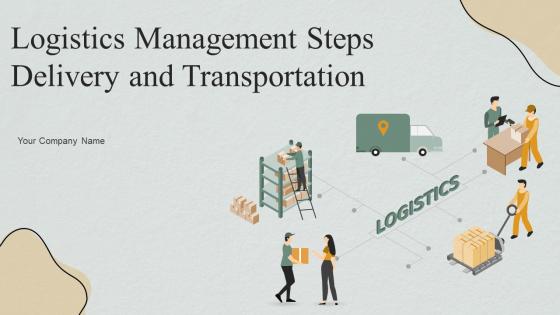
Slide 1: This slide introduces Logistics Management Steps Delivery and Transportation. State your company name and begin.
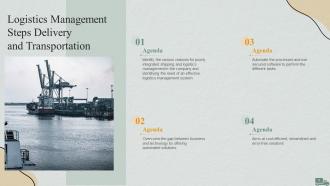
Slide 2: This slide states Agenda of the presentation.
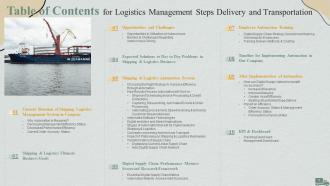
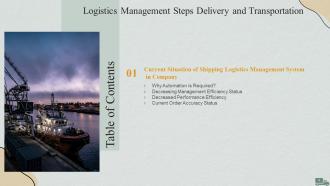
Slide 3: This slide shows Table of Content for the presentation.
Slide 4: This slide highlights title for topics that are to be covered next in the template.
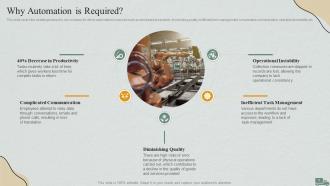
Slide 5: This slide covers the challenges faced by our company for which automation is required.
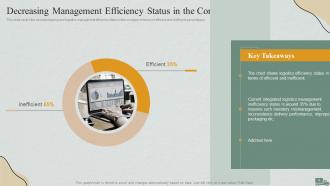
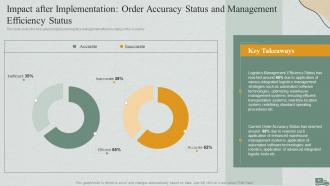
Slide 6: This slide covers the current shipping and logistics management efficiency status in the company in terms of efficient and inefficient percentages.
Slide 7: This slide covers the reasons why company wants to implement automation in business.
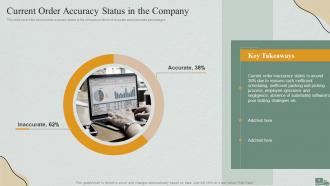
Slide 8: This slide covers the current order accuracy status in the company in terms of accurate and inaccurate percentages.
Slide 9: This slide exhibit table of content for other topics discussed in further slide.
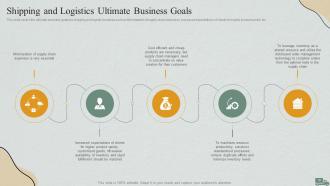
Slide 10: This slide covers the ultimate business goals for shipping and logistic business.
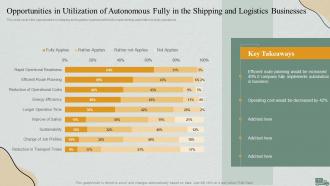
Slide 11: This slide covers the opportunities in the shipping and logistics business while fully implementing automation in daily operations.
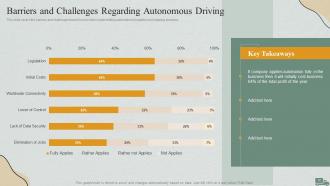
Slide 12: This slide covers the barriers and challenges that will occur while implementing automation in logistics and shipping business.
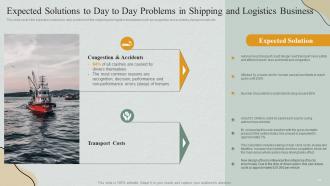
Slide 13: This slide covers the expected solutions to daily problems of the shipping and logistics businesses.
Slide 14: This slide exhibit table of content- Shipping and Logistics Automation System.
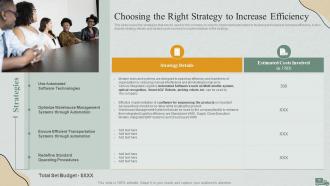
Slide 15: This slide covers the strategies that can be used by the company in order to implement automation in business processes to increase efficiency.
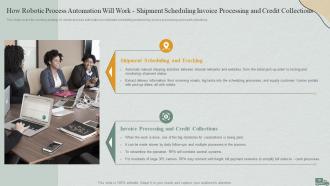
Slide 16: This slide covers the working strategy of robotic process automation in shipment scheduling and tracking, invoice processing and credit collections.
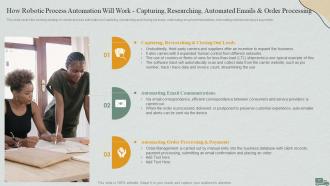
Slide 17: This slide covers the working strategy of robotic process automation in Capturing, researching and closing out loads etc.
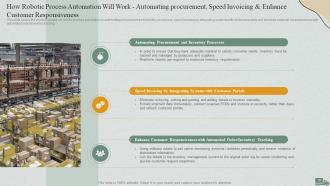
Slide 18: This slide covers the working strategy of robotic process automation in automating procurement and inventory processes.
Slide 19: This slide exhibit table of content- Shipping and Logistics Automation System.
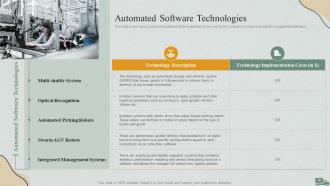
Slide 20: This slide covers various automated software technologies that can be used by the company to enhance its logistics management efficiency.
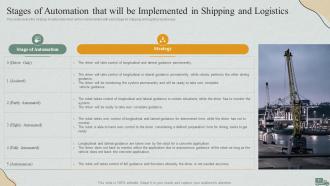
Slide 21: This slide covers the strategy of automation that will be implemented with each stage for shipping and logistics businesses.
Slide 22: This slide covers the strategy of automation that will be implemented with each stage for shipping and logistics businesses.
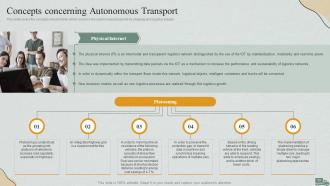
Slide 23: This slide covers the concepts of automation which concerns the autonomous transports for shipping and logistics industry.
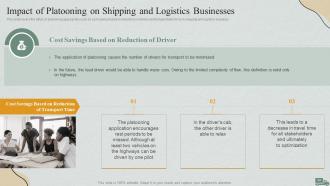
Slide 24: This slide covers the effect of platooning approaches.
Slide 25: This slide exhibit table of content- Transformation of Supply Chain.
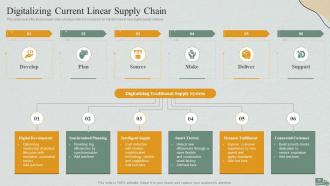
Slide 26: This slide covers the linear supply chain structure which is needed to be transformed In new digital supply network.
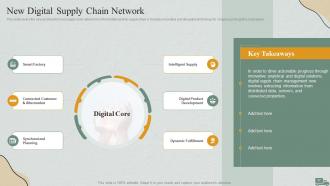
Slide 27: This slide covers the new and transformed supply chain network from the traditional liner supply chain.
Slide 28: This slide exhibit table of content for other topics discussed in further slide.
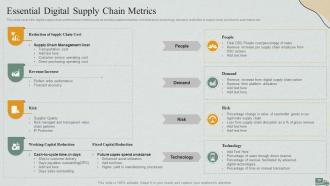
Slide 29: This slide covers the digital supply chain performance metrics.
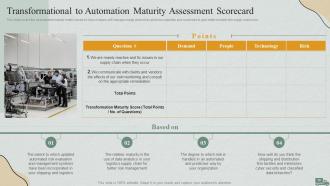
Slide 30: This slide covers the assessment maturity matrix based on how company will manage supply chain risks.
Slide 31: This slide exhibit table of content for other topics discussed in further slide.
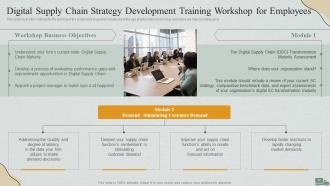
Slide 32: This slide covers the material for the training of the employees to get them understand the use of automation technology and how it will help business grow.
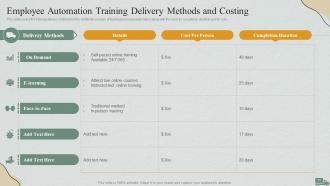
Slide 33: This slide covers the training delivery methods for the certificate courses of business process automation.
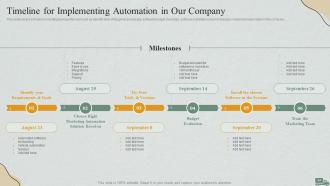
Slide 34: This slide covers a Timeline for Implementing Automation in Our Company.
Slide 35: This slide exhibit table of content- After Implementation of Automation.
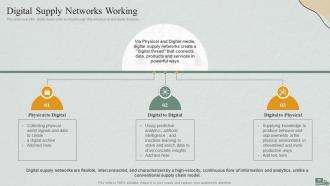
Slide 36: This slide covers the digital supply chain working through different physical and digital channels.
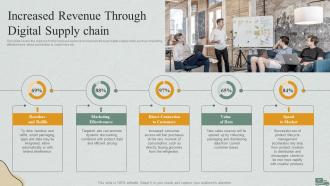
Slide 37: This slide covers the reasons for the increase revenue in business through digital supply chain.
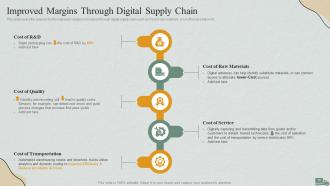
Slide 38: This slide covers the reasons for the improved margins in business through digital supply chain.
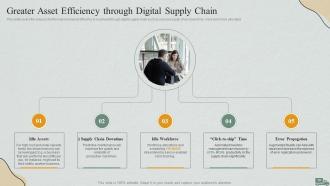
Slide 39: This slide covers the reasons for the improved asset efficiency in business through digital supply chain.
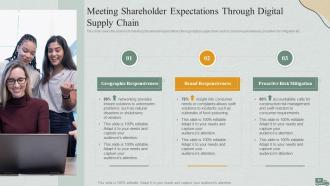
Slide 40: This slide covers the reasons for Meeting Shareholder Expectations through digital supply chain.
Slide 41: This slide exhibit table of content- Impact on Efficiency.
Slide 42: This slide covers the forecasted shipping and logistics management efficiency status in the company.
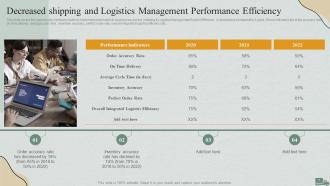
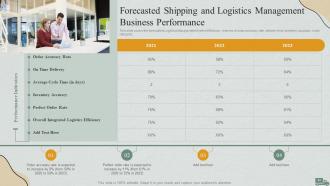
Slide 43: This slide covers the forecasted Logistics Management System Efficiency in terms of order accuracy rate, delivery time, inventory accuracy, order rating etc.
Slide 44: This slide exhibit table of content- KPI & Dashboard.
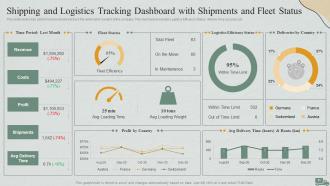
Slide 45: This slide covers Key performance indicators to track the automation system of the company.
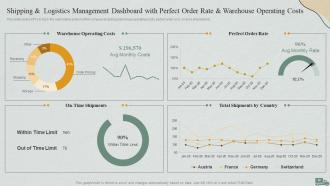
Slide 46: This slide covers KPI’s to track the automation system of the company including warehouse operating costs, perfect order cost, on-time shipment etc.
Slide 47: This slide contains all the icons used in this presentation.
Slide 48: This slide is titled as Additional Slides for moving forward.
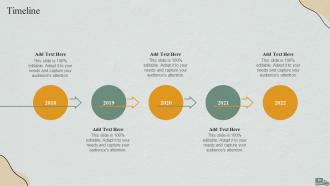
Slide 49: This is a Timeline slide. Show data related to time intervals here.
Slide 50: This is About Us slide to show company specifications etc.
Slide 51: This is Our Team slide with names and designation.
Slide 52: This slide showcases Magnifying Glass to highlight information, specifications etc
Slide 53: This slide shows Post It Notes. Post your important notes here.
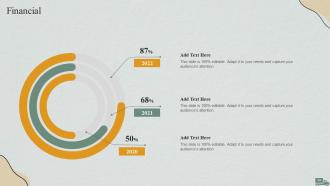
Slide 54: This is a Financial slide. Show your finance related stuff here.
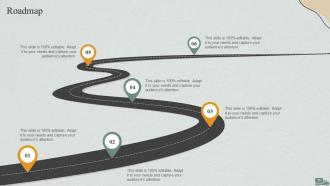
Slide 55: This slide presents Roadmap with additional textboxes.
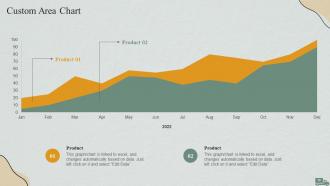
Slide 56: This slide depicts Area chart with two products comparison.
Slide 57: This is a Thank You slide with address, contact numbers and email address.
Logistics Management Steps Delivery And Transportation Powerpoint Presentation Slides with all 62 slides:
Use our Logistics Management Steps Delivery And Transportation Powerpoint Presentation Slides to effectively help you save your valuable time. They are readymade to fit into any presentation structure.











FAQs for Logistics Management Steps Delivery And Transportation
**INPUT**: What are the key components of an effective logistics management strategy? **OUTPUT**: Key components include strategic sourcing, inventory optimization, transportation management, warehouse operations, and demand forecasting technologies. These elements streamline supply chains by reducing costs, improving delivery times, and enhancing customer satisfaction, with many organizations finding that integrated logistics platforms ultimately deliver competitive advantage and operational efficiency. --- **Word count**: 52 words ✓
AI and IoT enhance logistics management by automating route optimization, enabling real-time shipment tracking, and predicting maintenance needs through sensor data analysis. These technologies streamline warehouse operations, reduce fuel costs, and minimize delivery delays, with companies like Amazon and FedEx finding that predictive analytics ultimately delivers faster customer service and significant operational efficiency gains.
Data analytics optimizes supply chain logistics by enabling predictive demand forecasting, real-time inventory management, route optimization, and performance monitoring across all operational touchpoints. Through advanced analytics platforms, logistics companies streamline warehouse operations, reduce transportation costs, and enhance delivery accuracy, with many finding that data-driven insights ultimately deliver significant competitive advantages and improved customer satisfaction.
Businesses can reduce logistics costs through strategic route optimization, warehouse automation, consolidated shipments, predictive analytics, and supplier partnerships. These approaches streamline operations by minimizing transportation expenses, reducing inventory carrying costs, and enhancing operational efficiency, while many organizations find that technology-driven logistics ultimately delivers faster delivery times and improved customer satisfaction alongside significant cost savings.
Best practices for inventory management in logistics include demand forecasting, ABC analysis, safety stock optimization, automated reordering systems, and real-time tracking technologies. These approaches streamline operations by reducing carrying costs, minimizing stockouts, and improving order fulfillment accuracy, with many retailers and manufacturers finding that strategic inventory positioning ultimately delivers faster customer service and enhanced competitive advantage.
Global trade regulations significantly impact logistics management through compliance requirements, documentation standards, customs procedures, and supply chain routing decisions. These regulations compel organizations to enhance tracking systems, automate documentation processes, and develop strategic partnerships with customs brokers, ultimately delivering greater transparency and operational efficiency while enabling businesses to navigate increasingly complex international markets with reduced delays and costs.
Logistics managers face inventory optimization, supply chain visibility, rising transportation costs, regulatory compliance, and technology integration challenges. These obstacles impact operational efficiency through delayed deliveries, increased expenses, and customer satisfaction issues, with many organizations finding that strategic automation and data analytics help streamline processes, ultimately delivering competitive advantage.
Sustainability in logistics management is increasingly critical for regulatory compliance, cost reduction, and competitive advantage, with companies implementing route optimization, alternative fuel vehicles, green packaging, and warehouse energy efficiency measures. These eco-friendly practices enable organizations to minimize environmental impact while reducing operational costs, with many retailers and manufacturers finding that sustainable logistics ultimately delivers improved brand reputation and long-term profitability.
Key logistics efficiency metrics include order fulfillment time, inventory turnover rates, transportation costs, delivery accuracy, warehouse productivity, and customer satisfaction scores. These measurements enable companies to streamline operations, reduce costs, and enhance service quality, with many retail and manufacturing organizations finding that tracking these indicators delivers significant competitive advantages and improved customer experiences.
Reverse logistics significantly enhances overall supply chain performance by reducing waste, recovering value from returned products, and improving customer satisfaction through efficient return processes. Through strategic reverse logistics programs, companies streamline operations, minimize disposal costs, and capture additional revenue streams from refurbishment and resale, ultimately delivering competitive advantage and stronger customer loyalty.
Emerging logistics trends include autonomous vehicles and drones, AI-powered predictive analytics, blockchain for supply chain transparency, sustainable green logistics, and IoT-enabled real-time tracking systems. These technologies streamline operations by reducing delivery times, minimizing costs, and enhancing visibility, with many companies finding that strategic adoption ultimately delivers competitive advantage in an increasingly complex global marketplace.
Companies improve last-mile delivery through route optimization software, real-time tracking systems, local distribution hubs, flexible delivery options, and automated sorting technologies. These solutions streamline operations by reducing delivery times, minimizing fuel costs, and enhancing customer satisfaction, with many retailers finding that strategic combinations of these approaches ultimately deliver competitive advantage and significantly lower operational expenses.
Vendor management ensures logistics operations run efficiently by establishing strategic partnerships, negotiating favorable contracts, maintaining quality standards, and minimizing supply chain disruptions. Through effective vendor relationships, organizations streamline procurement processes, reduce operational costs, and enhance delivery performance, with many companies finding that strong vendor partnerships ultimately deliver competitive advantages and improved customer satisfaction.
Customer expectations directly influence logistics management through demands for faster delivery, real-time tracking, flexible return policies, and personalized service options. These evolving requirements drive companies to optimize warehouse locations, invest in automation technologies, and develop omnichannel distribution strategies, with retailers and e-commerce platforms finding that meeting these expectations delivers competitive advantage and customer loyalty.
Outsourcing logistics functions delivers cost reduction, specialized expertise, scalability, advanced technology access, and enhanced operational flexibility. Third-party providers enable companies to focus on core competencies while leveraging established networks and infrastructure, with many manufacturers and retailers finding significantly improved delivery times, reduced overhead costs, and enhanced customer satisfaction through strategic partnerships.
-
“One of the best experiences with SlideTeam for my presentation.Everything on time, communication is efficient and price is reasonable. All good in one place.”
-
Loved the collection. Editing the presentation was seamless with their templates.