


Logistics Transport Company Profile Competitor Comparison By Operations And Revenue





Try Before you Buy Download Free Sample Product
 Impress Your
Audience
 100%
Editable
 Save Hours
of Time


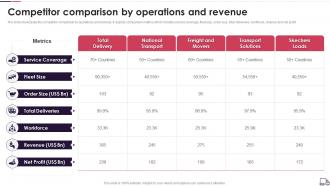
The slide showcases the competitor comparison by operations and revenue. It depicts comparison metrics which includes service coverage, fleet size, order size, total deliveries, workforce, revenue and net profit.
People who downloaded this PowerPoint presentation also viewed the following :
Logistics Transport Company Profile Competitor Comparison By Operations And Revenue with all 6 slides:
Use our Logistics Transport Company Profile Competitor Comparison By Operations And Revenue to effectively help you save your valuable time. They are readymade to fit into any presentation structure.





FAQs for Logistics Transport Company Profile Competitor Comparison By
Key logistics competitor analysis KPIs include delivery speed, cost efficiency, service reliability, geographic coverage, customer satisfaction scores, and technology adoption rates. These metrics enable companies to benchmark operational performance, identify market gaps, and optimize resource allocation, with many logistics providers finding that tracking competitor pricing strategies, capacity utilization, and digital transformation initiatives ultimately delivers significant competitive advantages.
AI and blockchain revolutionize logistics competitive strategies by enabling predictive analytics for demand forecasting, automating supply chain decisions, and creating transparent tracking systems that enhance customer trust. Companies leveraging these technologies gain significant advantages through reduced operational costs, faster delivery times, and improved visibility, with many logistics providers finding that early adoption delivers measurable competitive differentiation in an increasingly technology-driven marketplace.
Logistics companies commonly use strategic partnerships with local providers, technology integration for operational advantages, niche specialization in specific sectors, aggressive pricing models, and geographic expansion into underserved markets. These approaches enable firms to streamline operations, reduce costs, and enhance customer experiences while minimizing direct competition, with many companies finding that combining multiple strategies delivers sustained competitive advantage.
Customer feedback can be integrated through social media monitoring, review platform analysis, customer surveys, and direct testimonials to identify competitor strengths and service gaps. By analyzing feedback patterns across logistics providers, companies can benchmark delivery times, customer service quality, and pricing satisfaction, while identifying unmet market needs that present opportunities for differentiation and competitive advantage.
Geographical location significantly influences logistics competitive dynamics through access to transportation hubs, proximity to major markets, labor availability, regulatory environments, and infrastructure quality. Companies strategically positioned near ports, airports, or distribution centers often deliver faster services and lower costs, with many logistics providers finding that location advantages ultimately determine market share and operational efficiency in increasingly competitive supply chains.
Leading logistics competitors differentiate through value-based pricing, dynamic rate adjustments, service bundling, technology-enabled cost transparency, and specialized solution premiums rather than competing solely on base rates. In saturated markets, companies like FedEx and UPS leverage premium positioning for expedited services, while regional players focus on competitive local delivery rates, ultimately delivering differentiated value propositions that justify pricing structures.
Logistics competitors typically excel in specialized areas like regional coverage, technology integration, or cost efficiency, while facing challenges in scalability, service consistency, or resource allocation. Through comprehensive competitor analysis, companies can identify market gaps in delivery speed, customer communication, and service reliability, with many logistics firms finding that strategic positioning against competitors' weaknesses delivers significant competitive advantage.
Companies can assess operational efficiency against competitors through benchmarking key performance indicators like delivery times, cost per shipment, warehouse utilization rates, and customer satisfaction scores. By analyzing publicly available data, industry reports, and conducting market research, logistics companies can identify performance gaps and improvement opportunities, ultimately enabling strategic investments in technology and processes that deliver competitive advantages and enhanced customer experiences.
Leading logistics firms are adopting electric vehicle fleets, carbon-neutral shipping options, warehouse solar installations, sustainable packaging materials, and route optimization technologies. These practices streamline operations by reducing fuel costs, minimizing waste, and enhancing brand reputation, with companies like DHL and FedEx finding that sustainability initiatives ultimately deliver competitive advantage while meeting increasingly environmentally-conscious customer expectations.
Logistics companies monitor competitors' social media for pricing strategies, service announcements, customer feedback patterns, and market positioning shifts, while tracking engagement metrics and sentiment analysis. Through platforms like LinkedIn and Twitter, companies identify competitive gaps, benchmark service quality against customer complaints, and adjust their messaging strategies, ultimately enabling faster market responses and stronger competitive positioning in increasingly crowded logistics markets.
Regulatory compliance significantly reshapes logistics competition by creating barriers for smaller players while enabling compliant companies to access premium markets, international routes, and enterprise contracts. Organizations with robust compliance frameworks, particularly in pharmaceuticals and hazardous materials transport, gain competitive advantages through reduced liability, faster customs clearance, and enhanced customer trust, ultimately commanding higher margins.
Data analytics enhances logistics competitor analysis by processing vast datasets on pricing strategies, delivery performance, route optimization, and market share trends, enabling comprehensive competitive intelligence. Through predictive modeling and real-time monitoring, logistics companies can identify competitor weaknesses, anticipate market shifts, and optimize their own operations, ultimately delivering strategic advantages and improved service positioning.
Tracking logistical innovation among competitors involves monitoring technology adoption, supply chain partnerships, automation investments, delivery method changes, and sustainability initiatives. Through competitor websites, industry reports, and supply chain publications, organizations can identify emerging trends like drone delivery, AI-powered routing, and warehouse automation, ultimately enabling strategic positioning and competitive advantage.
Partnerships and alliances reshape logistics competition by enabling expanded service networks, shared infrastructure costs, and enhanced technological capabilities that individual companies couldn't achieve alone. Through strategic collaborations, logistics firms access new markets, streamline cross-border operations, and deliver comprehensive end-to-end solutions, with many finding that alliances ultimately enhance competitive positioning while reducing operational risks.
Reverse logistics creates competitive advantage through enhanced customer satisfaction, cost reduction via material recovery, and differentiated service offerings that streamline returns processing. Logistics providers leveraging advanced reverse logistics capabilities often capture additional revenue streams from refurbishment and resale operations, while delivering faster return processing and improved customer experiences, ultimately positioning themselves as comprehensive supply chain partners in an increasingly sustainability-focused market.
-
What a stunning collection of customizable templates! Really a time-saver..
-
I downloaded some of the presentations for work. They were simple to modify and saved me a lot of time and effort.