

Luggage Handling By Front Office In Hotel Training Ppt




Try Before you Buy Download Free Sample Product
 Impress Your
 Audience
 100%
100% Editable
 Save Hours
 of Time


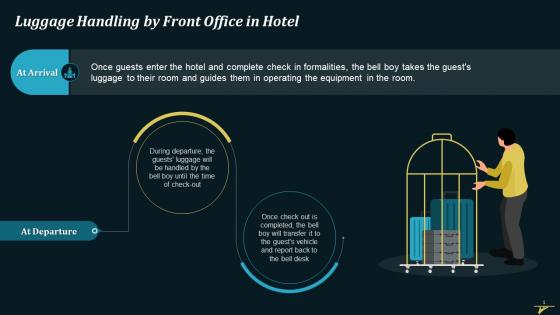
This slide highlights the luggage handling by front office in the hotel at the time of arrival and during departure by bell boy in the hotel.
People who downloaded this PowerPoint presentation also viewed the following :
Luggage Handling By Front Office In Hotel Training Ppt with all 19 slides:
Use our Luggage Handling By Front Office In Hotel Training Ppt to effectively help you save your valuable time. They are readymade to fit into any presentation structure.










FAQs for Luggage Handling By Front Office In
Peak times are brutal - you get these massive volume spikes that jam everything up. Conveyor systems break down constantly, plus they're honestly too old for how many passengers we get now. Bags get misrouted all the time too. Staff shortages don't help since someone has to manually sort the problem bags and oversized stuff. Weather delays make it ten times worse because flights get backed up but bags keep flowing in anyway. Most problems happen when passenger flow doesn't match what the system can actually handle. Having backup processes helps, but it's still a mess half the time.
Oh man, airports are so much smoother now with all the tech stuff. Those crazy conveyor systems? They're basically run by AI that scans your bag tags and figures out where everything goes. RFID chips let you actually track your luggage on apps - honestly such a game changer because who hasn't stressed about lost bags? The algorithms predict busy times and route things better, plus robotic arms do the heavy lifting instead of workers throwing out their backs. Definitely download your airline's tracking app before you fly, it's weirdly satisfying to watch your bag's journey.
So basically, airlines run the whole luggage show from when you drop it off until you pick it up. They've got these sorting systems and scanners that track your bag everywhere it goes. Ground crews at different airports all work with the airline to move your stuff around - though honestly, sometimes it feels like they're just winging it lol. The airline owns the whole process, so when your bag inevitably goes missing (because let's be real, it happens), you gotta file the claim with them, not the airport. They're the ones responsible for tracking it down and getting it back to you.
Dude, real-time luggage tracking is huge for cutting down passenger stress. Instead of standing at baggage claim having a mild panic attack wondering if your suitcase made it through that tight connection in Atlanta, people actually know where their stuff is. Push notifications keep them updated from check-in all the way to pickup. Honestly transforms the whole experience - passengers go from anxiously waiting around to being in the loop. Even basic SMS alerts work wonders. Just "your bag's loaded" and "heading to carousel 3" makes people way happier.
So your bag gets a barcode when you check it in, and they scan it at every step. Loading, transfers, arrival - the whole thing. RFID tracking is pretty standard now too, which honestly works way better than just barcodes. The system flags it right away if something goes wrong, like a missed connection or whatever. Then staff can reroute it to meet you at your destination. Oh, and definitely keep your claim ticket! I always take a photo of my bag before handing it over - saved me once when mine went missing in Denver.
Basically, international flights mean your bags get way more screening - customs, agriculture checks, all that stuff. Domestic is just regular TSA and straight to your destination. Super simple. For international though? Your luggage goes through extra security for banned items, customs forms, the works. Oh and don't get me started on the liquid restrictions in international terminals - it's honestly kind of a pain. You'll definitely want to pack extra time for connections and maybe Google what you can't bring. Trust me on this one, I learned the hard way with some fancy cheese once.
Honestly, RFID tags are probably your best bet right now - they let you track bags in real-time so no more hunting around blind. Automated sorting systems are huge too, way faster than manual scanning. I've heard some places are testing robotic carts and AI routing that supposedly cuts loading time by 30% (sounds almost too good to be true but whatever). Smart conveyor belts automatically sort by destination which is clutch. If I were you I'd push hard for RFID first since it kills most of the guesswork that slows everything down.
Your bag gets screened the whole way through once you drop it off. X-ray machines scan everything first, then there's explosive detection stuff, and TSA agents will manually check bags if needed. The conveyor belts have checkpoints built right in - if something looks sketchy, your bag automatically gets pulled aside for extra screening. I think it's actually pretty cool how smooth the whole system runs. The security checks are woven into the normal process, so things don't really get backed up unless they find something that actually needs investigating.
Ugh, weather absolutely destroys baggage handling - like 20-40% slower when it's nasty out. Your crews can't move as fast in rain and snow because it's slippery and dangerous. Ice is honestly brutal since all the ramp equipment slides around. Once winds hit 35mph, they basically have to ground the baggage carts or they'll tip over (learned that one the hard way). Flight delays pile on top of everything too. Bags just start stacking up everywhere and the sorting systems can't keep up. I always tell people to build in extra turnaround time when storms are coming and have some indoor backup space ready.
Yeah, most airports bring in extra staff and extend baggage hours during busy times. They'll usually hire temp workers and open more carousels. Some places are way better at this than others though - like, I've noticed the bigger hubs tend to have their act together more. They'll run longer shifts for sorting crews and throw extra customer service people at the problem when bags inevitably get delayed or lost. The fancier airports even use some kind of predictive system to spot problems before they blow up. Honestly, just check your airport's website before you go - they usually post current baggage policies and wait times.
Hey! So you'll need safety training first - hazmat recognition, lifting techniques, all that stuff. Equipment certification too for the conveyor belts and baggage carts. Security clearance training since you're in restricted areas. Honestly? The lifting part is crucial. I cannot stress this enough - your back will hate you if you don't learn proper form. My buddy Jake learned that the hard way. Annual refresher courses keep your certs valid. Can't touch any luggage until you're fully certified though. Check with your supervisor about the next training dates - they usually run them pretty regularly.
Definitely check in online first - it's a game changer. Print your boarding pass at home too, then you can skip the regular line and go straight to bag drop. Oh, and weigh your bags beforehand if you've got a scale. Trust me, nobody wants to be that person repacking at the counter while everyone watches. Remove old luggage tags from previous trips and have your ID ready. I always throw liquids in my checked bag when I can since security takes forever otherwise. Honestly the online check-in thing alone probably saves you like 30 minutes.
Look, baggage handling is honestly kind of a mess with all the different rules. IATA Resolution 753 covers the tracking stuff, then you've got ISO standards like 17712 for security seals. Most airlines just mix international standards with whatever local regs they have to follow. I'd start with IATA's baggage manuals - they're pretty comprehensive and cover loading, damage prevention, all that. Each carrier does their own thing though, so you'll need to check what applies to your specific routes. It's way more complicated than it should be, but those IATA docs are your best bet.
So basically airlines are finally ditching those awful diesel tugs for electric ones - took long enough! They're also using automated baggage systems which cuts down on all those fuel-burning trips between terminals. Route optimization software is getting way better too. Solar-powered conveyor belts are popping up at more airports, plus smart sorting tech that doesn't require as much transport. The cool thing is automated systems mean fewer vehicles overall. Oh and definitely ask vendors about their sustainability stuff and electric options when you're shopping around.
Use your legs when lifting - seriously learned that lesson the hard way last month when I messed up my back! Conveyor belts are your friend, use them whenever you can. Stack stuff by putting heavy bags on bottom, lighter ones up top. Keep those fragile stickers where people can actually see them. Oh and talk to your teammates about any busted bags you notice coming through - saves everyone headaches later. I know it's tempting to rush but honestly? Taking that extra second to handle each bag right makes a huge difference for your body and keeps passengers happy.
-
“Excellent service from the customer support team when I wanted a slide that was a bit different from those on their standard menu. Super helpful.”
-
Editable, diversified, compatible with MS PPT and Google Slides, and on top of that finest graphics!! I mean in the words of the famous Ross Geller, “What more do you want!”