

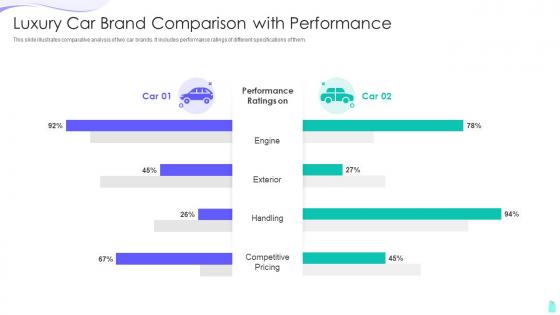
Luxury Car Brand Comparison With Performance




Try Before you Buy Download Free Sample Product
 Impress Your
 Audience
 100%
100% Editable
 Save Hours
 of Time


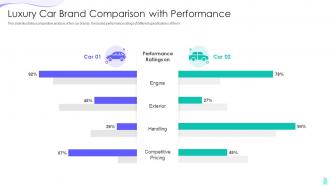
This slide illustrates comparative analysis of two car brands. It includes performance ratings of different specifications of them
People who downloaded this PowerPoint presentation also viewed the following :
Luxury Car Brand Comparison With Performance with all 7 slides:
Use our Luxury Car Brand Comparison With Performance to effectively help you save your valuable time. They are readymade to fit into any presentation structure.





FAQs for Luxury Car Brand
Luxury cars distinguish themselves through superior acceleration capabilities, advanced suspension systems, precision-engineered transmissions, high-performance braking technology, and enhanced noise reduction features. These performance elements work together by delivering smoother rides, faster response times, and refined driving experiences, with many premium manufacturers finding that these metrics ultimately justify higher price points while attracting discerning customers.
Horsepower significantly enhances luxury car driving experiences by delivering rapid acceleration, effortless highway merging, and responsive power delivery when needed. High-performance luxury vehicles like BMW M-series or Mercedes-AMG models combine substantial horsepower with refined engineering, ultimately providing drivers with confidence, driving pleasure, and commanding road presence while maintaining the sophisticated comfort expected from premium automobiles.
Flagship luxury models vary significantly in acceleration, with Tesla Model S Plaid leading at 1.99 seconds 0-60mph, followed by Porsche Taycan Turbo S at 2.6 seconds, McLaren 720S at 2.8 seconds, and traditional luxury brands like Mercedes S-Class AMG and BMW M8 achieving 3.0-3.4 seconds. These performance differences reflect each manufacturer's engineering philosophy and target market positioning, ultimately delivering distinct driving experiences for discerning customers.
Weight significantly impacts luxury car performance through acceleration, handling, braking efficiency, and fuel economy, with lighter vehicles delivering quicker responses and enhanced agility. Leading brands like BMW, Mercedes-Benz, and Audi optimize this through carbon fiber construction, aluminum chassis, and strategic material placement, ultimately delivering superior performance while maintaining the premium comfort and safety features that define luxury automotive experiences.
Tire specifications significantly impact luxury vehicle performance through width, sidewall height, compound composition, and tread design, directly affecting grip, steering response, and ride comfort. These elements enhance cornering precision, braking distances, and acceleration capabilities, with luxury manufacturers like BMW, Mercedes, and Audi increasingly partnering with premium tire brands to deliver optimized handling dynamics and superior driving experiences.
Luxury cars employ adaptive suspension systems, turbo/supercharged engines, all-wheel drive systems, active aerodynamics, and advanced traction control to enhance performance and driving dynamics. These technologies work together by optimizing power delivery, improving handling precision, and adapting to road conditions in real-time, with manufacturers like BMW, Mercedes, and Audi delivering superior acceleration, cornering stability, and ultimately more engaging driving experiences.
Driving mode selection significantly transforms luxury car performance by adjusting engine response, suspension settings, transmission behavior, and steering characteristics to match specific conditions. Through adaptive systems, drivers can optimize fuel efficiency for city commuting, enhance comfort for highway cruising, or maximize power for spirited driving, with many luxury manufacturers finding that these customizable modes deliver both versatility and competitive advantage.
Luxury car manufacturers differ significantly in braking performance through advanced materials, system designs, and technological integration. BMW emphasizes carbon-ceramic composites and precision engineering, Mercedes-Benz focuses on electronic brake distribution systems, while Porsche delivers track-tested stopping power with adaptive technologies, ultimately enabling drivers to experience enhanced safety, superior control, and competitive performance advantages across varying driving conditions.
AWD enhances traction, stability, and acceleration across varied conditions through power distribution to all wheels, while RWD delivers superior handling dynamics, weight balance, and driving engagement preferred by performance enthusiasts. Luxury brands like Audi and BMW increasingly offer both configurations, with AWD systems excelling in adverse weather and RWD providing optimal cornering precision for spirited driving experiences.
Luxury electric vehicles deliver instant torque and acceleration that often surpasses gasoline counterparts, with models like Tesla Model S and Porsche Taycan achieving 0-60 mph times under three seconds. While traditional luxury vehicles offer engine sound and longer range, electric models provide silent operation, lower maintenance costs, and increasingly sophisticated battery technology, ultimately delivering comparable or superior performance with enhanced efficiency and environmental benefits.
Aerodynamics significantly enhances luxury car performance by reducing drag coefficients, optimizing airflow management, and improving downforce distribution at high speeds. Through advanced wind tunnel testing and computational fluid dynamics, manufacturers like Mercedes, BMW, and Audi achieve better fuel efficiency, enhanced stability, and superior handling characteristics, ultimately delivering competitive advantages in both performance metrics and driving refinement.
Hybrid luxury cars deliver enhanced fuel efficiency, instant electric torque for smoother acceleration, reduced emissions, quieter operation, and extended driving range through combined powertrains. These technologies enable manufacturers like BMW, Mercedes, and Lexus to offer superior performance while minimizing environmental impact, with many luxury buyers finding that hybrid systems ultimately provide both sustainability and competitive acceleration advantages.
Engine displacement and configuration significantly influence luxury vehicle performance by determining power output, torque delivery, fuel efficiency, and overall driving dynamics. Larger displacement engines, particularly V8 and V12 configurations found in brands like Mercedes-AMG and BMW M-Series, deliver exceptional horsepower and smooth acceleration, while smaller turbocharged configurations enhance fuel economy without sacrificing responsiveness, ultimately providing manufacturers with strategic options to meet diverse performance expectations.
Advanced suspension technologies in luxury cars significantly influence both comfort and performance through adaptive damping systems, air suspension, active anti-roll bars, and magnetorheological dampers. These systems enhance ride quality by automatically adjusting to road conditions and driving modes, while delivering superior handling precision and reduced body roll, with many luxury manufacturers finding that strategic suspension integration ultimately provides competitive advantage in an increasingly sophisticated automotive market.
Luxury car performance metrics vary significantly between regions due to regulatory standards, fuel quality, climate conditions, and infrastructure differences. European models often prioritize efficiency and emissions compliance, while American variants emphasize power output, and Asian markets balance technology integration with local driving conditions, ultimately delivering region-specific optimizations that enhance customer satisfaction and competitive positioning.
-
The PPTs are extremely simple to modify. Thank you for providing the slides that are ready to be used. They assist me in saving a lot of time.
-
Editable templates with innovative design and color combination.