

M And A Strategy Process With Planning And Execution




Try Before you Buy Download Free Sample Product
 Impress Your
 Audience
 100%
100% Editable
 Save Hours
 of Time


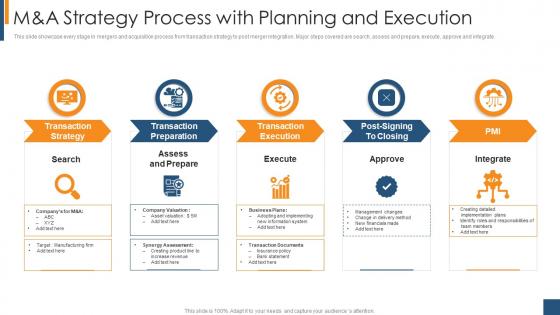
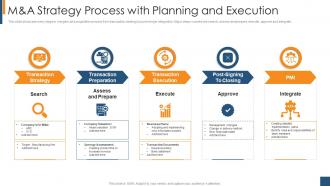
This slide showcase every stage in mergers and acquisition process from transaction strategy to post merger integration. Major steps covered are search, assess and prepare, execute, approve and integrate.
People who downloaded this PowerPoint presentation also viewed the following :
M And A Strategy Process With Planning And Execution with all 6 slides:
Use our M And A Strategy Process With Planning And Execution to effectively help you save your valuable time. They are readymade to fit into any presentation structure.





FAQs for M And A Strategy Process With
Key components of a successful M&A strategy include clear strategic rationale, thorough due diligence, cultural integration planning, robust valuation methods, and comprehensive post-merger integration frameworks. These elements work together by aligning business objectives, minimizing risks, and ensuring seamless operational consolidation, with many organizations finding that strategic M&A delivers accelerated growth and enhanced competitive positioning.
Cultural differences significantly impact M&A integration through communication barriers, conflicting management styles, employee resistance, and misaligned values that can derail synergy realization. Organizations increasingly address these challenges through comprehensive cultural assessments, cross-functional integration teams, and structured change management programs, with successful companies finding that proactive cultural integration delivers higher retention rates and faster value creation.
Companies should track financial metrics like revenue synergies, cost savings, EBITDA improvements, and return on investment, alongside operational indicators such as customer retention, employee satisfaction, and market share growth. These comprehensive measurements enable organizations to assess integration effectiveness across departments, identify areas requiring strategic adjustment, and ultimately demonstrate whether the acquisition delivers competitive advantage and long-term value creation.
Due diligence can be streamlined through digital data rooms, AI-powered document analysis, automated compliance checks, and standardized evaluation frameworks. These technologies enhance M&A efficiency by accelerating document review, minimizing manual processes, and enabling real-time collaboration, with investment banks and private equity firms finding that streamlined due diligence reduces transaction timelines significantly while improving accuracy.
Technology revolutionizes modern M&A strategies through advanced data analytics, AI-powered due diligence platforms, cloud-based integration tools, and automated valuation models. These technologies streamline deal sourcing, enhance risk assessment accuracy, and accelerate post-merger integration processes, with investment banks and private equity firms finding that digital tools reduce transaction timelines while improving strategic decision-making outcomes.
Companies leverage M&A for market entry by acquiring local expertise, established customer bases, distribution networks, regulatory knowledge, and brand recognition. Through strategic acquisitions, organizations bypass lengthy market development timelines, gain immediate competitive positioning, and access proven operational infrastructure, with many finding that acquiring established players delivers faster market penetration than organic expansion efforts.
Common M&A negotiation pitfalls include inadequate due diligence, overvaluing synergies, cultural misalignment assessment, rushed timelines, and insufficient legal structure planning. These challenges often arise when organizations focus heavily on financial metrics while underestimating integration complexities, with many companies finding that thorough preparation and realistic expectation-setting ultimately deliver smoother transactions and sustainable post-merger success.
Firms assess long-term acquisition value through comprehensive due diligence, financial modeling, market analysis, strategic fit evaluation, and cultural compatibility assessment. These methodologies enable organizations to evaluate synergy potential, revenue growth opportunities, and integration costs, with many companies in sectors like technology and healthcare finding that thorough valuation processes ultimately deliver stronger returns and competitive advantage.
Effective post-merger integration strategies include cultural alignment initiatives, streamlined communication protocols, unified technology systems, consolidated operational processes, and strategic talent retention programs. These approaches enhance organizational cohesion by minimizing disruption, accelerating synergy realization, and preserving institutional knowledge, with many organizations finding that early stakeholder engagement ultimately delivers faster integration timelines and improved employee retention rates.
Companies should approach M&A financing through strategic debt-equity combinations, cash reserves, stock exchanges, and external funding sources like private equity or investment banks. The optimal financing mix depends on deal size, market conditions, and strategic objectives, with many organizations finding that diversified financing structures minimize risk while preserving flexibility for future growth opportunities.
Regulatory considerations significantly influence M&A strategy by determining deal structure, timeline, and feasibility through antitrust reviews, foreign investment approvals, and sector-specific compliance requirements. These frameworks require strategic planning around regulatory timelines, potential divestitures, and approval conditions, with many organizations finding that early regulatory assessment streamlines execution and enhances deal success rates.
Companies ensure alignment of goals between merging entities through comprehensive due diligence, cultural assessment workshops, joint strategic planning sessions, and integrated governance structures. These approaches enable organizations to identify potential conflicts early, establish unified objectives, and create shared performance metrics, with many successful mergers finding that consistent communication and phased integration ultimately deliver sustainable synergies and competitive advantage.
Effective M&A communication practices include establishing transparent stakeholder updates, creating dedicated communication channels, maintaining consistent messaging across all levels, implementing regular progress briefings, and developing clear escalation protocols. These approaches streamline information flow by reducing uncertainty, enhancing stakeholder confidence, and minimizing operational disruptions, with many organizations finding that structured communication frameworks ultimately deliver smoother integrations and stronger employee retention throughout the transition process.
Brand management plays a crucial role in M&A strategies by influencing valuation assessments, integration planning, and post-merger market positioning. Companies must evaluate brand equity, customer loyalty, and market perception during due diligence, while developing comprehensive strategies for brand portfolio optimization, ultimately determining whether to maintain separate identities or pursue unified branding approaches.
Recent high-profile M&A outcomes reveal that successful deals prioritize cultural integration, clear strategic alignment, robust due diligence, and realistic synergy targets. While failures like AOL-Time Warner highlight the risks of overvaluation and poor cultural fit, successes such as Disney-Pixar and Microsoft-LinkedIn demonstrate how strategic combinations can enhance market position, streamline operations, and ultimately deliver sustained competitive advantage.
-
The templates you provide are great! They have saved me tons of time and made my presentations come alive. Thank you for this awesome product. Keep up the good work!
-
Professional and unique presentations.