

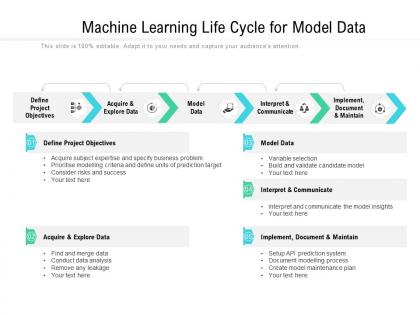
Machine learning life cycle for model data




Try Before you Buy Download Free Sample Product
 Impress Your
 Audience
 100%
100% Editable
 Save Hours
 of Time


Keep up the good work. Thousands of Machine Learning Life Cycle For Model Data means that each presentation you give can look fresh and engaging.
People who downloaded this PowerPoint presentation also viewed the following :
Machine learning life cycle for model data with all 2 slides:
Kick off your next project with illuminating design. Our digital artists have developed a collection of Machine Learning Life Cycle For Model Data for every business need.
FAQs for Machine learning life cycle
So there are basically six stages in the ML lifecycle - problem definition, data collection/prep, model development, training/validation, deployment, and monitoring. First thing's first: figure out exactly what you're trying to solve. Then comes data gathering and cleaning (which honestly will eat up like 70% of your time, no joke). After that you'll build your model, train it, test how well it works, push it live, and keep an eye on performance. Oh, and don't skip over that first step too quickly. Spending real time on problem definition will save you so much pain down the road - trust me on this one.
Honestly, data quality is everything in ML - like, it literally decides if your project succeeds or crashes and burns. You know that saying "garbage in, garbage out"? That's your reality here. I've watched teams waste months perfecting algorithms while their data was completely screwed from day one. Biased or messy data means your model learns all those problems and makes them worse in production. Clean your data first, validate it, make sure it actually looks like what you'll get in the real world. Don't get excited about fancy models until this part's solid.
Dude, EDA is like being a detective before you build anything. You're hunting for data quality problems, weird patterns, outliers - all that fun stuff. I used to skip straight to modeling (terrible mistake btw). Missing values and wonky distributions will absolutely wreck your models later. Start with basic stats and simple plots first. Then go deeper once you see what's actually in your data. It'll save you so much frustration down the road, trust me. Plus you might find features you didn't even know were useful.
Honestly, I usually just throw a few different algorithms at the wall and see what sticks! First figure out what type of problem you're dealing with - classification, regression, whatever. Small datasets? Stick with simple stuff like logistic regression or decision trees. Got tons of data? That's when deep learning becomes worth it. Your computer specs matter too since some algorithms will absolutely destroy your RAM. Oh, and if you need to explain your results to someone else, interpretability becomes huge. Start with basic models as your baseline, then get fancy if you need better performance. Data quality obviously makes or breaks everything.
Honestly, it's all about what problem you're solving. Classification? Go with accuracy, precision, recall, F1-score. Just watch out for accuracy with imbalanced data - super misleading. Regression needs MAE, MSE, RMSE, R-squared. Here's the thing though: business metrics matter just as much. I've seen models with "worse" performance actually crush it in the real world. Pick 2-3 metrics that actually match your definition of success and stick with them. Don't overthink it - you can always adjust later if something feels off during development.
So you'll want to check your data from different angles before jumping into training. Look at demographic breakdowns first - are all the groups you care about actually represented? Missing subgroups or wonky samples can totally mess things up later. I've watched so many projects crash because people thought their data looked fine on the surface. Run some statistical tests to catch weird correlation patterns that might hide bias. Oh, and definitely get domain experts plus people from different backgrounds to eyeball your dataset - they'll catch stuff you completely missed. Document it all so you can trace back any problems.
Start with correlation matrices - they're dead simple and show you which features actually matter. Recursive feature elimination and mutual information work great too if you want to get fancier. The real fun starts with feature engineering though. Try polynomial combinations, bin your continuous vars, or pull day-of-week from timestamps. Honestly, domain knowledge beats any algorithm here - knowing your problem helps you create features that actually make sense. Scikit-learn handles most of this stuff pretty easily. Just start basic and keep tweaking based on what your model's telling you.
So overfitting? Try dropout layers or L1/L2 regularization - basically anything that keeps your model from memorizing the training data. Cross-validation catches this stuff early, which is honestly a lifesaver. Underfitting's the opposite problem. Make your model more complex, throw in extra features, dial back any regularization you've got. I always build simple first, then bump up complexity until validation performance stops improving. Oh, and watch both training and validation loss like a hawk. Training loss drops while validation climbs? You've gone too far and need to scale back.
Deployment is honestly where the magic happens - that's when your model stops being a fancy experiment and actually helps real people. I learned this the hard way after building models that never left my laptop lol. You're basically setting up APIs and monitoring so users can get predictions without everything crashing. Think about stuff like speed, what happens when things break, and how you'll update models later. Latency becomes super important once you're serving thousands of requests. The biggest mistake? Treating deployment like some afterthought instead of planning for it from day one.
So you'll want continuous monitoring to catch when your model starts acting weird before it completely tanks in production. Track stuff like accuracy and how your input data's changing - models get worse over time because real-world data shifts constantly. User habits change, markets move, whatever. Think of it like regular doctor visits but for your ML system. Honestly, the angry user emails are way worse than just setting up alerts early. Dashboards help you spot problems and retrain before everything goes to hell. Just build the monitoring in from the start.
Start thinking about bias and fairness right from the beginning - your training data probably has some nasty historical inequalities baked in. Check if you're representing different groups fairly. Privacy's another big one, obviously. Give users actual control over their data instead of just saying you do. The explainable AI thing is honestly where most people mess up - if you can't explain how your model makes decisions, you're gonna have problems later. Especially with stuff like hiring algorithms. Oh, and document everything! Audit your models after they're live because weird stuff always pops up.
Dude, you absolutely need domain experts or you're gonna build something that's technically solid but totally pointless. Get them involved right from the start - they'll help you figure out what problem you're actually solving and whether your features make any real sense. I've watched so many data scientists (myself included, honestly) create these beautiful models that completely miss the mark because we never talked to people who actually know the business. They're also gold for interpreting your results and figuring out how to deploy without breaking everything. Trust me, involve them early and often.
MLflow's your best bet - it's open source and plays nice with everything. If you're already running Kubernetes, Kubeflow's worth checking out. Azure ML and SageMaker are great too but you're kinda locked into their ecosystems. Weight & Biases is solid for tracking experiments (honestly, their UI is pretty slick). Really depends on your team size though. I'd start with MLflow since it covers most bases and you won't hit a paywall. You can always layer on other tools later when things get messier.
Set up automated retraining that kicks in when performance tanks or you've got enough fresh data. I track stuff like accuracy drift and how the data's changing - honestly saved my ass so many times when models just randomly start sucking. Version everything so you can roll back if the new model is worse. Finding that balance is tricky though - retrain too much and you're burning money, too little and your predictions get stale. Oh, and definitely establish your baseline metrics first so you actually know when things are going sideways and need fixing.
Ugh, data drift is the worst - your model works great in testing then completely tanks in production. Performance just keeps dropping because real-world data never matches what you trained on. Latency becomes a nightmare, dependency hell is real, and most teams (mine included) totally underestimate how much monitoring you actually need. Rollbacks are impossible without proper version control. Oh, and data formats between environments? They're never the same, obviously. Honestly though, if you set up good monitoring and auto-retraining from day one, you'll avoid so much stress later.
No Reviews