

Machine Learning Process Step Data Collection Training Ppt




Try Before you Buy Download Free Sample Product
 Impress Your
Audience
 100%
Editable
 Save Hours
of Time


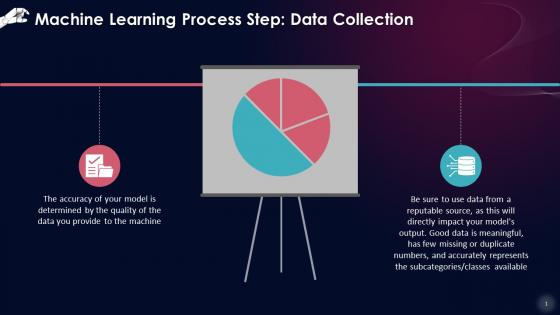
This slide describes the first step of Machine Learning Data Collection. Machines begin by learning from the data that you provide them. It is critical to obtain reliable data to identify the correct patterns for your Machine Learning model. Be sure to use data from a reputable source, as this will directly impact your models output. Good data is meaningful, has few missing or duplicate numbers, and accurately represents the subcategories or classes available.
People who downloaded this PowerPoint presentation also viewed the following :
Machine Learning Process Step Data Collection Training Ppt with all 17 slides:
Use our Machine Learning Process Step Data Collection Training Ppt to effectively help you save your valuable time. They are readymade to fit into any presentation structure.







FAQs for Machine Learning Process Step Data
The key stages in the machine learning process include data collection, data preprocessing, feature selection, model training, model evaluation, and deployment. These stages work together by ensuring data quality, optimizing algorithm performance, and validating results, with many organizations finding that systematic implementation across sectors like healthcare, finance, and retail ultimately delivers improved decision-making and competitive advantage.
Data collection and preparation significantly impact model performance by determining data quality, completeness, and relevance for training algorithms. Poor data collection introduces bias and gaps, while inadequate preparation creates noise and inconsistencies that reduce accuracy. Banks using clean, comprehensive datasets for fraud detection achieve 90% higher accuracy than those with incomplete data, ultimately delivering more reliable predictions and better business outcomes.
Feature engineering transforms raw data into meaningful inputs that machine learning algorithms can effectively process, involving selecting relevant variables, creating new features from existing data, scaling measurements, and removing noise or irrelevant information. This critical preprocessing step significantly impacts model accuracy and performance, with many data scientists finding that well-engineered features often matter more than algorithm selection for delivering reliable predictions and actionable insights.
**INPUT**: How can we determine whether our training data is sufficient for model accuracy? **OUTPUT**: You can assess training data sufficiency through learning curves, cross-validation performance, and validation set accuracy metrics that stabilize as data increases. Healthcare organizations and financial institutions typically find that insufficient data shows continued improvement with additional samples, while adequate datasets demonstrate plateauing performance, ultimately enabling confident model deployment and reliable predictions. **Word count: 54 words**
Model validation and evaluation methods include cross-validation, holdout validation, bootstrap sampling, time series splitting, and stratified sampling techniques. These approaches enhance model reliability by assessing performance across different data segments, detecting overfitting through statistical measures, and ensuring robust predictions, with many organizations finding that comprehensive validation ultimately delivers more accurate forecasting and strategic decision-making capabilities.
Choosing the right machine learning algorithms depends on your data type, problem complexity, interpretability requirements, and performance goals. Consider supervised algorithms like regression for continuous outcomes or classification for categorical predictions, while unsupervised methods handle pattern discovery, with many organizations finding that testing multiple approaches through cross-validation ultimately delivers optimal results.
Overfitting prevention strategies include cross-validation, regularization techniques, early stopping, dropout methods, and data augmentation approaches. These techniques work by constraining model complexity, improving generalization, and ensuring robust performance across datasets, with many organizations in healthcare, finance, and retail finding that combining multiple strategies delivers more reliable predictions and sustainable competitive advantage.
Hyperparameter tuning is crucial for optimizing model performance, as poor parameter choices can significantly reduce accuracy and efficiency. Key techniques include grid search, random search, Bayesian optimization, and automated approaches like AutoML, with financial institutions and healthcare organizations finding that systematic tuning improves prediction accuracy by 15-30%, ultimately delivering competitive advantage.
Supervised learning uses labeled data to predict outcomes, unsupervised learning discovers patterns in unlabeled data through clustering and association, while reinforcement learning optimizes decisions through reward-based feedback systems. These approaches enable organizations to tackle different challenges, with banks using supervised learning for fraud detection, retailers applying unsupervised learning for customer segmentation, and manufacturers leveraging reinforcement learning for operational optimization.
Handling imbalanced datasets involves techniques like oversampling minority classes, undersampling majority classes, synthetic data generation through SMOTE, and adjusting class weights during model training. These approaches enhance model performance by ensuring better representation across all classes, with financial institutions using these methods for fraud detection and healthcare organizations for rare disease diagnosis, ultimately delivering more accurate predictions and reliable business outcomes.
Common pitfalls include inadequate data validation, insufficient model monitoring, poor version control, lack of scalability planning, and ignoring bias detection. These challenges can derail deployments through degraded performance, compliance issues, and operational inefficiencies, with many organizations finding that robust testing frameworks and continuous monitoring ultimately deliver more reliable, sustainable machine learning implementations.
The choice of loss function directly influences how models learn by defining optimization objectives, gradient calculations, and convergence behavior during training. Different loss functions like cross-entropy for classification or mean squared error for regression guide models toward specific outcomes, with financial institutions finding that appropriate loss function selection significantly improves fraud detection accuracy and loan approval precision.
Ethical machine learning measures include implementing bias detection algorithms, establishing diverse development teams, creating transparent decision-making processes, conducting regular algorithmic audits, and developing clear data governance frameworks. These approaches enhance trust and accountability by ensuring fair outcomes across demographics, protecting privacy, and maintaining regulatory compliance, with many financial institutions and healthcare organizations finding that proactive ethical frameworks ultimately deliver competitive advantage and reduced legal risks.
Machine learning model predictions can be interpreted through explainable AI techniques like LIME, SHAP, feature importance analysis, decision trees, and model-agnostic methods. These approaches enable organizations to understand algorithmic decisions by visualizing feature contributions, identifying prediction drivers, and creating transparent audit trails, with financial services and healthcare sectors finding that interpretable models enhance regulatory compliance, build stakeholder trust, and ultimately deliver more accountable AI implementations.
**INPUT**: What future trends should we be aware of in the machine learning landscape? **OUTPUT**: Key machine learning trends include automated ML platforms, edge computing integration, explainable AI systems, federated learning approaches, and enhanced human-AI collaboration frameworks. These developments streamline model deployment, reduce infrastructure costs, and improve transparency, with financial services and healthcare organizations finding that automated solutions accelerate innovation while maintaining regulatory compliance and operational efficiency. **Word count: 54 words**
-
Keep doing the good work guys. Surpass the needs and expectations always!!
-
The content is very helpful from business point of view.