

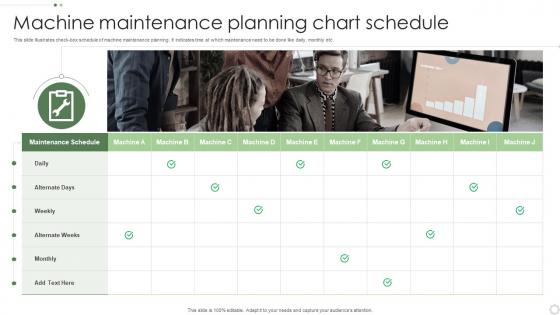
Machine Maintenance Planning Chart Schedule




Try Before you Buy Download Free Sample Product
 Impress Your
Audience
 100%
Editable
 Save Hours
of Time


This slide illustrates check box schedule of machine maintenance planning. It indicates time at which maintenance need to be done like daily, monthly etc.
People who downloaded this PowerPoint presentation also viewed the following :
Machine Maintenance Planning Chart Schedule with all 6 slides:
Use our Machine Maintenance Planning Chart Schedule to effectively help you save your valuable time. They are readymade to fit into any presentation structure.






FAQs for Machine Maintenance
Start with all your equipment info - model numbers, serials, where everything's located. Break down maintenance by how often you need to do it: daily stuff, weekly checks, monthly deep cleaning. Those big quarterly jobs that nobody wants to touch? Yeah, those too. Bob's gonna say he didn't know it was his shift again, so spell out who does what. List the tools you'll need, what parts to keep stocked, how long each thing takes. Make it detailed enough that people won't bug you with questions every five minutes. Trust me on this one.
Honestly, check your manual first - that's your baseline. Most critical stuff needs attention every 30-90 days though. Production lines? Monthly for sure. Your HVAC probably too if it's running hard. Other equipment can usually wait 3 months between checkups. I get it, feels excessive when you're busy. But breakdowns cost way more than prevention - learned that the hard way once. Set phone reminders or you'll definitely forget. Oh, and write down what you find each time. Patterns start showing up pretty quick when you actually track this stuff.
Look, data analysis is like having a crystal ball for when stuff's gonna break. Track your equipment failures and performance trends - you'll start seeing patterns instead of just guessing "oh let's service it every 3 months or whatever." Honestly, most people are flying blind here. Collect basic stuff first: runtime hours, temps, failure logs. Even throwing it in a spreadsheet will show you things you're missing. The whole point is catching weird vibrations or declining performance before everything goes to hell. Way better than waiting for catastrophic failure, trust me.
Safety stuff comes first - no question about it. If a machine could hurt someone when it breaks, that's your top priority. After that, hit the bottlenecks that'll shut down your whole production line. Most people screw this up by treating every piece of equipment the same way, which is honestly just asking for trouble. Try to schedule maintenance during your planned downtime, but never skip safety checks just to hit production numbers. Make a simple ranking system. Stick to it religiously.
Honestly, just track the basics but be consistent about it - date, machine ID, what you did, parts you swapped, and who worked on it. Photos are clutch for complex stuff, trust me. We had this press that kept crapping out and nobody could figure out why until we started actually documenting everything properly. Write down weird sounds or wear patterns you notice too. Yeah it feels like busy work at first, but when something breaks at 2am and you're scrambling to fix it? You'll be so glad you kept good records. Future you will definitely appreciate the effort.
Dude, IoT sensors are a game changer for maintenance. You get real-time alerts on vibration, temperature, all that stuff - way better than just guessing when machines need work. My buddy's shop started with their most critical equipment first, which makes sense. Now they catch problems before things actually break down, which saves them tons of money. The whole predictive maintenance thing is honestly pretty slick. You'll shift away from those rigid schedules to actually knowing what's happening. It's like having a health monitor on every machine, but less annoying than my fitness tracker.
Honestly, broken equipment is your worst enemy - it'll derail everything when you least expect it. Management always wants zero downtime during crunch periods too, which is super frustrating. Nobody wants to do the boring documentation stuff either, so half your records end up missing or wrong. I learned this the hard way but build in extra time for everything. Even a basic shared spreadsheet helps if people actually use it. Oh, and maintenance work just doesn't feel as important as hitting production numbers, so you're constantly fighting that mindset.
So basically, proactive maintenance is scheduling regular checkups before stuff breaks down. Oil changes, replacing worn parts, that kind of thing. Reactive maintenance? That's when you're running around like crazy after something already fails - like when your conveyor belt suddenly snaps mid-shift (been there, not fun). Look, we all end up doing reactive work sometimes, but the proactive approach saves you serious cash long-term. You'll avoid those nightmare emergency repairs and random downtime that kills productivity. My advice? Figure out which equipment you absolutely can't afford to lose and start there with your maintenance schedule.
So we went through this exact thing last year - total nightmare with spreadsheets everywhere. CMMS software saved our butts though. UpKeep's probably your best bet to start with, super easy to figure out. Fiix and Maintenance Connection are solid too. The automated reminders alone make it worth it, plus you get work order tracking and equipment history in one spot. I mean, you could try rigging something with Google Calendar if money's tight, but honestly? Just bite the bullet and get proper CMMS software. UpKeep has free trials so there's really no excuse not to test it out first.
Honestly, you've gotta bake downtime right into your maintenance schedule and track it separately. I always add 20-30% buffer time because stuff ALWAYS takes longer than you think. Murphy's law is real, trust me. Track both what you planned versus what actually happened - you'll start seeing patterns that help with future estimates. Oh, and definitely loop in the production teams so they know when equipment goes down. Better to be realistic upfront than constantly moving deadlines around. If you're not tracking this data yet, start now. Future you will thank you for it.
Okay so there's four main things you should track. Equipment downtime is the big one - both planned and unplanned stuff. Also watch your maintenance costs per asset and something called OEE (overall equipment effectiveness). Mean time between failures matters too since it shows whether you're actually preventing problems or just putting out fires constantly. Most teams totally ignore the cost tracking which is kinda dumb because that's how you prove it's worth doing. I'd honestly just pick two of these that match whatever's driving you crazy right now and start there.
So industry standards are basically your starting point - they're built from real data and failure analysis, so they keep you compliant and reduce surprise breakdowns. ISO standards, manufacturer specs, all that stuff. But here's the thing - you don't have to stop there. If your machines run harder or you've got harsh conditions, bump up those maintenance checks. I've seen too many people treat standards like gospel when really they're just the minimum. Look at what's actually happening in your facility and adjust from there. Standards give you the foundation, then you build on it.
You'll need to hit three main things with your maintenance crew. Start with the technical stuff - how your equipment actually works, what usually breaks, and how to spot problems early. Safety training comes next because honestly, maintenance accidents are no joke and totally preventable. Don't skip the system training either - whatever you're using for scheduling, whether it's fancy software or just basic logs. Hands-on practice works way better than just lectures. Get your best tech to run the sessions since they know the real-world quirks your manuals won't cover.
So basically you want to match the schedule to how hard each machine works. Heavy-duty stuff needs way more attention than equipment that just sits around most days. Runtime hours matter a lot - plus things like dust and humidity absolutely destroy machines faster. Age is huge too. And honestly? Your main production line breaking down will cost you way more than some backup unit, so prioritize accordingly. I'd start by grouping similar equipment together, then figure out different intervals for inspections and oil changes and all that. Environmental conditions are probably more important than people think.
Yeah, machine age totally changes your maintenance game. Newer equipment? You can get away with quarterly checks. But once they hit that 5-year mark, I'd bump it up to monthly - trust me on this one. It's basically like how we start needing more doctor visits as we age (though hopefully less dramatic than my dad's weekly pharmacy trips). Older machines need you to switch from just preventing problems to actually predicting when they'll break. Start keeping track of equipment ages now. Otherwise you'll be dealing with surprise breakdowns that could've been avoided.
-
The website is jam-packed with fantastic and creative templates for a variety of business concepts. They are easy to use and customize.
-
I am really satisfied with their XYZ products. Used their slides for my business presentations and now I am taking their help for my son's high-school assignments. Super satisfied!!