

Management strategy for information technology powerpoint presentation




Try Before you Buy Download Free Sample Product
 Impress Your
 Audience
 100%
100% Editable
 Save Hours
 of Time


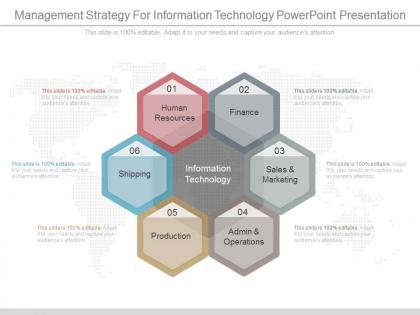
Welcome to the Management strategy for Information technology PowerPoint Presentation. Since management is the core of any department, it has not even left the IT sector behind. This presentation make use of icons and the graphic images to showcase the process clearly. In fact, this administration plan PPt slide template work while laying stress on making a plan and arranging it in a vivid manner. The managing slide icons initiate to explain the entire process within six steps, namely: Sales and marketing, finance, shipping, production, human resources, admin and operations. The use of all these six major ingredients of planning in this management planning PowerPoint Presentation make it a perfect slideshow to come up with, in front of your desired audience. If talked about its aim, this management strategy PowerPoint slide template basically focus on framing a plan or a scheme, which bring out the positive output and make the communication smooth and information clear which is a key element of any IT operations. Establish an enduring framework with our Management Strategy For Information Technology Powerpoint Presentation. Give your format a firm foundation.
People who downloaded this PowerPoint presentation also viewed the following :
Content of this Powerpoint Presentation
Description:
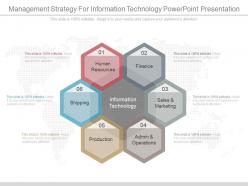
The image showcases a PowerPoint slide titled "Management Strategy For Information Technology PowerPoint Presentation," which illustrates a hexagonal arrangement of key organizational functions that interface with information technology.
The slide features six interconnected areas:
1. Human Resources:
Implying the role of HR in IT management, possibly in talent acquisition and workforce development.
2. Finance:
Highlighting the financial aspects of IT strategy, such as budgeting and investment.
3. Sales & Marketing:
Reflecting the integration of IT in driving sales initiatives and marketing strategies.
4. Admin & Operations:
Signifying the operational support provided by IT for administrative functions.
5. Production:
Indicating the production processes that rely on IT systems for efficiency and automation.
6. Shipping:
Denoting the logistics and distribution components managed through IT solutions.
The repeated statement "This slide is 100% editable. Adapt it to your needs and capture your audience's attention." suggests that the presenter can customize the content based on the specific IT strategies and integration points within their organization.
Use Cases:
The structured approach depicted in the slide is versatile and can be relevant across multiple industries where IT plays a central role in business operations:
1. Technology and Software:
Use: Outlining the integration of IT across different business units.
Presenter: IT Director
Audience: Internal stakeholders, IT teams
2. Healthcare:
Use: Demonstrating how IT supports patient care and administrative services.
Presenter: Chief Information Officer
Audience: Healthcare administrators, medical staff
3. Manufacturing:
Use: Explaining IT's role in production automation and supply chain management.
Presenter: Operations Manager
Audience: Production supervisors, logistics managers
4. Retail:
Use: Discussing IT systems for sales data analysis and inventory management.
Presenter: Retail Technology Strategist
Audience: Store managers, IT support staff
5. Banking and Finance:
Use: Describing the IT infrastructure supporting financial transactions and services.
Presenter: Financial Systems Manager
Audience: Bank executives, finance personnel
6. Education:
Use: Integrating IT in administrative operations and educational delivery.
Presenter: Director of Information Services
Audience: School administrators, IT staff
7. Logistics and Transportation:
Use: Showcasing IT solutions in tracking, delivery, and operations.
Presenter: Logistics Director
Audience: Operations team, supply chain partners
Management strategy for information technology powerpoint presentation with all 7 slides:
Clarity emerges with our Management Strategy For Information Technology Powerpoint Presentation. Everything comes into fine focus.



FAQs for Management strategy for information
Effective IT management strategies include strategic planning and governance, infrastructure management, cybersecurity protocols, data management frameworks, and performance monitoring systems. These components work together by aligning technology investments with business objectives, ensuring operational continuity, and minimizing security risks, with many organizations finding that this integrated approach delivers enhanced efficiency and competitive advantage.
Organizations align IT strategy with business goals by establishing clear governance frameworks, conducting regular strategic planning sessions, and creating cross-functional teams that include both business and IT leaders. Through integrated roadmaps and performance metrics, companies streamline operations, enhance customer experiences, and accelerate digital transformation initiatives, with many enterprises finding that this strategic alignment delivers competitive advantage and measurable ROI.
Cybersecurity fundamentally influences IT management strategies by driving risk assessment protocols, infrastructure design decisions, budget allocation priorities, and compliance frameworks. Organizations increasingly integrate security-first approaches into their technology roadmaps, with financial institutions and healthcare providers finding that proactive cybersecurity measures enhance operational resilience, protect customer trust, and deliver competitive advantages.
Cloud computing transforms IT management practices by centralizing infrastructure oversight, automating resource provisioning, and enabling real-time scalability adjustments across distributed systems. Through cloud platforms, organizations streamline operational workflows, reduce hardware maintenance burdens, and enhance disaster recovery capabilities, while financial services and healthcare institutions increasingly find that hybrid approaches deliver cost efficiency and improved service reliability.
IT management strategy success metrics include system uptime percentages, security incident response times, project delivery timelines, cost per user ratios, and user satisfaction scores. These measurements enable organizations to track operational efficiency, resource optimization, and strategic alignment, with many enterprises finding that combining technical performance indicators with business outcome metrics delivers comprehensive insights into their technology investments' competitive advantage.
AI and machine learning revolutionize IT management by automating routine tasks, predicting system failures, and optimizing resource allocation across enterprise networks. These technologies enable IT teams to shift from reactive maintenance to proactive strategy, with financial institutions and healthcare organizations finding significantly reduced downtime, enhanced security monitoring, and streamlined operations that deliver competitive advantage.
IT governance and compliance best practices include establishing clear oversight frameworks, implementing robust risk management protocols, ensuring regulatory adherence, maintaining comprehensive documentation, and conducting regular audits. These strategic approaches streamline operations by enhancing transparency, minimizing compliance risks, and enabling scalable oversight, with many organizations finding that structured governance ultimately delivers operational efficiency and competitive advantage in increasingly regulated business environments.
IT management strategies foster innovation by establishing flexible infrastructure, encouraging experimentation through dedicated resources, promoting cross-functional collaboration, and implementing agile methodologies that accelerate project delivery. Through cloud computing and DevOps practices, organizations streamline development processes, reduce time-to-market, and enable rapid prototyping, with many companies finding that strategic IT investments ultimately deliver competitive advantages and enhanced customer experiences.
Managing remote IT teams presents challenges including communication barriers, project coordination difficulties, security vulnerabilities, performance monitoring complexities, and maintaining team cohesion across distributed locations. These obstacles can be addressed through robust collaboration platforms, structured daily standups, comprehensive cybersecurity protocols, and performance tracking tools, with many organizations finding that strategic investment in cloud infrastructure and regular virtual team-building ultimately enhances productivity and employee satisfaction.
Organizations ensure effective stakeholder communication in IT management through regular status updates, clear progress dashboards, standardized reporting frameworks, and structured feedback channels. These approaches streamline information flow by establishing consistent communication cadences, translating technical concepts into business language, and creating transparent project visibility, with many companies finding that proactive stakeholder engagement significantly reduces project risks while enhancing strategic alignment.
IT service management can be enhanced through ITIL framework adoption, automated incident management, proactive monitoring systems, standardized change processes, and comprehensive SLA governance. These strategies streamline operations by reducing response times, minimizing downtime, and improving user satisfaction, with many organizations finding that strategic automation and process standardization ultimately deliver significant cost reductions and competitive operational efficiency.
Workforce skills and training significantly influence IT management strategies by determining technology adoption capabilities, implementation timelines, and resource allocation priorities. Organizations with skilled technical teams can pursue advanced digital transformation initiatives more aggressively, while those with skills gaps must incorporate extensive training programs, phased rollouts, and strategic hiring into their IT roadmaps, ultimately shaping budget decisions and competitive positioning.
Data management plays a foundational role in IT strategy development by ensuring data quality, accessibility, security, and governance across organizational systems. Through strategic data architecture and analytics capabilities, organizations can make informed technology investments, optimize resource allocation, and enhance operational efficiency, with many enterprises finding that robust data management ultimately delivers competitive advantage and supports scalable digital transformation initiatives.
IT project management can be streamlined through agile methodologies, automated workflow tools, clear stakeholder communication protocols, and regular milestone tracking systems. These approaches enhance efficiency by reducing administrative overhead, accelerating decision-making processes, and improving resource allocation, with many organizations finding that streamlined frameworks ultimately deliver faster project completion and significantly better alignment with business objectives.
Regulatory changes significantly impact IT management strategies by requiring enhanced data governance, updated security protocols, and revised compliance frameworks. Organizations must reallocate resources toward regulatory technology solutions, automated reporting systems, and continuous monitoring capabilities, with many financial institutions and healthcare providers finding that proactive compliance strategies ultimately deliver competitive advantages and reduced operational risks.
-
Commendable slides with attractive designs. Extremely pleased with the fact that they are easy to modify. Great work!
-
Unique and attractive product design.