

Manager Performance Appraisal Review Phases




Try Before you Buy Download Free Sample Product
 Impress Your
 Audience
 100%
100% Editable
 Save Hours
 of Time


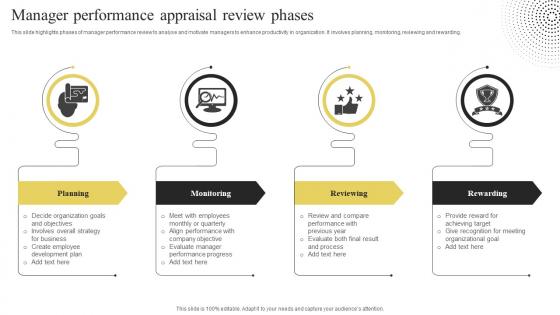
This slide highlights phases of manager performance review to analyse and motivate managers to enhance productivity in organization. It involves planning, monitoring, reviewing and rewarding.
People who downloaded this PowerPoint presentation also viewed the following :
Manager Performance Appraisal Review Phases with all 9 slides:
Use our Manager Performance Appraisal Review Phases to effectively help you save your valuable time. They are readymade to fit into any presentation structure.








FAQs for Manager Performance
Manager performance appraisal reviews aim to evaluate leadership effectiveness, assess goal achievement, identify development opportunities, provide constructive feedback, and align individual performance with organizational objectives. These comprehensive evaluations enable organizations to strengthen management capabilities, enhance team productivity, and drive strategic outcomes, with many companies finding that structured appraisal processes ultimately deliver improved employee engagement and competitive advantage.
Performance appraisal reviews significantly influence engagement and motivation by providing clear feedback, recognizing achievements, identifying development opportunities, and aligning individual goals with organizational objectives. Through structured evaluation processes, managers can enhance employee satisfaction, strengthen retention rates, and boost productivity levels, with many organizations finding that regular, constructive reviews ultimately deliver improved performance and competitive advantage.
Best practices for setting performance metrics in manager evaluations include establishing clear, measurable objectives aligned with organizational goals, incorporating both quantitative targets and qualitative leadership behaviors, ensuring metrics reflect team development responsibilities, and creating balanced scorecards that assess strategic thinking alongside operational results. These comprehensive frameworks enable organizations to evaluate managerial effectiveness across multiple dimensions, while providing managers with transparent expectations that drive both individual performance and team success, ultimately delivering stronger organizational outcomes.
Performance appraisals should be conducted quarterly or bi-annually, with continuous feedback sessions throughout the year to maintain effectiveness and employee engagement. This frequency enables managers to address performance gaps promptly, recognize achievements consistently, and align individual goals with organizational objectives, while many companies find that regular touchpoints significantly improve employee satisfaction and productivity outcomes.
Self-assessment enables managers to reflect on their achievements, identify development areas, and align their perspective with organizational goals before formal evaluations. This process encourages ownership of professional growth while providing valuable insights to supervisors, with many organizations finding that self-reflective managers demonstrate greater accountability, improved goal-setting capabilities, and enhanced leadership effectiveness.
Team member feedback enhances manager performance appraisals by providing comprehensive perspectives on leadership effectiveness, communication skills, decision-making abilities, and team development capabilities that traditional top-down evaluations often miss. This 360-degree approach enables organizations to identify specific improvement areas, strengthen manager-team relationships, and ultimately deliver better employee engagement and retention, with many companies finding that upward feedback significantly improves leadership development outcomes.
Organizations face challenges including inconsistent evaluation criteria, manager bias during assessments, insufficient feedback training, time constraints, and resistance to constructive criticism. These obstacles can undermine appraisal effectiveness, with many companies finding that inadequate preparation and unclear performance metrics lead to reduced employee engagement, missed development opportunities, and ultimately weaker leadership development across teams.
Technology streamlines performance appraisal reviews through automated data collection, real-time feedback platforms, and integrated analytics dashboards that eliminate manual paperwork and scheduling conflicts. These digital solutions enable managers to track employee progress continuously, generate comprehensive reports instantly, and facilitate more objective evaluations, with many organizations finding significantly reduced review cycle times and enhanced transparency.
Methods for ensuring fairness and objectivity include standardized evaluation criteria, multiple reviewer perspectives, documented evidence-based assessments, calibration sessions, and blind review processes. These approaches streamline bias reduction by establishing consistent measurement frameworks, incorporating diverse viewpoints, and maintaining transparent documentation, with many organizations finding that structured methodologies ultimately deliver more equitable outcomes and enhanced employee trust.
A 360-degree feedback approach enhances manager performance evaluations by gathering comprehensive input from supervisors, peers, direct reports, and external stakeholders, creating a holistic view of leadership effectiveness across multiple dimensions. This multi-source evaluation enables organizations to identify blind spots, strengthen communication skills, and develop targeted improvement plans, with many companies finding that managers demonstrate significantly improved self-awareness and team engagement following these comprehensive assessments.
Common mistakes during manager appraisal processes include lack of preparation, focusing solely on recent events, avoiding difficult conversations, providing vague feedback, and failing to set clear development goals. These oversights undermine the process by reducing trust, missing growth opportunities, and creating inconsistent evaluations, with many organizations finding that structured frameworks and regular feedback cycles ultimately deliver more effective leadership development and improved team performance.
Evaluators need training in competency-based assessment frameworks, behavioral observation techniques, feedback delivery methods, bias recognition, and legal compliance standards. Through structured programs covering goal-setting alignment, evidence documentation, and difficult conversation management, organizations enhance assessment accuracy, reduce subjective judgments, and ultimately deliver more effective performance outcomes, with many companies finding that trained evaluators significantly improve manager development results.
Organizations should address underperformance through structured improvement plans, targeted training programs, regular coaching sessions, and clear performance milestones with defined timelines. This approach enables managers to identify specific skill gaps, provide necessary resources, and monitor progress systematically, while ultimately delivering enhanced productivity and employee retention across departments.
Well-structured performance appraisals significantly enhance talent retention by providing clear career pathways, regular feedback, and recognition of contributions. Through systematic evaluation processes, employees receive targeted development opportunities, understand advancement potential, and feel valued for their achievements, with many organizations finding that comprehensive appraisal systems reduce turnover rates while strengthening employee engagement and loyalty.
Follow-up actions post-appraisal can be optimized through regular check-ins, targeted development programs, measurable goal-setting, and continuous feedback loops that track progress against established objectives. These strategic approaches enhance performance by creating accountability, providing ongoing support, and enabling real-time adjustments, with many organizations finding that consistent follow-through ultimately delivers improved employee engagement and sustained productivity gains.
-
“I always have a wonderful experience with SlideTeam. It's my ""go to"" when I need a template.”
-
Definitely recommend SlideTeam to all who need help with PowerPoint presentations. Their design team can create anything you need.