


Managing Logistics Activities Management Packing And Shipping Process Workflow




Try Before you Buy Download Free Sample Product
 Impress Your
 Audience
 100%
100% Editable
 Save Hours
 of Time


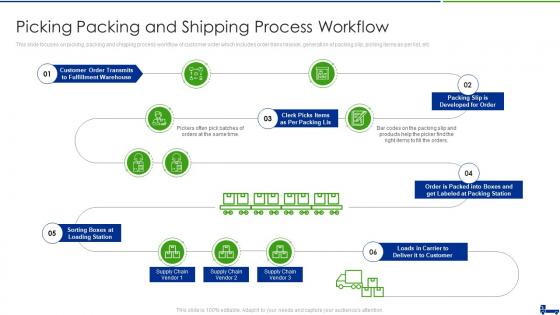
This slide focuses on picking, packing and shipping process workflow of customer order which includes order transmission, generation of packing slip, picking items as per list, etc.
People who downloaded this PowerPoint presentation also viewed the following :
Managing Logistics Activities Management Packing And Shipping Process Workflow with all 6 slides:
Use our Managing Logistics Activities Management Packing And Shipping Process Workflow to effectively help you save your valuable time. They are readymade to fit into any presentation structure.





FAQs for Managing Logistics Activities Management Packing And
Key components of an effective logistics management system include transportation planning, inventory control, warehouse operations, demand forecasting, and supplier relationship management. These elements work together by streamlining supply chain workflows, minimizing operational costs, and enhancing delivery accuracy, with many organizations finding that integrated systems ultimately deliver improved customer satisfaction and competitive advantage.
Technology revolutionizes logistics management through AI-powered route optimization, IoT tracking systems, automated warehousing, and predictive analytics for demand forecasting. These innovations streamline operations by reducing delivery times, minimizing costs, and enhancing inventory accuracy, with companies like Amazon and FedEx leveraging these tools to deliver faster services and superior customer experiences.
Data analytics transforms supply chain logistics by providing real-time visibility, predictive insights, and performance optimization across operations. Through advanced analytics, logistics managers can forecast demand patterns, optimize route planning, reduce inventory costs, and identify bottlenecks before they impact delivery schedules, with many organizations finding that data-driven approaches deliver significantly improved efficiency and customer satisfaction.
Companies improve inventory management through strategic logistics optimization by implementing real-time tracking systems, demand forecasting analytics, automated reorder points, and cross-docking facilities. These approaches streamline supply chain visibility, reduce carrying costs, and minimize stockouts, with retail giants and manufacturing firms finding that integrated logistics networks ultimately deliver faster inventory turnover and enhanced customer satisfaction.
Global logistics challenges include supply chain disruptions, regulatory compliance variations, transportation delays, inventory management complexities, and currency fluctuations. These obstacles significantly impact operational efficiency across industries like automotive and retail, with many organizations finding that strategic technology integration and diversified supplier networks help minimize risks while delivering improved cost control and customer satisfaction.
Sustainability integrates into logistics management through green transportation methods, optimized route planning, renewable energy adoption, waste reduction programs, and sustainable packaging solutions. These strategies enable companies to minimize carbon footprints, reduce operational costs, and enhance brand reputation, with many logistics providers finding that eco-friendly practices ultimately deliver competitive advantages while meeting increasingly stringent environmental regulations.
E-commerce significantly transforms logistics operations by demanding faster delivery times, enhanced inventory visibility, real-time tracking capabilities, and flexible fulfillment strategies. This digital shift drives organizations to streamline warehouse automation, optimize last-mile delivery networks, and integrate omnichannel distribution systems, with many retailers finding that strategic logistics partnerships ultimately deliver competitive advantage and improved customer experiences.
Logistics management practices vary significantly based on industry-specific requirements, with healthcare prioritizing temperature-controlled supply chains, automotive emphasizing just-in-time delivery, and retail focusing on omnichannel distribution networks. These sector-specific approaches streamline operations by addressing unique compliance standards, customer expectations, and operational constraints, ultimately delivering enhanced efficiency and competitive advantage tailored to each industry's strategic needs.
Third-party logistics providers offer cost reduction, enhanced scalability, access to specialized expertise, advanced technology systems, and improved supply chain flexibility. These partnerships enable companies to streamline operations, reduce overhead expenses, and focus on core business activities, while 3PLs deliver faster distribution, better inventory management, and enhanced customer experiences through their established networks and resources.
Risk management integration into logistics planning involves conducting comprehensive risk assessments, developing contingency protocols, diversifying supplier networks, implementing real-time monitoring systems, and establishing flexible response frameworks. Organizations enhance operational resilience by identifying potential disruptions across transportation, warehousing, and supply chains, ultimately delivering improved service continuity and competitive advantage in increasingly volatile markets.
Critical logistics performance metrics include delivery accuracy, order fulfillment time, inventory turnover, transportation costs, and customer satisfaction scores. These measurements enable organizations to streamline operations, reduce operational expenses, and enhance customer experiences, with many logistics companies finding that tracking these interconnected metrics ultimately delivers competitive advantage and improved supply chain efficiency.
JIT revolutionizes logistics operations by minimizing inventory storage costs, reducing waste, and synchronizing supply chain timing with actual demand patterns. This approach enables manufacturers like Toyota and retailers like Walmart to streamline warehouse operations, accelerate order fulfillment, and enhance cash flow management, ultimately delivering significant cost savings and improved operational efficiency.
Best practices for reverse logistics include establishing clear return policies, implementing tracking systems, optimizing collection networks, automating processing workflows, and integrating sustainability measures. These approaches streamline operations by reducing processing times, minimizing costs, and enhancing customer satisfaction, with many retailers and manufacturers finding that strategic reverse logistics ultimately delivers competitive advantage and improved resource recovery.
Companies enhance customer satisfaction through effective logistics by ensuring accurate, timely deliveries, maintaining real-time shipment visibility, and providing flexible delivery options that meet diverse customer preferences. Through streamlined warehouse operations and strategic distribution networks, businesses minimize delays, reduce costs, and improve order accuracy, with many retail and e-commerce companies finding that optimized logistics directly translates to higher customer retention and competitive advantage.
AI and IoT reshape logistics management by enabling predictive analytics, real-time tracking, automated inventory management, route optimization, and demand forecasting. These technologies streamline operations through intelligent sensors monitoring shipments, AI algorithms predicting maintenance needs, and automated systems coordinating warehouse activities, ultimately delivering faster deliveries, reduced costs, and enhanced supply chain transparency.
-
Easy to edit slides with easy to understand instructions.
-
Topic best represented with attractive design.