

Managing The Successful Convergence Of It And Ot Powerpoint Presentation Slides





Try Before you Buy Download Free Sample Product
 Impress Your
Audience
 100%
Editable
 Save Hours
of Time


IT or OT integration helps combine production structures that monitor physical activities and procedures with back end hardware and information conveyance and retrieval applications. Grab our efficiently designed Managing the successful convergence of IT and OT template covering IT or OT convergence integration of information technology IT systems with operational technology OT systems. In this presentation, we have covered the strategy to make Operational technology OT and information technology IT converge and become increasingly the same based on data, security, and Competencies. Further, it includes Enterprise Technical Challenges, IT or OT Convergence Challenges, Catalysts, Model Of Integration, and Fully Integrated services and systems. It also covers the Representation of IT or OT technological convergence and Representation of convergence through the pooling of IT or OT competencies and Corporate Actors Affected By IT or OT Convergence. This PPT presentation covers the IT or OT Convergence Suggested General Approach and broader subjects. It includes Data Flow Distribution of Responsibilities Between IT or OT Teams, Convergence Data Platform, Scaling up Mechanism of Data Projects, and the Organizational Structure Around Data Use. In this presentation, we have also covered Two way Interactions between Safety, Security, and Cybersecurity, the Launch of Cyber IT or OT Strategy, IT or OT Organizational Structure, etc. Customize this 100 percent editable template now.
People who downloaded this PowerPoint presentation also viewed the following :
Content of this Powerpoint Presentation
Slide 1: This slide introduces Managing the Successful Convergence of IT and OT. State your company name and begin.
Slide 2: This slide states Agenda of the presentation.
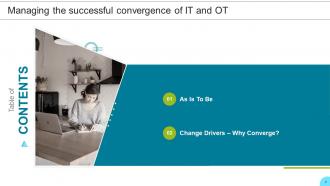
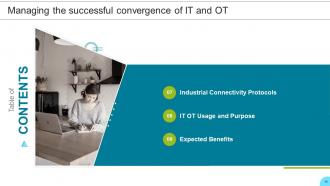
Slide 3: This slide presents Table of Content for the presentation.
Slide 4: This slide highlights title for topics that are to be covered next in the template.
Slide 5: This slide covers current situation of the enterprise and future state where it want to be.
Slide 6: This slide covers the change drivers which are driving the IT OT convergence growth.
Slide 7: This slide highlights title for topics that are to be covered next in the template.
Slide 8: This slide covers technical challenges such as environmental, compatibility, skills shortage and security.
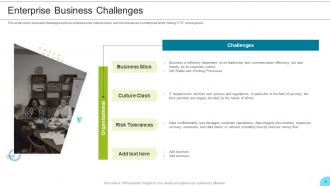
Slide 9: This slide presents business challenges such as business silos, cultural clash, and risk tolerances.
Slide 10: This slide highlights title for topics that are to be covered next in the template.
Slide 11: This slide displays IT/OT Convergence Challenges and Catalysts.
Slide 12: This slide represents Traditional model with separate IT and OT environments.
Slide 13: This is another slide continuing Model of IT/OT Integration.
Slide 14: This slide showcases Fully Integrated IT and OT Services and Systems.
Slide 15: This slide highlights title for topics that are to be covered next in the template.
Slide 16: This slide shows Using New and Better Industrial Connectivity Protocols.
Slide 17: This slide presents Defining Information Technology and Operational Technology Usage and Purpose.
Slide 18: This slide displays Expected benefits of IT/OT Convergence.
Slide 19: This slide highlights title for topics that are to be covered next in the template.
Slide 20: This slide represents Representation of IT/OT Technological Convergence.
Slide 21: This slide showcases Representation of Convergence Through Pooling of IT/OT Competencies.
Slide 22: This slide shows Corporate Actors Affected by IT/OT Convergence.
Slide 23: This slide highlights title for topics that are to be covered next in the template.
Slide 24: This slide presents IT/OT Convergence Suggested General Approach.
Slide 25: This slide covers data security and competencies identification of objectives.
Slide 26: This slide highlights title for topics that are to be covered next in the template.
Slide 27: This slide displays IT/OT Convergence Data- Objectives Challenges Catalysts and Benefits.
Slide 28: This slide represents Data Flow- Distribution of Responsibilities Between IT/OT Teams.
Slide 29: This slide covers data platform to transmitting, processing and maintaining the integrity of data between systems.
Slide 30: This slide showcases Scaling-up Mechanism of Data Projects.
Slide 31: This slide shows The Organizational Structure Around Data Use.
Slide 32: This slide highlights title for topics that are to be covered next in the template.
Slide 33: This slide presents IT/OT Convergence Security- Objectives Challenges Catalysts and Benefits.
Slide 34: This slide displays Two-way Interactions between Safety, Security and Cybersecurity.
Slide 35: This slide covers IT/OT cyber security strategy and approaches.
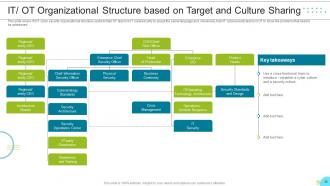
Slide 36: This slide represents IT/OT Organizational Structure based on Target and Culture Sharing.
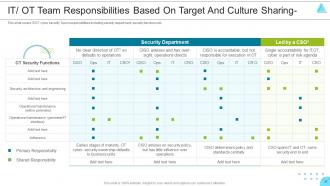
Slide 37: This slide showcases IT/OT Team Responsibilities based on Target and Culture Sharing-.
Slide 38: This slide covers breaking of internal networks up into autonomous zones.
Slide 39: This slide shows Single Database for two Separate IT/OT Socs.
Slide 40: This slide highlights title for topics that are to be covered next in the template.
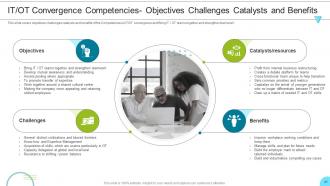
Slide 41: This slide presents IT/OT Convergence Competencies- Objectives Challenges Catalysts and Benefits.
Slide 42: This slide displays variety of IT / OT integration competencies that suited certain types of roles.
Slide 43: This slide is useful in Enhancing the ways in which competencies complement each other.
Slide 44: This slide covers the effect of IT/OT strategy on organization.
Slide 45: This slide contains all the icons used in this presentation.
Slide 46: This slide is titled as Additional Slides for moving forward.
Slide 47: This is About Us slide to show company specifications etc.
Slide 48: This is Our Mission slide with related imagery and text.
Slide 49: This is Our Team slide with names and designation.
Slide 50: This slide shows Post It Notes. Post your important notes here.
Slide 51: This slide depicts Venn diagram with text boxes.
Slide 52: This slide displays Column chart with two products comparison.
Slide 53: This is a Thank You slide with address, contact numbers and email address.
Managing The Successful Convergence Of It And Ot Powerpoint Presentation Slides with all 58 slides:
Use our Managing The Successful Convergence Of It And Ot Powerpoint Presentation Slides to effectively help you save your valuable time. They are readymade to fit into any presentation structure.



















FAQs for Managing The Successful Convergence Of It And Ot
IT-OT convergence delivers enhanced operational visibility, predictive maintenance capabilities, improved quality control, streamlined production processes, and reduced downtime for manufacturing industries. Through integrated systems, manufacturers achieve real-time monitoring across production lines, faster decision-making, and optimized resource allocation, with many industrial facilities finding that this strategic combination ultimately delivers significant cost reductions and competitive advantage.
IT-OT convergence significantly expands cybersecurity attack surfaces by connecting previously isolated operational technology to networked IT infrastructure, creating vulnerabilities in critical systems like manufacturing equipment, power grids, and industrial controls. Organizations now face dual challenges of protecting both data confidentiality and operational safety, with many finding that traditional IT security measures must be enhanced with OT-specific protocols to prevent disruptions that could impact physical operations and business continuity.
Organizations face security vulnerabilities, integration complexities, skills gaps, regulatory compliance issues, and cultural resistance when implementing IT-OT convergence strategies. These challenges present both obstacles and opportunities, with many manufacturing and energy companies finding that strategic planning, phased implementation, and cross-functional training ultimately deliver enhanced operational efficiency and competitive advantage.
Real-time data analytics enables better decision-making in integrated IT-OT environments by providing instant visibility into operational performance, predicting equipment failures before they occur, and correlating business metrics with operational data. Through advanced analytics platforms, organizations streamline maintenance schedules, optimize resource allocation, and enhance production efficiency, with manufacturing and energy companies finding that this integration delivers faster response times and significant cost reductions.
IIoT serves as a crucial bridge between IT and OT systems by enabling seamless data flow from operational devices to enterprise networks through connected sensors, smart controllers, and edge computing platforms. This integration allows organizations in manufacturing, energy, and logistics to enhance real-time monitoring, predictive maintenance, and operational efficiency, ultimately delivering improved decision-making capabilities and competitive advantage.
Cloud computing accelerates IT-OT integration by providing centralized data processing, real-time analytics, and scalable infrastructure that connects operational technology with enterprise systems. Through cloud platforms, manufacturers and utilities streamline remote monitoring, predictive maintenance, and cross-system data sharing, while reducing infrastructure costs and enabling rapid scaling, ultimately delivering enhanced operational visibility and faster decision-making capabilities.
IT prioritizes data security, system availability, and standardized protocols, while OT focuses on real-time performance, safety compliance, and continuous operational uptime. These different priorities create integration challenges, with IT emphasizing cybersecurity and data management while OT prioritizes physical safety and process reliability, ultimately requiring strategic alignment to deliver seamless operational efficiency across manufacturing, energy, and industrial sectors.
Companies can ensure successful IT-OT convergence by implementing robust cybersecurity protocols, establishing clear governance frameworks, conducting comprehensive risk assessments, and investing in employee training across both domains. These practices enable organizations to streamline operations while maintaining security, with many manufacturers and energy companies finding that gradual integration approaches deliver enhanced operational efficiency and competitive advantage.
Organizations measure IT-OT convergence ROI through operational efficiency metrics, cost reduction analysis, productivity improvements, downtime minimization, and enhanced data visibility across systems. Manufacturing companies and energy providers typically track reduced maintenance costs, faster production cycles, and improved asset utilization, with many finding that integrated operations deliver 15-25% efficiency gains within the first year.
IT-OT convergence enhances supply chain visibility by integrating operational technology sensors with information systems, enabling real-time tracking, predictive analytics, automated inventory management, and seamless data flow across production networks. Through connected manufacturing systems, organizations streamline logistics coordination, minimize bottlenecks, and accelerate decision-making processes, ultimately delivering faster response times and competitive operational efficiency.
Regulatory compliance significantly influences IT-OT convergence by requiring enhanced data security, audit trails, and standardized protocols across manufacturing, healthcare, and energy sectors. Industries like pharmaceuticals and utilities must balance operational efficiency with strict regulatory frameworks, often implementing segmented network architectures and continuous monitoring systems, ultimately driving more strategic, compliance-aware integration approaches that deliver both regulatory adherence and competitive advantage.
Employees need cybersecurity fundamentals, network protocols understanding, data analytics capabilities, systems integration knowledge, and cross-functional communication skills to navigate IT-OT convergence effectively. Manufacturing engineers increasingly require IT literacy while IT professionals must understand operational technologies, with many organizations finding that hybrid training programs combining technical workshops with collaborative projects ultimately deliver faster adaptation and enhanced operational efficiency.
Machine learning and AI enhance converged IT-OT systems by enabling predictive maintenance, real-time anomaly detection, automated decision-making, and intelligent resource optimization across operational networks. These technologies streamline manufacturing processes, enhance supply chain visibility, and minimize equipment downtime, with industries like automotive and energy finding that AI-driven insights ultimately deliver significant cost reductions and improved operational efficiency.
Successful IT-OT convergence case studies include Siemens' digital factories integrating production systems with enterprise software, Shell's smart refinery operations connecting operational technology with business analytics, and GE's Predix platform merging industrial equipment data with cloud computing for predictive maintenance. These implementations demonstrate that strategic phased integration, robust cybersecurity frameworks, and cross-functional team collaboration enable enhanced operational efficiency, reduced downtime, and data-driven decision making, ultimately delivering competitive advantage in increasingly connected industrial environments.
Organizations can foster IT-OT collaboration through cross-functional training programs, shared governance structures, joint project teams, and unified communication platforms that bridge traditional silos. By establishing common performance metrics, rotating personnel between departments, and creating integrated workflows, companies in manufacturing, energy, and utilities increasingly find that collaborative cultures accelerate digital transformation while delivering enhanced operational visibility and strategic agility.
-
“Excellent information with easy access.”
-
The quality of the templates is as fine as it could get. It was a purchase well made!