


Map of continental europe 1314




Try Before you Buy Download Free Sample Product
 Impress Your
 Audience
 100%
100% Editable
 Save Hours
 of Time


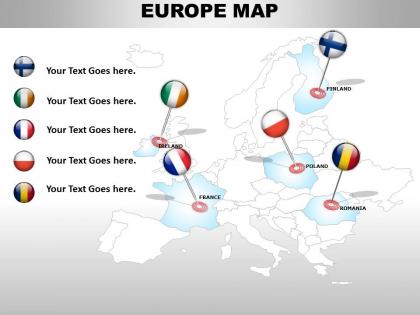
Are you looking for PPT inspiration for your presentation purposes? Do you have extensive knowledge about various European countries but can’t find an information sharing medium that does justice to that knowledge. Do not worry and browse our website for numerous such PPT slides ready to be downloaded and applied. The map of continental Europe Presentation deck is one such example of PPT that will assist you and the audience in taking the best decisions. Whether you are a businessman, project manager, a teacher in university, college or school, or even a statistician working with numbers, this map embedded PPT slide will certainly take you a step closer to make data less cumbersome and less complex. Go ahead and pin the cities and countries of your choice, use text areas to write about any country and customize additional features with trouble. The aesthetic PPT infographics convert this PowerPoint layout into a great PPT ideas generating tool. Download for maximum benefits.Our Map Of Continental Europe 1314 will give you a different look. Exhibitan air of confidence.
People who downloaded this PowerPoint presentation also viewed the following :
Map of continental europe 1314 with all 5 slides:
Our Map Of Continental Europe 1314 are fairly electric. You will feel the force of their energy.



FAQs for Map of
Key political entities in Continental Europe in 1314 included the Holy Roman Empire under Henry VII, the Kingdom of France under Philip IV, the Crown of Aragon, Castile, Portugal, the Papal States, and emerging city-states like Venice and Genoa. These fragmented territories created a complex political landscape where dynastic conflicts, territorial disputes, and competing claims for authority shaped medieval European governance, with many regions experiencing the tension between centralized monarchical power and local feudal autonomy that would ultimately drive centuries of political evolution.
Feudalism shaped Europe's 1314 political landscape through hierarchical land-based relationships, decentralized power structures, and personal loyalty bonds between lords and vassals. This system enabled regional autonomy while maintaining strategic alliances, with kingdoms like France and England leveraging feudal networks to expand territorial control, collect resources, and ultimately deliver military strength across fragmented political territories.
The Holy Roman Empire dominated Central Europe in 1314, controlling vast territories from Germany through northern Italy, fragmented into hundreds of semi-autonomous duchies, bishoprics, and free cities under Emperor Louis IV. This decentralized structure created a complex political landscape that influenced trade routes, diplomatic alliances, and territorial boundaries across medieval Europe, with neighboring kingdoms like France and Poland constantly navigating the Empire's fragmented but extensive influence.
Major monarchies in Continental Europe during 1314 included the Kingdom of France under Philip IV covering modern France, the Holy Roman Empire spanning Germany and parts of Italy, the Crown of Aragon controlling eastern Spain and Mediterranean territories, and Castile dominating central Spain. These powerful realms shaped medieval European politics through strategic alliances, territorial expansion, and dynastic marriages, ultimately establishing the foundation for modern European nation-states and influencing continental trade routes and cultural exchange.
The territorial disputes of 1314 established precedents for centralized monarchies, feudal consolidation, and strategic border control that shaped centuries of European statecraft. These conflicts, particularly involving France, England, and the Holy Roman Empire, ultimately delivered frameworks for national identity formation, diplomatic treaty structures, and territorial sovereignty concepts that medieval kingdoms leveraged to build the foundation of modern European nation-states.
The Avignon Papacy (1309), Knights Templar dissolution (1312), Holy Roman Empire fragmentation, French expansion under Philip IV, and ongoing English-French tensions shaped Europe by 1314. These events weakened papal authority, shifted power balances between church and state, and intensified territorial conflicts, with many kingdoms finding that centralized monarchies increasingly challenged traditional feudal structures, ultimately delivering more defined national boundaries and concentrated royal power.
The Catholic Church profoundly shaped European political boundaries through papal authority over territorial disputes, excommunications that legitimized or delegitimized rulers, control of marriage alliances, and the Crusades which redirected military resources. Church governance intertwined with secular power through bishops holding temporal authority, ecclesiastical courts managing legal matters, and papal interdicts that could economically cripple regions, ultimately delivering unified Christian identity while enabling strategic political manipulation across fragmented medieval kingdoms.
**INPUT**: What were the major trade routes, and how did they impact the economies of different regions in 1314? **OUTPUT**: Major trade routes in 1314 included the Hanseatic League's Baltic networks, Mediterranean routes connecting Italian city-states, overland paths through Alpine passes, and emerging Atlantic coastal trade. These routes enabled regional specialization by facilitating grain exports from Eastern Europe, luxury goods from Venice and Genoa, and manufactured textiles from Flanders, ultimately delivering unprecedented economic integration across Continental Europe. [Word count: 60 words]
European social structure in 1314 mirrored regional power through feudal hierarchies, with stronger monarchies in France and England creating more centralized noble classes, while fragmented areas like the Holy Roman Empire maintained diverse local power structures. The concentration of landed nobility, merchant guilds, and ecclesiastical authority varied significantly across regions, with emerging commercial centers like Italian city-states developing unique patrician classes that challenged traditional feudal arrangements, ultimately reflecting each area's political consolidation and economic development.
The Black Death significantly destabilized existing political structures across Continental Europe, accelerating the fragmentation of larger kingdoms while consolidating power in smaller, more manageable territories that could better respond to crisis management. This demographic catastrophe ultimately reshaped territorial boundaries by weakening feudal obligations, enabling emerging city-states and regional powers to gain independence from traditional monarchies, particularly in the Holy Roman Empire and Italian peninsula regions.
The rise of city-states fundamentally transformed Continental Europe's political landscape by creating independent urban centers that challenged traditional feudal authority, with Italian city-states like Venice, Florence, and Genoa leading commercial networks while northern European cities formed powerful trading leagues. This urbanization process enabled enhanced trade relationships, streamlined governance structures, and strategic economic alliances, ultimately delivering increased political fragmentation and competitive commercial advantages across the continent.
Italy led cultural advancement through Renaissance precursors in city-states like Florence and Venice, while France developed Gothic architecture and scholasticism, and the Byzantine Empire preserved classical knowledge despite territorial decline. These cultural achievements enhanced political influence by attracting trade partnerships, diplomatic alliances, and skilled artisans, with many regions finding that intellectual prominence translated directly into economic prosperity and strategic leverage.
The Knights Templar's dissolution in 1312 shifted significant wealth and territorial control to rival orders and monarchies, particularly strengthening French royal power while destabilizing Crusader infrastructure across Europe. This reallocation of resources enhanced centralized monarchical authority in France and England, reduced papal influence over military orders, and ultimately delivered greater territorial consolidation for emerging nation-states, with many kingdoms finding strategic opportunities in redistributed Templar assets.
The Anglo-French rivalry fundamentally shaped Continental Europe's 1314 boundaries through England's substantial territorial holdings in France, including Gascony and remnants of the Angevin Empire, while ongoing disputes over Flanders, Normandy, and feudal obligations created contested zones. These competing claims established the foundation for the Hundred Years' War, with territorial fragmentation ultimately delivering strategic advantages to emerging nation-states and reshaping European political landscapes.
**INPUT**: What were the major alliances or conflicts that defined the interactions between neighboring states in Continental Europe during this time? **OUTPUT**: Major alliances in 1314 Continental Europe included the Franco-Scottish Alliance against England, the Flemish-English commercial partnerships, and the complex web of Holy Roman Empire vassalage relationships. These strategic combinations shaped territorial disputes like the ongoing Scottish Wars of Independence and Flemish succession conflicts, while trade alliances between Italian city-states and northern European powers ultimately delivered enhanced commercial networks and competitive advantages across regions.
-
Informative design.
-
It saves your time and decrease your efforts in half.