

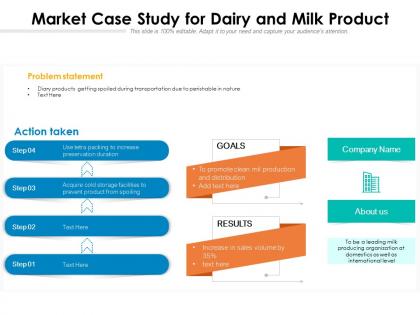
Market case study for dairy and milk product




Try Before you Buy Download Free Sample Product
 Impress Your
 Audience
 100%
100% Editable
 Save Hours
 of Time


Douse feelings of anger that emerge with our Market Case Study For Dairy And Milk Product. Address attempts at causing ire.
People who downloaded this PowerPoint presentation also viewed the following :
Market case study for dairy and milk product with all 2 slides:
Control irate folk with our Market Case Study For Dairy And Milk Product. Enable them to counter any instigation.
FAQs for Market case study for dairy
Key drivers influencing dairy product demand include rising global population, increasing disposable income, growing health consciousness, expanding food processing industries, and urbanization trends. These factors enhance consumption by creating larger consumer bases, enabling premium product purchases, and driving demand for protein-rich foods, with emerging markets like Asia-Pacific finding significant growth opportunities in value-added dairy segments.
Plant-based alternatives have significantly disrupted traditional dairy markets by capturing market share, driving innovation, and forcing pricing adjustments across milk, cheese, and yogurt categories. While traditional dairy companies initially faced challenges, many have successfully diversified their portfolios to include plant-based options, ultimately expanding their customer base and maintaining competitive positioning in an increasingly health-conscious marketplace.
Major trends shaping dairy consumption include plant-based alternatives, organic and grass-fed products, functional dairy with probiotics, sustainable packaging, and convenient on-the-go formats. These preferences drive innovation across retail, food service, and manufacturing sectors, with many dairy companies finding that premium positioning, health-focused marketing, and environmental transparency ultimately deliver stronger customer loyalty and competitive advantage.
International trade policies significantly influence dairy market dynamics through tariffs, quotas, export subsidies, and bilateral agreements that determine pricing, supply chains, and market access. These policies create competitive advantages for certain regions while challenging others, with countries like New Zealand and Denmark leveraging favorable trade agreements to expand globally, ultimately reshaping production patterns and consumer pricing worldwide.
Technology revolutionizes dairy production through automated milking systems, precision feeding technologies, health monitoring sensors, data analytics platforms, and supply chain optimization tools. These innovations enhance operational efficiency by reducing labor costs, improving milk quality, and enabling predictive health management, with many dairy farms finding that strategic technology adoption delivers significantly higher yields and competitive advantage.
Key sustainability challenges facing dairy farmers include managing greenhouse gas emissions, reducing water consumption, implementing waste management systems, maintaining soil health, and balancing animal welfare standards with operational efficiency. These challenges present both environmental responsibilities and economic opportunities, with many progressive dairy operations finding that sustainable practices like methane capture, precision feeding, and regenerative agriculture ultimately deliver cost savings, improved brand reputation, and enhanced long-term viability.
Dairy companies leverage data analytics to enhance marketing strategies by analyzing consumer purchasing patterns, seasonal demand fluctuations, regional preferences, and competitor pricing dynamics. Through predictive analytics and customer segmentation, companies can optimize product positioning, personalize promotional campaigns, and identify emerging market opportunities, while streamlining inventory management and ultimately delivering targeted marketing that increases customer loyalty and market share.
COVID-19 significantly disrupted dairy supply chains through processing plant shutdowns, labor shortages, and transportation delays, while simultaneously shifting consumer behavior toward increased home consumption and bulk purchasing. Many dairy producers found that pivoting to direct-to-consumer sales, enhancing e-commerce capabilities, and streamlining distribution networks helped maintain market presence, ultimately accelerating digital transformation across the industry.
Pricing strategies vary significantly across dairy categories, with milk following cost-plus pricing due to commodity nature, while premium products like artisanal cheeses and organic yogurts utilize value-based pricing to capture higher margins. Specialty segments like lactose-free and plant-based alternatives command premium pricing through differentiation, while bulk products such as butter and cream cheese rely on competitive pricing strategies, ultimately enabling dairy companies to optimize revenue across diverse consumer segments and market positioning requirements.
Future growth opportunities in emerging markets for dairy companies include expanding middle-class populations, increasing urbanization, rising health consciousness, growing demand for premium products, and underdeveloped cold chain infrastructure investments. These markets enable companies to capture new consumer segments through localized product development, strategic partnerships with regional distributors, and value-added offerings, with many dairy corporations finding that early market entry delivers significant competitive advantages.
Regulatory changes in food safety are reshaping the dairy industry through stricter quality standards, enhanced traceability requirements, and modernized processing protocols. These developments drive operational improvements by streamlining compliance procedures, accelerating product testing, and strengthening supply chain transparency, with many dairy producers finding that updated safety measures ultimately deliver competitive advantages and consumer trust.
Current dairy processing innovations include ultra-high temperature pasteurization, membrane filtration, cold plasma treatment, automated quality control systems, and precision fermentation technologies. These advancements streamline production by reducing energy consumption, extending shelf life, and minimizing waste, with many processors finding that smart packaging and blockchain tracking ultimately deliver enhanced product safety and operational efficiency.
Climate change affects dairy farming through increased heat stress, altered precipitation patterns, shifting growing seasons, and extreme weather events that disrupt feed production and cow productivity. These environmental pressures reduce milk yields, increase operational costs, and force dairy operations to invest in cooling systems, drought-resistant feed crops, and adaptive management practices, ultimately requiring strategic adjustments to maintain profitability and supply chain stability.
Consumer health trends significantly influence dairy product development through demand for organic options, lactose-free alternatives, probiotic-enriched products, reduced-sugar formulations, and plant-based hybrids. These evolving preferences drive innovation across traditional dairy companies and startups alike, with manufacturers increasingly reformulating existing products and launching functional dairy items that deliver enhanced nutritional benefits, ultimately enabling brands to capture health-conscious market segments while maintaining competitive advantage.
Animal welfare concerns significantly influence dairy purchasing decisions, with studies showing 60-70% of consumers willing to pay premiums for ethically-sourced products, driving demand for cage-free, grass-fed, and certified humane options. This trend reshapes market dynamics by compelling dairy producers to adopt transparent farming practices, implement welfare certifications, and develop premium product lines, ultimately delivering competitive differentiation and enhanced brand loyalty in an increasingly conscious marketplace.
No Reviews