

Market share analysis powerpoint presentation slides





Try Before you Buy Download Free Sample Product
 Impress Your
 Audience
 100%
100% Editable
 Save Hours
 of Time


Market Share Analysis PowerPoint Presentation Slides helps you showcase your organization’s market reach. This market share assessment PPT theme is useful for marketers to explain the assessment agenda of their organization. Exploit the design of market share evaluation PowerPoint slideshow to illustrate key statistics using impactful data visualization techniques. Further, you can also use market share research PPT template to graphically represent the market survey results. Communicate the market landscape to your audience by the means of infographics included in this market share review PowerPoint theme. Utilize the market analysis Venn diagram given in market intelligence PPT slideshow to demonstrate market relevance, market opportunities, and market fit. Showcase market sizing and market opportunity analysis by incorporating data visualization tools given in this visually appealing PowerPoint presentation. So, download this market size estimation PPT deck to portray product opportunity analysis through various key performance indicators.
People who downloaded this PowerPoint presentation also viewed the following :
Content of this Powerpoint Presentation
Slide 1: This slide introduces Market Share Analysis. State your Company name and begin.
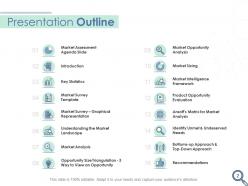
Slide 2: This slide depicts Presentation Outline.
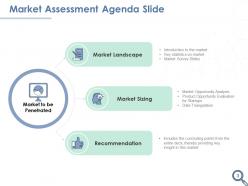
Slide 3: This is Market Assessment Agenda Slide
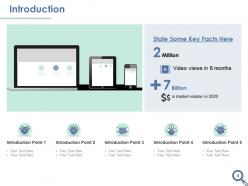
Slide 4: This slide displays Introduction
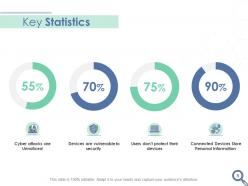
Slide 5: This slide Showcases Key Statistics
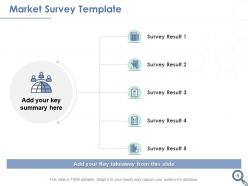
Slide 6: This is Market Survey Template. Add your Key takeaway from this slide
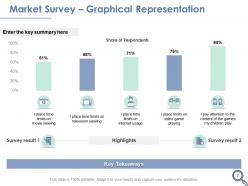
Slide 7: This slide displays Market Survey – Graphical Representation
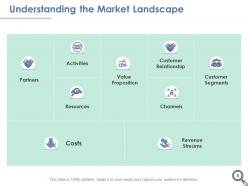
Slide 8: This slide provides an Understanding of the Market Landscape
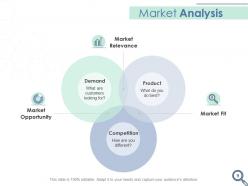
Slide 9: This slide depicts Market Analysis.
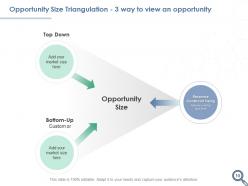
Slide 10: This slide displays Opportunity Size Triangulation - 3 way to view an opportunity
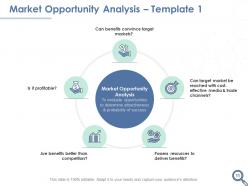
Slide 11: This slide shows Market Opportunity Analysis – Template 1
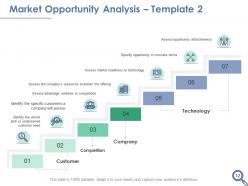
Slide 12: This slide shows Market Opportunity Analysis – Template 2
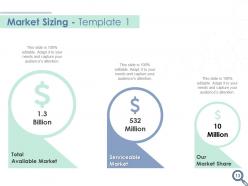
Slide 13: This slide depicts Market Sizing - Template 1
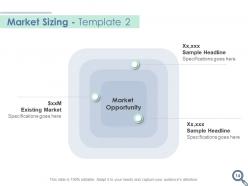
Slide 14: This slide depicts Market Sizing - Template 2
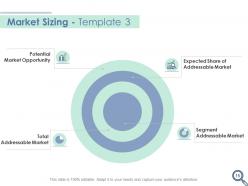
Slide 15: This slide shows Market Sizing - Template 3
Slide 16: This slide represents Product Opportunity Evaluation
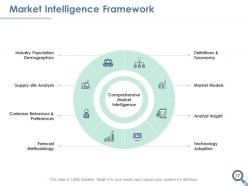
Slide 17: This slide Market Intelligence Framework
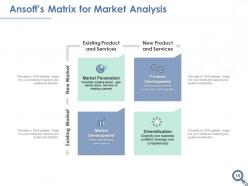
Slide 18: This slide shows Ansoff’s Matrix for Market Analysis
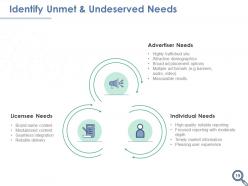
Slide 19: This slide helps to Identify Unmet & Undeserved Needs
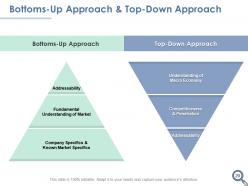
Slide 20: This slide depicts Bottoms-Up Approach & Top-Down Approach
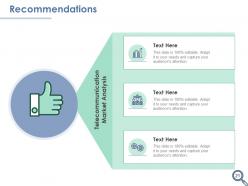
Slide 21: This slide represents Recommendations
Slide 22: This is Market Share Analysis Icons Slide.
Slide 23: This slide is titled as Additional Slides for moving forward.
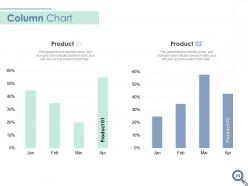
Slide 24: This slide displays Column Chart with product comparison.
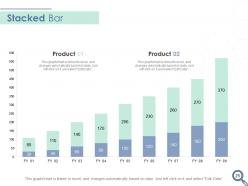
Slide 25: This slide displays Stacked Bar chart with product Comparison.
Slide 26: This is 30 60 90 Days Plan slide.
Slide 27: This is Idea Generation slide to highlight important beliefs and facts.
Slide 28: This is Puzzle slide.
Slide 29: This slide displays Mind Map process.
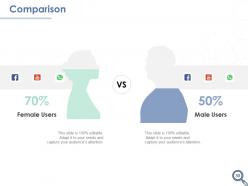
Slide 30: This slide shows Comparison.
Slide 31: This is Thank You slide with Contact details.
Market share analysis powerpoint presentation slides with all 31 slides:
Use our Market Share Analysis Powerpoint Presentation Slides to effectively help you save your valuable time. They are readymade to fit into any presentation structure.





FAQs for Market share analysis
Key metrics for evaluating market share include revenue share, unit sales share, customer base percentage, geographic penetration, and brand recognition levels. These measurements enable organizations to assess competitive positioning by tracking growth trends, identifying market opportunities, and benchmarking against competitors, with many companies finding that combining multiple metrics delivers more comprehensive strategic insights.
Market share data influences strategic decisions by revealing competitive positioning, identifying growth opportunities, and guiding resource allocation across product lines and markets. This analysis enables businesses to prioritize high-potential segments, adjust pricing strategies, and make informed investment decisions, with companies like Amazon and Netflix using market insights to expand strategically and maintain competitive advantage in evolving industries.
Market segmentation enables businesses to understand market share distribution across specific customer groups, geographic regions, product categories, and demographic segments rather than viewing it as a single metric. This granular approach helps organizations identify underperforming segments, discover growth opportunities in niche markets, and develop targeted strategies, with many companies finding that segment-specific insights reveal competitive advantages previously hidden in aggregate data.
Changes in consumer preferences directly reshape market share dynamics by forcing companies to adapt their offerings, marketing strategies, and operational approaches to maintain competitive positioning. Organizations that quickly identify and respond to shifting preferences through product innovation, enhanced customer experiences, and strategic repositioning often capture market share from slower competitors, while businesses that fail to adapt typically see their market positions erode, ultimately creating significant opportunities for agile companies to establish stronger footholds.
Market share calculation methods include revenue-based analysis, unit sales comparison, customer base measurement, geographic segmentation, and time-period benchmarking. Revenue-based calculations often deliver the most comprehensive accuracy by reflecting actual market value, with many organizations finding that combining multiple methods—such as unit sales with revenue analysis—provides deeper competitive insights, ultimately enabling more strategic positioning and resource allocation decisions.
New entrants can capture market share through strategic differentiation, targeted niche positioning, competitive pricing strategies, innovative technology adoption, and superior customer experience delivery. While saturated markets present significant challenges, companies like Tesla in automotive and Netflix in entertainment demonstrate how disruptive approaches, combined with agile operations and customer-centric solutions, ultimately enable newcomers to establish competitive advantage.
Competitor analysis significantly enhances market share assessment by identifying competitive positioning, pricing strategies, product differentiation, and market gaps that directly influence share calculations. Through comprehensive competitor evaluation, businesses can benchmark their performance, uncover untapped opportunities, and develop strategic responses that strengthen their market position, with many organizations finding that regular competitor analysis delivers more accurate share assessments and sustainable competitive advantages.
Market share data informs product development by revealing competitive gaps, customer preferences, unmet market needs, and emerging trends that guide innovation priorities. Through analyzing competitor performance, customer feedback, and market positioning, companies identify strategic opportunities for new features, services, or products, while optimizing resource allocation to maximize market penetration and competitive advantage.
Relying solely on market share figures overlooks profitability margins, customer satisfaction levels, brand loyalty strength, operational efficiency metrics, and competitive positioning nuances. While market share indicates relative size, it doesn't reveal whether that position delivers sustainable profits, quality customer experiences, or strategic advantages, with many successful companies finding that smaller, profitable segments outperform broader market dominance.
Economic factors influence market share trends by affecting consumer spending patterns, operational costs, and competitive dynamics across sectors. During economic downturns, essential industries like healthcare and utilities often maintain stable shares, while luxury goods and discretionary spending sectors experience volatility, with companies that adapt pricing strategies and optimize efficiency typically gaining competitive advantage over less agile competitors.
Companies can increase market share sustainably through customer retention programs, product innovation, strategic partnerships, competitive pricing, and enhanced customer experiences. These approaches work by building loyalty, differentiating offerings, and expanding reach, with many organizations finding that combining digital transformation with personalized service delivery creates lasting competitive advantages while reducing acquisition costs.
Technology and digital transformation enhance market share by streamlining operations, automating customer interactions, and enabling data-driven decision making. Through AI-powered analytics and cloud platforms, companies accelerate product development, deliver personalized experiences, and optimize resource allocation, with many retail and financial services organizations finding that digital initiatives ultimately reduce costs while improving competitive positioning.
Market share shifts signal changing competitive dynamics, customer preferences, revenue potential, and industry positioning that directly impact investment valuations and strategic decisions. These changes influence stock prices, dividend sustainability, merger opportunities, and resource allocation priorities, with investors in sectors like technology, retail, and pharmaceuticals finding that monitoring these trends enables better portfolio management and risk assessment strategies.
Companies leverage customer loyalty to enhance market share by implementing retention programs, personalized experiences, referral incentives, and cross-selling strategies that increase customer lifetime value. These approaches strengthen competitive positioning by reducing churn, generating word-of-mouth marketing, and expanding wallet share, with many organizations finding that loyal customers cost significantly less to serve while delivering higher revenue growth and sustainable market expansion.
Branding influences market share by building customer loyalty, differentiating products from competitors, and creating perceived value that justifies premium pricing. Strong brands like Apple and Nike demonstrate how consistent messaging and emotional connections drive customer retention and attract new segments, ultimately delivering sustained competitive advantage and enabling companies to defend market position while expanding into new territories.
-
Excellent template with unique design.
-
Perfect template with attractive color combination.
-
Easily Editable.
-
Amazing product with appealing content and design.
-
Excellent template with unique design.