

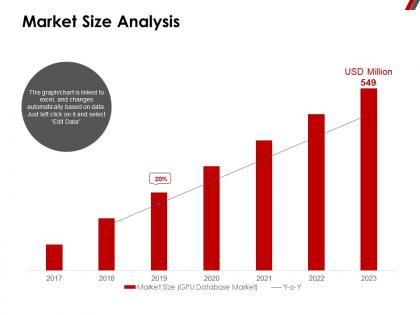
Market size analysis graph ppt powerpoint presentation summary slide




Try Before you Buy Download Free Sample Product
 Impress Your
Audience
 100%
Editable
 Save Hours
of Time


Our Market Size Analysis Graph Ppt Powerpoint Presentation Summary Slide are topically designed to provide an attractive backdrop to any subject. Use them to look like a presentation pro.
People who downloaded this PowerPoint presentation also viewed the following :
Market size analysis graph ppt powerpoint presentation summary slide with all 2 slides:
Use our Market Size Analysis Graph Ppt Powerpoint Presentation Summary Slide to effectively help you save your valuable time. They are readymade to fit into any presentation structure.


FAQs for Market size analysis graph ppt powerpoint
Market size estimation methodologies include top-down analysis, bottom-up calculations, value theory approaches, competitor analysis, and primary market research through surveys and focus groups. These strategic approaches enable businesses to assess market potential by analyzing industry data, customer segments, and pricing models, with many organizations finding that combining multiple methodologies delivers more accurate forecasts and competitive advantage.
Economic indicators influence market size by affecting consumer spending power, investment flows, and business expansion decisions across industries. While GDP growth typically expands technology and luxury markets, unemployment rates impact retail and housing sectors differently, with healthcare and essential services showing greater resilience during economic downturns, ultimately enabling businesses to strategically adjust resource allocation and capitalize on sector-specific opportunities.
Consumer behavior significantly influences market size estimates by determining purchasing patterns, demand frequency, price sensitivity, adoption rates, and market segmentation preferences across different demographics. Understanding these behavioral factors enables businesses to accurately forecast market potential, identify growth opportunities, and develop targeted strategies, with many organizations finding that behavioral insights ultimately deliver more precise revenue projections and competitive positioning.
Market segmentation enhances accuracy by enabling granular analysis of distinct customer groups, demographic clusters, behavioral patterns, geographic regions, and industry verticals within broader markets. This targeted approach delivers more precise revenue projections, realistic growth forecasts, and strategic resource allocation, with many organizations finding that segment-specific insights reveal untapped opportunities and competitive advantages.
Key factors driving market size fluctuations include economic conditions, consumer behavior shifts, technological disruptions, regulatory changes, and competitive dynamics. These variables interact to create market volatility, with industries like retail and financial services experiencing significant impacts from economic cycles, while technology sectors navigate disruption-driven growth, ultimately requiring businesses to maintain flexible strategies for sustained competitive advantage.
The competitive landscape significantly influences market size projections by determining market saturation levels, pricing dynamics, customer acquisition costs, and innovation rates. In highly competitive sectors like telecommunications or retail banking, intense rivalry can compress margins while expanding overall market accessibility, with many industries finding that increased competition ultimately drives market growth through enhanced customer experiences and service differentiation.
**INPUT**: What data sources are most reliable for conducting market size analysis? **OUTPUT**: Reliable market size analysis sources include government statistical agencies, industry association reports, established research firms like Gartner or McKinsey, public company filings, and trade publications. These sources deliver comprehensive data through verified methodologies, peer review processes, and regulatory oversight, with many organizations finding that combining multiple authoritative sources enhances accuracy and provides competitive strategic insights. **Word count: 58 words**
Technological advancements can dramatically expand emerging markets by reducing barriers to entry, enabling digital payment systems, improving infrastructure accessibility, and creating entirely new product categories. Through mobile banking, e-commerce platforms, and cloud-based services, businesses can reach previously untapped consumer segments in developing regions, while automation and AI streamline operations, ultimately delivering broader market participation and increased economic opportunities.
Global trends like sustainability significantly reshape market sizes by creating new demand patterns, regulatory requirements, and consumer preferences across industries. Sectors such as renewable energy, electric vehicles, and sustainable packaging experience substantial growth, while traditional industries like fossil fuels face contraction, with many organizations finding that early sustainability adoption delivers competitive advantages and access to expanding eco-conscious market segments.
Businesses face challenges including rapidly changing consumer preferences, emerging technologies disrupting traditional markets, regulatory shifts, economic volatility, and insufficient historical data for new sectors. These uncertainties complicate forecasting accuracy, with many organizations finding that external factors like geopolitical events or technological breakthroughs can significantly alter market trajectories, ultimately requiring more flexible, scenario-based planning approaches.
Market size analysis informs investment strategies by quantifying market potential, identifying growth opportunities, and assessing competitive landscapes across different sectors and geographies. Through comprehensive market evaluation, investors can strategically allocate resources, minimize risks, and maximize returns, with many financial institutions finding that data-driven sizing ultimately delivers superior portfolio performance and competitive advantage.
Regulatory environments significantly influence market size assessments by creating barriers to entry, compliance costs, and operational constraints that can limit addressable markets. These frameworks shape opportunity calculations across sectors like pharmaceuticals, financial services, and telecommunications, with many analysts finding that regulatory changes can expand or contract market potential by 20-40%, ultimately requiring dynamic forecasting approaches.
TAM represents the total revenue opportunity for a product across all markets, SAM narrows this to segments your business can realistically serve, and SOM reflects the portion you can actually capture given competition and constraints. These metrics help companies prioritize market entry strategies, allocate resources effectively, and set realistic growth targets, with many organizations using this framework to guide investment decisions and demonstrate market potential to stakeholders.
Demographic shifts significantly influence market size by altering consumer demand patterns, purchasing power distribution, and product preferences across targeted industries. Aging populations drive healthcare and senior services expansion, while younger demographics fuel technology adoption and sustainable products, with many retail, financial services, and housing sectors finding that strategic demographic analysis enables better resource allocation and competitive positioning.
Market growth rate reveals how quickly market size expands over time, indicating future opportunity potential, competitive intensity, and investment attractiveness for businesses. Companies in high-growth markets, like renewable energy or digital healthcare, often achieve faster revenue scaling and stronger investor interest, while those in mature markets focus on market share capture, ultimately enabling strategic resource allocation and timing decisions for market entry or expansion.
No Reviews