

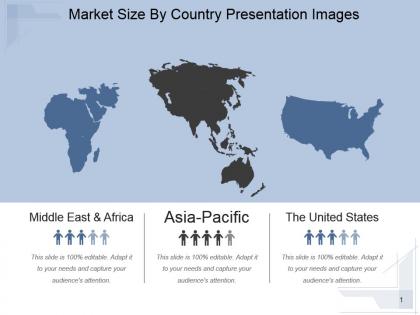
Market size by country presentation images




Try Before you Buy Download Free Sample Product
 Impress Your
 Audience
 100%
100% Editable
 Save Hours
 of Time


Folks acknowledge your attempt to improve conditions with our Market Size By Country Presentation Images. They appreciate your interference.
People who downloaded this PowerPoint presentation also viewed the following :
Market size by country presentation images with all 5 slides:
Elaborate on the deal with our Market Size By Country Presentation Images. Highlight the benefits agreement can bring.
FAQs for Market size by
Market size by country is typically measured using GDP, population demographics, consumer spending power, industry revenue, market penetration rates, and competitive landscape analysis. These metrics enable businesses to assess market potential across different regions, with many multinational companies finding that combining economic indicators with sector-specific data delivers strategic insights for resource allocation and expansion planning.
Understanding market size by country enables businesses to prioritize resource allocation, identify high-potential markets, and tailor entry strategies based on revenue opportunities and competitive landscapes. This data-driven approach helps organizations optimize investment decisions, customize product offerings for specific regions, and develop phased expansion plans, with many multinational companies finding that targeted market analysis significantly enhances their international growth outcomes.
Challenges include limited statistical infrastructure, informal economy prevalence, data collection resource constraints, inconsistent reporting standards, and currency fluctuation impacts. These obstacles create significant gaps in market intelligence, with many multinational corporations finding that traditional research methods require adaptation through local partnerships, mobile data collection technologies, and hybrid formal-informal market analysis approaches to achieve meaningful business insights.
Cultural factors significantly impact market size assessments by influencing consumer behavior, purchasing patterns, product acceptance, and communication preferences across different countries. These cultural dimensions affect demand forecasting, pricing strategies, and market penetration rates, with many multinational companies finding that localized cultural analysis delivers more accurate market valuations and competitive positioning in diverse regions.
Government regulation significantly influences market size through licensing requirements, safety standards, environmental policies, trade barriers, and investment incentives that either restrict or encourage industry growth. Countries with supportive regulatory frameworks, like Germany's renewable energy policies or Singapore's fintech sandbox programs, typically see expanded market opportunities, while restrictive regulations can limit market potential, ultimately determining competitive positioning across global industries.
Businesses can effectively leverage market size data by analyzing GDP growth rates, population demographics, consumer spending patterns, and competitive landscape gaps to pinpoint underserved segments. This strategic approach enables companies to prioritize market entry decisions, optimize resource allocation, and tailor product offerings, with many organizations finding that data-driven expansion delivers faster market penetration and sustainable competitive advantages.
Consumer goods, technology services, healthcare, automotive, and financial services show the most significant market size variation across countries. These sectors depend heavily on local purchasing power, regulatory frameworks, cultural preferences, and economic development levels, with emerging markets like India and Brazil often demonstrating vastly different opportunities compared to established economies, ultimately creating strategic advantages for businesses that adapt their approaches regionally.
Population density significantly impacts market size through concentrated consumer bases, higher purchasing power, and enhanced distribution efficiency in urban areas. Urban markets typically deliver greater revenue potential per square mile, faster service deployment, and economies of scale, while rural markets present opportunities for specialized products and services, with many businesses finding that strategic rural expansion complements their urban market dominance.
Businesses can access country-specific market size data through government statistical agencies, international organizations like the World Bank and IMF, commercial research firms such as McKinsey and Nielsen, and industry associations. These resources enable companies to make informed expansion decisions, assess competitive landscapes, and optimize resource allocation across different markets, with many multinational corporations finding that combining multiple data sources delivers the most comprehensive market intelligence for strategic planning.
Technology enhances market size estimation accuracy through AI-powered data analytics, satellite imagery analysis, mobile data tracking, social media sentiment analysis, and real-time consumer behavior monitoring. These tools enable businesses to capture granular regional insights, cross-reference multiple data sources, and identify emerging market patterns across diverse geographic areas, ultimately delivering more precise forecasting and strategic market entry decisions.
Economic indicators like GDP significantly influence market size analysis by providing baseline measurements for purchasing power, consumer spending capacity, infrastructure development, and overall economic stability across different regions. These metrics enable businesses to prioritize market entry strategies, adjust pricing models, and forecast demand patterns, with many multinational corporations finding that GDP per capita correlates directly with premium product adoption and service penetration rates.
Competitor presence reveals market maturity, demand validation, and competitive intensity when evaluating market size by country, indicating both existing opportunities and barriers to entry. While established competitors in markets like Germany or Japan signal proven demand and purchasing power, they also present challenges for differentiation, with many companies finding that less saturated markets often deliver faster growth despite smaller initial size.
Seasonal trends significantly impact market size by creating cyclical demand fluctuations, weather-dependent purchasing patterns, cultural celebrations, and tourism variations across different countries. These patterns enable businesses to strategically time product launches, adjust inventory levels, and optimize marketing campaigns, with many retail, hospitality, and consumer goods companies finding that seasonal adaptation ultimately delivers enhanced revenue streams and competitive market positioning.
**INPUT**: What methodologies are commonly used for forecasting market size in new and evolving markets? **OUTPUT**: Forecasting methodologies for emerging markets include analogical reasoning from similar markets, expert judgment panels, scenario modeling, customer surveys, and pilot program extrapolation. These approaches streamline uncertainty by combining quantitative data with qualitative insights, enabling organizations to assess market potential, allocate resources strategically, and ultimately deliver competitive advantage in rapidly evolving landscapes. [Word count: 54 words]
Demographic shifts significantly impact market size projections by altering consumer bases, labor forces, and spending patterns across countries. Aging populations in Japan and Germany create expanding healthcare markets while shrinking traditional retail sectors, whereas younger demographics in India and Nigeria drive technology adoption and consumer goods demand, ultimately reshaping global market opportunities and investment strategies.
-
Easily Understandable slides.
-
Thanks for all your great templates they have saved me lots of time and accelerate my presentations. Great product, keep them up!