

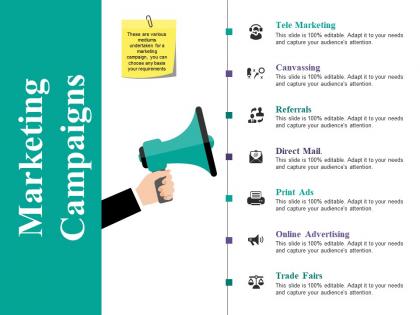
Marketing campaigns example of ppt




Try Before you Buy Download Free Sample Product
 Impress Your
 Audience
 100%
100% Editable
 Save Hours
 of Time


Impress folks with your credentials due to our Marketing Campaigns Example Of Ppt. Convince them that you are ideally equipped for the assignment.
People who downloaded this PowerPoint presentation also viewed the following :
Marketing campaigns example of ppt with all 5 slides:
Our Marketing Campaigns Example Of Ppt allow you to function effortlessly. They make you feel in the groove.



FAQs for Marketing campaigns
Successful marketing campaigns include clear target audience identification, compelling value propositions, consistent messaging across channels, strategic timing, and measurable objectives. These elements work together by aligning brand messaging with customer needs, optimizing resource allocation, and enabling data-driven adjustments, with many organizations finding that integrated approaches ultimately deliver higher engagement rates and stronger ROI.
Storytelling integrates into marketing campaigns through compelling narratives that connect emotionally with audiences, consistent brand messaging across touchpoints, and authentic customer testimonials. Successful campaigns like Coca-Cola's happiness stories or Nike's athlete journeys demonstrate how narrative-driven content enhances engagement, builds brand loyalty, and drives conversions by transforming products into meaningful experiences.
Social media serves as a central platform for brand awareness, customer engagement, targeted advertising, real-time feedback, and community building in modern marketing campaigns. Through strategic social media integration, companies like Nike, Starbucks, and Airbnb enhance customer relationships, amplify campaign reach, and drive measurable conversions, while enabling authentic interactions that ultimately deliver stronger brand loyalty and competitive market positioning.
Seasonal marketing campaigns focus on specific time periods, holidays, or events with targeted messaging and limited-duration promotions, while year-round strategies maintain consistent brand presence through ongoing content, relationship building, and sustained advertising efforts. Seasonal approaches enable businesses to capitalize on heightened consumer spending during peak periods like holidays or back-to-school seasons, ultimately delivering concentrated engagement and revenue spikes that complement steady brand-building activities.
Key metrics include conversion rates, return on investment (ROI), customer acquisition cost, engagement rates, and brand awareness metrics. These measurements enable businesses to assess campaign effectiveness by tracking revenue generation, cost efficiency, and audience response, with many organizations finding that combining multiple metrics delivers comprehensive insights for optimizing future marketing strategies.
Brands can leverage influencer partnerships by collaborating on authentic content creation, product endorsements, event partnerships, and co-branded campaigns that align with their target demographics. Through strategic influencer selection, companies like fashion retailers and tech brands enhance credibility, expand reach, and drive engagement, while accessing new audiences and building trust through genuine recommendations, ultimately delivering increased brand awareness and conversion rates.
Innovative email marketing approaches include AI-powered personalization, interactive content like polls and quizzes, automated behavioral triggers, dynamic product recommendations, and gamification elements. These strategies enhance customer engagement by delivering targeted messaging, creating memorable experiences, and driving higher conversion rates, with many brands finding that personalized campaigns generate significantly better ROI than traditional broadcast emails.
Cultural trends significantly influence marketing campaign development by shaping consumer values, communication preferences, language evolution, and platform choices. Brands increasingly align messaging with social movements, environmental consciousness, and generational shifts, while adapting visual aesthetics and storytelling approaches to reflect current cultural moments, ultimately delivering more authentic connections and enhanced engagement across diverse market segments.
Best practices for creating visually appealing marketing campaign presentations include consistent branding, compelling visuals, clear data visualization, strategic color schemes, and engaging storytelling elements. These approaches enhance audience engagement by simplifying complex information, reinforcing brand identity, and creating memorable experiences, with many marketing teams finding that well-designed presentations significantly improve client approval rates and campaign buy-in.
A/B testing optimizes marketing campaigns by comparing different versions of emails, ads, landing pages, and call-to-action buttons to identify highest-performing elements. Through systematic testing of headlines, visuals, and messaging, companies like e-commerce retailers and SaaS providers increase conversion rates, reduce acquisition costs, and enhance customer engagement, ultimately delivering data-driven insights that maximize ROI.
Marketers should prioritize transparency in messaging, respect customer privacy and data protection, ensure truthful advertising claims, avoid manipulative tactics, and consider cultural sensitivities across diverse audiences. These ethical practices build long-term brand trust and customer loyalty, with many organizations finding that responsible marketing approaches ultimately deliver stronger engagement, reduced legal risks, and sustainable competitive advantage in increasingly conscious markets.
User-generated content enhances marketing campaigns by building authentic brand credibility, expanding organic reach through social sharing, and creating cost-effective promotional materials that resonate with target audiences. Through customer testimonials, social media posts, and review campaigns, brands like Starbucks and Nike leverage authentic user experiences to drive engagement, reduce advertising costs, and ultimately deliver stronger conversion rates with audiences increasingly trusting peer recommendations over traditional advertising.
Data analytics revolutionizes marketing strategies by enabling predictive customer behavior modeling, real-time campaign optimization, personalized content delivery, and precise audience segmentation across multiple channels. Through advanced analytics platforms, organizations streamline targeting accuracy, enhance customer lifetime value predictions, and automate decision-making processes, with many retail and financial services companies finding that data-driven approaches deliver significantly higher ROI and competitive advantage.
Common pitfalls include unclear target audience definition, inconsistent messaging across channels, inadequate budget allocation, neglecting competitor analysis, and failing to establish measurable KPIs. These mistakes can significantly undermine campaign effectiveness, with many organizations finding that strategic planning, thorough market research, and comprehensive performance tracking ultimately deliver stronger ROI and competitive advantage.
Ensuring inclusive marketing campaigns requires comprehensive audience research, diverse creative teams, cultural sensitivity testing, authentic representation across demographics, and continuous feedback collection. Through inclusive storytelling and varied media channels, organizations enhance brand trust, expand market reach, and build stronger customer relationships, with many companies finding that diverse campaigns deliver significantly higher engagement rates and broader market penetration.
-
Colors used are bright and distinctive.
-
Professional and unique presentations.