


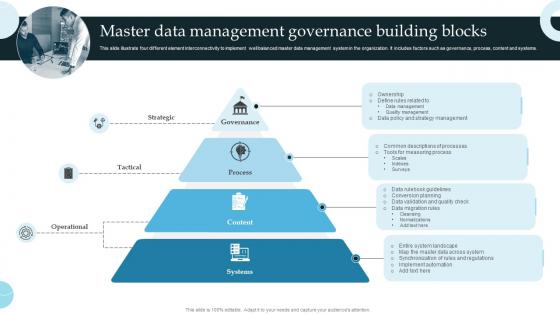
Master Data Management Governance Building Blocks




Try Before you Buy Download Free Sample Product
 Impress Your
 Audience
 100%
100% Editable
 Save Hours
 of Time


This slide illustrate four different element interconnectivity to implement well balanced master data management system in the organization. It includes factors such as governance, process, content and systems.
People who downloaded this PowerPoint presentation also viewed the following :
Master Data Management Governance Building Blocks with all 6 slides:
Use our Master Data Management Governance Building Blocks to effectively help you save your valuable time. They are readymade to fit into any presentation structure.






FAQs for Master Data Management
Key components of an effective Master Data Management strategy include data governance frameworks, quality management processes, integration platforms, standardization protocols, and stakeholder alignment initiatives. These elements work together by establishing clear ownership structures, ensuring consistent data across systems, and enabling seamless information flow, with many organizations finding that this strategic combination ultimately delivers enhanced operational efficiency and competitive advantage.
Organizations assess master data quality through completeness audits, accuracy verification, consistency checks across systems, timeliness validation, and uniqueness analysis to identify duplicates. These comprehensive evaluations enable businesses to benchmark current data integrity, prioritize improvement initiatives, and establish ongoing monitoring protocols, ultimately delivering enhanced operational efficiency and more reliable decision-making capabilities.
Data governance provides the framework, policies, and oversight mechanisms that ensure master data quality, consistency, and compliance across organizational systems. Through established governance structures, organizations streamline data stewardship responsibilities, enhance cross-departmental collaboration, and maintain regulatory adherence, while ultimately delivering improved decision-making capabilities and operational efficiency in increasingly data-driven business environments.
Master Data Management enhances customer relationship management by creating unified customer profiles, eliminating data silos, and ensuring consistent information across all touchpoints. Through centralized data governance, organizations streamline customer interactions, personalize marketing campaigns, and accelerate service delivery, with many financial services and retail companies finding that consolidated customer data significantly improves satisfaction and retention rates.
Common MDM implementation challenges include data quality issues, system integration complexities, organizational resistance to change, governance framework establishment, and resource allocation conflicts. These obstacles often arise when organizations underestimate the cultural shift required, with many financial services and healthcare institutions finding that successful MDM initiatives demand cross-departmental collaboration, executive sponsorship, and phased rollout strategies to minimize disruption while maximizing adoption.
Master Data Management integrates with AI and machine learning by providing clean, consistent data foundations for training algorithms, enabling predictive analytics, and automating data quality processes through intelligent validation rules. These technologies enhance MDM by streamlining data classification, identifying duplicate records, and delivering real-time insights, with many financial services and healthcare organizations finding that this strategic combination accelerates decision-making while reducing operational costs.
Organizations should follow practices including establishing data governance frameworks, implementing standardized data formats, creating comprehensive data quality rules, maintaining consistent data validation processes, and ensuring real-time synchronization across systems. These approaches streamline operations by eliminating data silos, reducing integration errors, and enhancing data accuracy, with many enterprises finding that strategic MDM integration ultimately delivers improved decision-making capabilities and operational efficiency.
Effective Master Data Management ensures regulatory compliance by establishing accurate, consistent data governance frameworks, automated audit trails, and standardized data quality controls across all systems. Through centralized data oversight, organizations in banking, healthcare, and financial services can demonstrate transparency, maintain complete regulatory reporting, and reduce compliance risks, while ultimately streamlining audit processes and avoiding costly penalties.
Key metrics for Master Data Management success include data accuracy rates, completeness percentages, consistency scores across systems, time-to-resolution for data issues, and user adoption rates. These measurements enable organizations to track data quality improvements, operational efficiency gains, and compliance adherence, with many enterprises finding that comprehensive metric tracking ultimately delivers faster decision-making and reduced operational costs.
Master Data Management facilitates better decision-making by ensuring all departments access consistent, accurate, and up-to-date information from a single source of truth. This eliminates data silos and discrepancies that often lead to conflicting insights across finance, marketing, and operations teams. With unified master data, organizations streamline cross-departmental collaboration, reduce decision delays, and ultimately deliver more strategic, data-driven outcomes that enhance competitive advantage.
Poor Master Data Management creates significant operational challenges including inconsistent customer records, duplicate inventory entries, inaccurate financial reporting, delayed decision-making, and compliance risks. These data quality issues ultimately result in increased operational costs, reduced productivity, and compromised customer experiences, with many organizations finding that unreliable master data undermines strategic initiatives and competitive positioning across departments.
Cloud-based solutions enhance Master Data Management by providing scalable infrastructure, real-time data synchronization, and centralized governance across multiple locations and systems. These platforms streamline data integration through automated workflows, reduce IT maintenance costs, and enable faster deployment, with many organizations finding that cloud MDM delivers improved data accessibility, enhanced security protocols, and seamless collaboration between departments while supporting global business expansion.
Master Data Management significantly enhances data security and privacy by centralizing data governance, implementing consistent access controls, and establishing standardized security protocols across all systems. Through unified data stewardship, organizations streamline compliance with regulations like GDPR and HIPAA, minimize data exposure risks, and enable precise audit trails, with many financial institutions and healthcare providers finding that centralized master data delivers both enhanced security and operational efficiency.
**INPUT**: What strategies can be adopted to ensure user buy-in for Master Data Management systems? **OUTPUT**: Effective user buy-in strategies include comprehensive training programs, clear communication of benefits, involving key stakeholders in system design, and demonstrating quick wins. These approaches streamline adoption by addressing user concerns, showcasing operational efficiency gains, and establishing data governance champions across departments, with many organizations finding that early engagement ultimately delivers higher compliance rates and sustained system utilization. [Word count: 58 words]
Industry standards like ISO 8000 and DMBOK significantly influence Master Data Management frameworks by providing structured governance protocols, data quality benchmarks, and standardized implementation methodologies. These frameworks enable organizations across sectors like financial services, healthcare, and manufacturing to establish consistent data practices, ensure regulatory compliance, and streamline integration processes, ultimately delivering enhanced operational efficiency and competitive advantage.
-
“Easy to use. I always wanted to have a quick search for products and SlideTeam has helped me have it.”
-
Easy to edit slides with easy to understand instructions.