


Masterclass investor funding elevator pitch deck ppt template





Try Before you Buy Download Free Sample Product
 Impress Your
 Audience
 100%
100% Editable
 Save Hours
 of Time


The masterclass is the new trend among students as a career enhancement program executed through quality experts and targets the market based on several segments. To provide the right approach, here is a professionally designed pitch deck on Masterclass Investor Funding based on the guide to offer customers valid and genuine solutions. The structure covered in the proposal starts from the introduction slide that presenters can use to provide the first impression of their business, covering details about vision, mission, and expertise. The introduction slide is followed by the problem slide, in which the presenters can clearly state the problem. The company can use the slide target market to address the potential investors about its market via geographic, demographic, psychographic, and behavioral information. Slides such as solution, traction, marketing and sales strategy, competition, team, and financials will assist the businesses in addressing the critical investors about the solution they are offering to overcome pain points, business traction, strategy for targeting potential customers, competitive landscape, team members contributing to business success and financial projection for next five years. Lastly, companies can tell investors how much funding they are looking for and what they plan to do with it. Book a free demo and get access now.
People who downloaded this PowerPoint presentation also viewed the following :
Content of this Powerpoint Presentation
Slide 1: This slide displays title i.e. 'Masterclass Investor Funding Elevator Pitch Deck'.
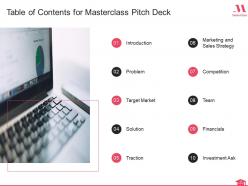
Slide 2: This slide presents table of contents.
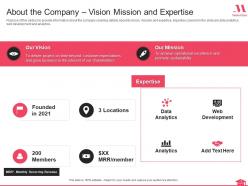
Slide 3: This slide provide information about the company covering details about its vision, mission and expertise.
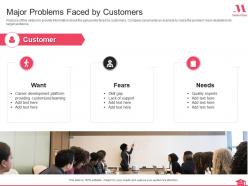
Slide 4: This slide provide information about the pain points faced by customers.
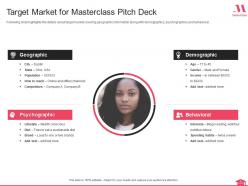
Slide 5: This slide highlights the details about target market covering geographic information.
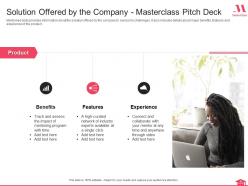
Slide 6: This slide provides information about the solution offered by the company to overcome challenges.
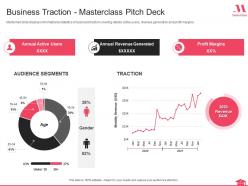
Slide 7: This slide displays informational statistics of business traction covering details active users, etc.
Slide 8: This slide shows the strategies that company will adopt in order to market its product.
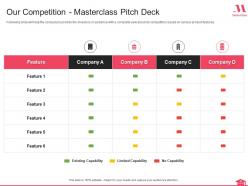
Slide 9: This slide will help the company to provide the investors or audience with a complete view about its competitors based on various product features.
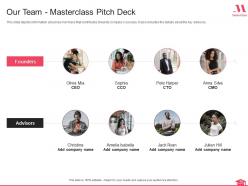
Slide 10: This slide depicts information about key members that contributes towards company’s success.
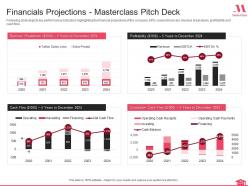
Slide 11: This slide depicts key performance indicators highlighting the financial projections of the company.
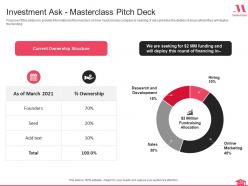
Slide 12: This slide provide information to the investors on how much money company is seeking.
Slide 13: This is the icons slide.
Slide 14: This slide presents title for additional slides.
Slide 15: This slide shows about your company, target audience and its client's values.
Slide 16: This slide depicts 30-60-90 days plan for projects.
Slide 17: This slide shows details of team members like name, designation, etc.
Slide 18: This slide presents your company's vision, mission and goals.
Slide 19: This slide exhibits yearly timeline.
Slide 20: This slide displays Venn.
Slide 21: This slide depicts posts for past experiences of clients.
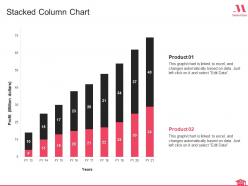
Slide 22: This slide exhibits yearly profits stacked column charts for different products. The charts are linked to Excel.
Slide 23: This slide highlights comparison of products based on selects.
Slide 24: This is thank you slide & contains contact details of company like office address, phone no., etc.
Masterclass investor funding elevator pitch deck ppt template with all 24 slides:
Use our Masterclass Investor Funding Elevator Pitch Deck Ppt Template to effectively help you save your valuable time. They are readymade to fit into any presentation structure.






FAQs for Masterclass investor funding elevator pitch
An effective investor pitch deck should include a compelling problem statement, unique solution, market size and opportunity, business model, competitive analysis, financial projections, and team credentials. These elements work together by demonstrating market need, showcasing scalability potential, and building investor confidence, with many successful startups finding that clear value propositions and realistic growth projections ultimately secure funding.
Storytelling enhances investor pitch decks by creating emotional connections, simplifying complex concepts, and making data memorable through narrative structure. Successful entrepreneurs weave compelling founder journeys, customer transformation stories, and market opportunity narratives throughout their presentations, with many investors finding that stories help them visualize potential returns and remember pitches long after meetings conclude.
Common mistakes include overloading slides with text, lacking clear financial projections, presenting unrealistic market assumptions, failing to address competition adequately, and neglecting to define the problem clearly. Many entrepreneurs also underestimate funding timelines, omit scalability discussions, or present inconsistent data across slides, with successful startups finding that focused storytelling, realistic projections, and clear value propositions ultimately deliver stronger investor engagement and funding outcomes.
Financial projections should present realistic revenue forecasts, detailed expense breakdowns, cash flow timelines, key performance metrics, and funding requirements with clear assumptions. These elements demonstrate viability through conservative growth estimates, milestone-based projections, and scenario planning, with many investors finding that transparent, data-driven forecasts showing scalable business models ultimately deliver greater confidence and investment interest.
The ideal investor pitch deck length is 10-12 slides for presentations and 15-20 slides for detailed review documents. This strategic length enables entrepreneurs to cover essential elements like market opportunity, business model, and financial projections while maintaining investor attention, with many successful startups finding that concise decks facilitate faster decision-making and more focused discussions.
Visuals and graphics improve pitch comprehensibility by simplifying complex data, highlighting key metrics, and creating memorable visual narratives that resonate with investors. Through strategic charts, infographics, and visual storytelling, startups can communicate market opportunities, business models, and growth projections more effectively, while reducing cognitive load and enhancing investor engagement, ultimately delivering clearer value propositions.
Market research validates your business opportunity by demonstrating market size, customer demand, competitive landscape, and growth potential through data-driven insights. It provides credibility to your value proposition and financial projections, with investors particularly focusing on total addressable market analysis, customer validation studies, and competitive differentiation strategies, ultimately enabling founders to present compelling evidence that supports their funding request and growth assumptions.
Founders can effectively convey their value proposition by clearly articulating the specific problem they solve, their unique solution approach, target market size, and competitive differentiation within 30-60 seconds. This involves focusing on quantifiable benefits, using concrete examples from early customers or pilot programs, and emphasizing scalable outcomes that resonate with investors' portfolio growth expectations.
**INPUT**: What are the best practices for tailoring a pitch deck to specific investors or audiences? **OUTPUT**: Best practices include researching investor portfolios and preferences, customizing market sizing to their focus areas, highlighting relevant case studies from their industry expertise, and adjusting financial projections to match their typical investment stages. Successful entrepreneurs often find that venture capital firms respond well to scalability narratives, while angel investors prefer founder stories and early traction metrics, ultimately delivering more engaging presentations and higher conversion rates.
Startups should address competition through competitive analysis slides, market positioning frameworks, differentiation strategies, and unique value propositions that clearly distinguish their offering. Rather than dismissing competitors, successful pitches acknowledge the competitive landscape while demonstrating superior technology, business models, or market approaches, with many investors appreciating transparency that showcases strategic awareness and sustainable competitive advantages.
Technology startup pitches should include user acquisition cost (CAC), monthly recurring revenue (MRR), customer lifetime value (LTV), churn rate, and growth metrics like user engagement and retention rates. These KPIs demonstrate scalability and market validation to investors, with many successful startups finding that clear LTV-to-CAC ratios and consistent month-over-month growth ultimately deliver the credibility needed for funding decisions.
A pitch deck maintains investor engagement through strategic storytelling flow, starting with a compelling problem statement, presenting a clear solution, demonstrating market opportunity, showcasing business model viability, and concluding with strong financial projections. This structured narrative approach enables entrepreneurs to build momentum progressively, address investor concerns systematically, and ultimately deliver persuasive presentations that secure funding commitments.
**INPUT**: What strategies can be employed to create a memorable call to action at the end of the pitch? **OUTPUT**: Memorable pitch calls to action include specific investment amounts with clear timelines, compelling urgency through market timing, strategic partnership opportunities, exclusive investor benefits, and tangible next steps. These approaches work by creating immediacy, demonstrating preparation, and offering concrete value propositions, with many successful startups finding that combining financial specificity with strategic urgency ultimately drives faster investor decisions and stronger commitment levels.
Design aesthetic significantly influences investor perceptions by establishing credibility, professionalism, and attention to detail that reflects management quality and business sophistication. A polished, cohesive visual presentation enhances message clarity, builds trust, and demonstrates the team's commitment to excellence, with many investors finding that poor design undermines even strong business fundamentals and reduces perceived investment viability.
Seeking feedback helps identify weak arguments, unclear messaging, and missing critical information that could derail investor interest. Through practice presentations to mentors, advisors, and industry experts, entrepreneurs can refine their narrative flow, anticipate tough questions, and strengthen financial projections, ultimately delivering a more polished and compelling pitch that maximizes funding opportunities.
-
Great designs, really helpful.
-
Great quality product.