

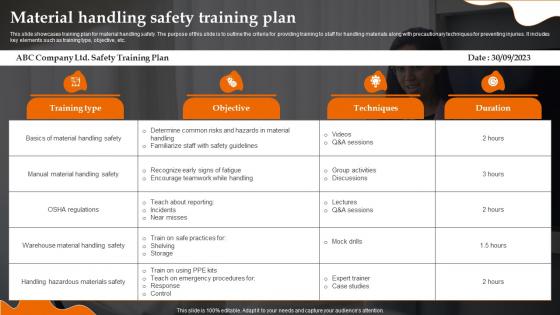
Material Handling Safety Training Plan




Try Before you Buy Download Free Sample Product
 Impress Your
 Audience
 100%
100% Editable
 Save Hours
 of Time


This slide showcases training plan for material handling safety. The purpose of this slide is to outline the criteria for providing training to staff for handling materials along with precautionary techniques for preventing injuries. It includes key elements such as training type, objective, etc.
People who downloaded this PowerPoint presentation also viewed the following :
Material Handling Safety Training Plan with all 9 slides:
Use our Material Handling Safety Training Plan to effectively help you save your valuable time. They are readymade to fit into any presentation structure.








FAQs for Material Handling
Dude, back injuries are the worst - happens when people lift wrong or try to be heroes with heavy stuff. Watch out for falling boxes too, that shit hurts. Forklift accidents are pretty common unfortunately. Your body's gonna hate you after a few months of repetitive motions, especially your shoulders and wrists. Spills make floors slippery as hell, and there's always random crap in walkways to trip over. Box edges will cut you up if you're not careful. Honestly just don't rush around like a maniac. Bend your knees when lifting and keep heavy things close to your chest.
Look, good training seriously prevents accidents because you learn proper lifting techniques and how to spot sketchy situations before they become problems. Your body develops that automatic muscle memory - kinda like when you first learned to parallel park, you know? Equipment operation becomes second nature when you've practiced it right. Real-world scenarios matter more than just textbook stuff though. Don't skip the refresher courses either since you'll get sloppy without them. Bottom line: knowing what you're doing keeps you and your coworkers from ending up in the ER.
Dude, you've gotta take ergonomics seriously for material handling - it'll save your body so much grief down the road. I messed up my back lifting boxes wrong for like 3 months straight, total nightmare. Proper lifting technique is everything - use your legs, not your back. Get your workstation adjusted to your height too. Regular breaks are clutch because that's when you get sloppy and accidents happen. Your shoulders and joints will thank you later. Honestly, most people think they're invincible until something pops. Don't be that guy.
Safety shoes with toe protection are a must, plus decent work gloves for grip. Back support belt if you're lifting heavy stuff all day. Eye protection too - trust me, getting dust in your eyes sucks. High-vis gear so people can actually see you around machinery and whatnot. Oh, and earplugs in loud areas because tinnitus is no joke. Honestly though, don't just throw on everything at once like some people do. Match what you're wearing to what you're actually doing. Your supervisor should tell you what's required for your specific job anyway.
Track your incident rates and near-miss reports - those are your bread and butter metrics. But here's what I've learned: the real insights come from just walking around and chatting with your crew. They know where the problems are way before the paperwork catches up. Don't forget training completion rates and how fast people report hazards. Honestly, quarterly walk-throughs with frontline folks beat fancy dashboards every time. Pick maybe 3 key things to watch monthly and you'll be good.
Okay so first thing - always bend your knees, not your back. Seriously learned this after I messed up my back moving last year, wasn't fun. Get a good grip and pull whatever you're lifting close to your chest before standing up. Oh and do that thing where you lift just one corner first to test if it's actually manageable? Super helpful. Anything over 50 pounds or just feels weird to handle, don't be stubborn about it. Grab someone to help or find a dolly. Trust me, your back will hate you later if you try to be all tough about it.
Smart workplace layout cuts way down on handling injuries - you'll see a huge difference. Put stuff people grab constantly at waist level so they're not constantly bending over or stretching up high. Wide aisles for moving equipment around, better lighting (seriously, half these accidents happen because people can't see properly), and storage spots that actually make sense. The workflow thing is key too - why make someone haul heavy boxes across the entire warehouse? Map out what you've got now and figure out where people are getting hurt most. Those are your starting points.
Yeah so robots definitely cut down on the nasty stuff - no more throwing out your back lifting heavy boxes or doing the same motion a thousand times. Hazardous areas too, obviously better to send a machine in there. But honestly, you get different problems now. People still get hurt during maintenance or when they wander too close to those robotic arms (which move fast as hell). Main thing is training your crew properly on how to work around automated equipment. Oh and having clear zones where humans and robots interact - that's where most accidents happen if you're not careful about protocols.
Think of safety audits like getting your car inspected - annoying but they catch stuff before it breaks. Walk around quarterly and you'll find equipment that's about to fail, workers cutting corners (we all do it), and holes in your procedures. I swear you become blind to problems when you see the same thing daily. Plus your team stays alert when they know someone's actually paying attention. Don't just sit in your office filling out forms though. Get out there with everyone and see what's really happening on the floor.
So OSHA sets the basic rules everyone has to follow, but each industry gets more specific from there. Manufacturing and warehouses have tighter lift limits and equipment cert stuff. Construction's all about crane ops and securing loads properly. Healthcare gets super detailed with patient lifting - like, way more complicated than you'd think. Check your state's OSHA site first since they sometimes add extra requirements on top of federal ones. Union contracts can throw in more rules too if that applies to you. Start with OSHA's general material handling standards, then look up whatever's specific to your field. It's actually not too hard to find once you know where to look.
Dude, first thing - gear up with whatever PPE the safety sheets say. Gloves, goggles, respirator, the whole deal. Actually read those SDS forms before touching anything (I know, boring but necessary). Keep incompatible stuff separated - trust me on that one, learned it the messy way. Label everything clearly and seal containers tight. Your team needs spill training, and keep emergency gear close by. Oh, and ventilation is huge, especially if you're stuck in some cramped space. When you're unsure about something? Just ask someone who knows.
Honestly, the biggest game-changer is picking one person to be the "voice" for tricky moves - multiple people shouting directions is just asking for trouble. Before you start each shift, do a quick huddle about what you're tackling that day and any sketchy stuff to watch for. Set up your hand signals and verbal cues so everyone's on the same page. If it's loud or you're spread out, radios are worth their weight in gold. Oh, and make sure everyone knows they can yell "stop" anytime without catching heat for it.
Good signage is honestly a game-changer for keeping people safe. When everyone can see weight limits and hazard zones clearly, accidents drop way down. Those "forklift crossing" signs? They actually work - people look up from their phones! Your signs need to be visible and current, obviously. But here's the thing - walk through your space monthly and think like a new guy. Could someone who's never been there figure out the dangerous spots just from your signs? That's the real test. Traffic flows better too when people know where they're going.
Honestly, the safety tech coming out lately is pretty sweet. Proximity sensors on forklifts will literally slam the brakes if someone gets too close - creates this invisible safety bubble around equipment. Smart vests now track your posture and buzz before you mess up a lift. AI cameras spot risky behavior and ping supervisors instantly. Oh, and exoskeletons are actually becoming affordable now, which is wild. I'd probably start with proximity sensors for your current forklifts though - easiest thing to roll out fast and you'll see results right away.
Look, incident reporting basically shows you what's actually going wrong instead of just guessing. You'll start noticing patterns - like the same spot keeps causing injuries or that one forklift is always involved. Pretty obvious stuff once you see it on paper. The data tells you where to focus your safety efforts and what training people actually need. Then you can fix the real problems - better procedures, new equipment, whatever. Oh and make sure your team knows they won't get in trouble for reporting things. Nobody wants to fill out paperwork just to get yelled at later.
-
Definitely recommend SlideTeam to all who need help with PowerPoint presentations. Their design team can create anything you need.
-
“Easy to use. I always wanted to have a quick search for products and SlideTeam has helped me have it.”