

Material Requirement Planning Powerpoint Ppt Template Bundles





Try Before you Buy Download Free Sample Product
 Impress Your
Audience
 100%
Editable
 Save Hours
of Time


Our Material Requirement Planning Powerpoint Ppt Template Bundles are topically designed to provide an attractive backdrop to any subject. Use them to look like a presentation pro.
People who downloaded this PowerPoint presentation also viewed the following :
Material Requirement Planning Powerpoint Ppt Template Bundles with all 31 slides:
Use our Material Requirement Planning Powerpoint Ppt Template Bundles to effectively help you save your valuable time. They are readymade to fit into any presentation structure.









FAQs for Material Requirement Planning Powerpoint
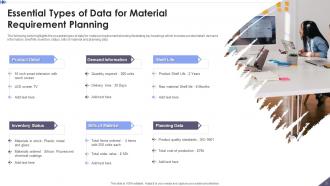
So you need three main things: accurate inventory data, a solid master production schedule, and a complete bill of materials. Honestly, most systems crash and burn because the inventory data is trash - fix that first or you're basically building on quicksand. Your master schedule tells you when stuff needs to get made, and the BOM breaks down exactly what materials you need for each product. Oh, and decent lead time data helps too, obviously. I'd definitely start with cleaning up inventory accuracy since that's what makes everything else actually work. It's like - why bother with the fancy stuff if your foundation is wonky?
So basically MRP calculates exactly what materials you need and when, which stops you from hoarding excess inventory that just eats up cash. No more guessing or ordering extra "just in case." The system looks at your production schedule and bill of materials to nail down precise quantities and timing. Rush orders become way less common since you get better lead time visibility. Honestly, when it actually works it's pretty satisfying to see everything sync up like that. Just make sure your data's clean first - your BOMs and inventory records need to be spot-on or you're screwed.
Okay so demand forecasting is literally the backbone of your whole MRP system. It drives everything - your production schedule, material orders, capacity planning, all of it. Get the forecast wrong and you're screwed either way: too much inventory eating up your cash or stockouts with pissed off customers. I've seen companies tank because they half-assed this part. Your MRP is only as good as what you feed it, you know? Spend the time upfront getting your forecasting models dialed in. Review them monthly at least. Trust me, it's way better than dealing with the mess later.
So MRP is basically what connects everything in your ERP - it calculates what materials you need, then automatically sends that info to procurement for purchase orders and updates your inventory numbers. Finance gets the cost data too, which saves tons of manual work. Your suppliers can see demand forecasts through the supply chain piece, and shipping schedules sync up to keep timing smooth. Honestly, the whole thing falls apart if your item masters and BOMs are messy though - clean data is everything. Oh, and make sure you've got good integration between modules or you'll be doing way too much manual entry.
Honestly, the worst part is usually crappy data - if your inventory numbers or lead times are off, everything falls apart fast. Your team will probably push back hard too since nobody wants to learn new software when the old way "works fine." I learned this the hard way, but clean up your data before you do anything else. Costs always end up higher than you think, especially with all the training time. Getting a few key people excited about it early makes a huge difference though. Oh, and expect some workflow chaos at first - it's just part of the process unfortunately.
So MRP basically shows you what materials you need and when you need them. No more scrambling for parts at the last second, you know? It calculates lead times for everything in your bill of materials, which means you can actually see bottlenecks before they hit. Pretty much like having a crystal ball for your supply chain - okay, maybe not that magical, but close! The trick is keeping your data accurate because if you put junk in, you'll get junk out. Map out your current lead times first and you'll notice scheduling gets way smoother almost immediately.
Honestly, start simple - just track inventory turnover and how often you're running out of stuff. Those two tell you if you're actually keeping the right amount on hand. Order fulfillment times are huge too. I'd also look at on-time delivery percentages and whether production is sticking to schedule (that one can be brutal if things are messy). If you want to get fancy later, compare your demand forecasts to what actually happened - super revealing but kind of a pain to calculate. Don't try measuring everything at once though, you'll go crazy.
Yeah, MRP systems are super flexible - you can tweak lead times, forecasting models, and how you structure your bills of materials. Fashion companies usually set up seasonal patterns since trends change so fast. Manufacturing folks mess with lot sizing and safety stock calculations mostly. The setup gets messy but that's honestly where it shines. Planning horizons are adjustable, plus you can pull in supplier data and set up alerts for whatever bottlenecks drive you crazy. I'd start by figuring out what weird quirks your industry has compared to regular manufacturing - that'll guide everything else.
Honestly, don't try to fix everything at once - you'll just overwhelm yourself. Pick one thing that's driving you crazy, like inventory or scheduling. Excel works fine to start with MRP basics before you drop serious cash on fancy software. The biggest game-changer is just knowing when to order stuff and how much. I've watched so many companies jump straight into full ERP systems and totally burn out their teams (it's brutal). Get your demand forecasting sorted first - that's your foundation. Maybe test it out with your 10 best-selling products? Way less stressful than going all-in from day one.
Dude, the MRP stuff happening right now is crazy good. AI can actually predict demand patterns that would take humans forever to spot. Cloud solutions mean smaller companies aren't stuck with those ancient expensive systems anymore - which honestly was way overdue. Real-time data from IoT sensors keeps everything synced up, so you're not working with stale inventory numbers. The analytics can spot bottlenecks coming before they wreck your timeline. If you're still dealing with some old clunky system, definitely look into cloud options with AI built in. The time you'll save is insane.
Dude, your BOM data HAS to be spot-on or MRP will totally screw you over. Here's the thing - MRP uses those bills to calculate what you need and when. One little mistake? It snowballs into shortages, too much inventory, delayed production. I've watched teams waste weeks thinking their system was broken when really their BOM was just wrong. Pretty frustrating, honestly. Everything gets messed up - purchasing, delivery dates, the whole nine yards. Start with your most important BOMs and get engineering to review them regularly. Trust me on this one.
Dude, MRP data accuracy is such a pain but totally fixable. First thing - ditch those yearly inventory counts and do cycle counting instead. Way better at catching problems early. Set up some automated rules to flag weird stuff like negative inventory numbers or crazy lead times. Honestly, most of this comes down to training your people properly since like 80% of data issues are just typos and user errors. Oh and make sure someone actually owns each dataset - can't tell you how many times I've seen data issues because nobody knows whose job it is to fix them. The trick is making it part of your daily routine instead of scrambling to fix everything once a quarter.
So MRP basically recalculates everything when you update your production schedule - it's always trying to catch up with what's actually happening. New demand comes in? It automatically tweaks your purchase orders and production plans. Running it daily seems overkill to me, but some companies do that now. The real trick is nailing your lead times and safety stock upfront so you're not panicking when demand randomly jumps. Oh, and don't forget to actually look at those exception reports - they'll save you headaches later. Frequent forecast updates help too.
Set up monthly data audits first - inventory accuracy, lead times, BOMs, all that stuff. Your master data has to be clean or you're basically screwed from the start. Train your team regularly because honestly, people forget this stuff faster than you'd think. Automated alerts are a lifesaver for catching negative inventory or overdue orders before they blow up. Oh, and do quarterly reviews with everyone involved to see what's working and what isn't. The data thing is where I'd start though - maybe shoot for next week?
Honestly, cloud MRP is a game changer because everyone can see the same data at the same time. No more back-and-forth emails about when stuff's arriving or how much inventory you've got. Your suppliers update delivery schedules directly in the system, you adjust production plans instantly - it actually works. Think of it like a shared spreadsheet but way more powerful. I'd start with your most important suppliers first, then bring the others on later. The whole "everyone staying in sync" thing sounds cheesy but it's real. Makes such a difference when you're not constantly chasing people down for updates.
-
Been using SlideTeam for some time now…can’t imagine why I wasted all that time in front of the screen trying to make the perfect presentation.
-
Thank you for offering such fantastic custom design services. The team is really helpful and innovative. In a very short time, I received my personalized template.