

Medical Device Industry Report Powerpoint Presentation Slides IR SS





Try Before you Buy Download Free Sample Product
 Impress Your
 Audience
 100%
100% Editable
 Save Hours
 of Time


The global medical devices market size was valued at USD 512.29 billion in 2022. The market is projected to reach USD 799.67 billion by 2030, exhibiting a CAGR of 5.9percent from 2023 to 2030. Our Global Medical Device Industry Outlook, a unique resource, is revolutionizing the medical device industry. Its a must-have for professionals seeking a deep understanding of this dynamic sector. This meticulously crafted report also delves into the medical device industrys growth drivers, trends, and market size. Furthermore, our Diagnostic Devices PPT offers a comprehensive market analysis, employing powerful frameworks such as SWOT, PESTLE, and Porters analysis to provide valuable insights. It also examines the competitive landscape, assessing key players and their strategies. Lastly, the Implantable Medical Devices Deck encompasses the latest industry laws and regulations, key restraints, and lucrative growth opportunities. Stay informed and make informed decisions with our cutting-edge Medical Device Industry report. Get access now.
People who downloaded this PowerPoint presentation also viewed the following :
Content of this Powerpoint Presentation
Slide 1: This slide introduces Medical Device Industry Report. State Your Company Name and begin.
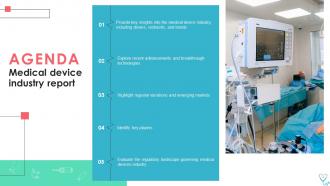
Slide 2: This slide is an Agenda slide. State your agendas here.
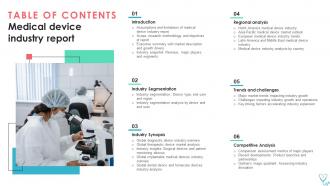
Slide 3: This slide shows a Table of Contents for the presentation.
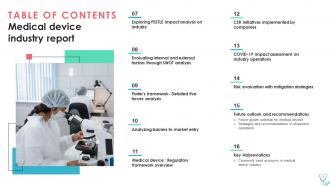
Slide 4: This slide is in continuation with the previous slide.
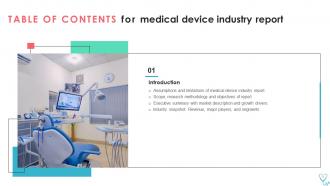
Slide 5: This slide is an introductory slide.
Slide 6: This slide represents the key considerations and limitations while building the medical device industry report.
Slide 7: The slide shows the overview of the medical device industry report.
Slide 8: This slide provides a concise overview of the medical device industry.
Slide 9: This slide gives a glimpse of key highlights of the medical device industry, enabling executives to grasp the main findings quickly.
Slide 10: This slide is an introductory slide.
Slide 11: This slide showcases the medical device industry segmentation based on attributes.
Slide 12: This slide highlights medical device market segmentation based on device type and end user.
Slide 13: This slide is an introductory slide.
Slide 14: The slide illustrates a comprehensive overview of diagnostic device industry.
Slide 15: This slide pertains to the industry outlook of therapeutic devices.
Slide 16: This slide outlines assessment of surgical devices and patient monitoring devices market.
Slide 17: This slide elucidates a comprehensive overview of the implantable medical device industry.
Slide 18: This slide entails market analysis of dental device and homecare devices.
Slide 19: This slide is an introductory slide.
Slide 20: This slide depicts overview of North American medical device industry.
Slide 21: This slide represents overview of Asia Pacific medical device industry.
Slide 22: This slide presents overview of Asia Pacific medical device industry.
Slide 23: This slide mentions overview of Asia Pacific medical device industry.
Slide 24: This slide indicates European medical device industry overview.
Slide 25: This slide projects comprehensive medical device industry scenario in Latin America and Middle East to equip stakeholders with valuable insights.
Slide 26: This slide outlines an overview of the medical device industry on a country-wise basis, facilitating market entry strategies and investment opportunities.
Slide 27: This slide is an introductory slide.
Slide 28: This slide covers key trends in medical device industry.
Slide 29: This slide analyzes challenges facing medical device industry.
Slide 30: This slide gives a comprehensive overview of the growth prospects in the medical device market.
Slide 31: This slide provides a comprehensive overview of the growth prospects in the medical device market.
Slide 32: This slide is an introductory slide.
Slide 33: This slide contains a comprehensive comparative analysis of major competitors in the medical device industry.
Slide 34: This slide highlights recent news and developments of major key players in the medical device industry.
Slide 35: This slide is in continuation with the previous slide.
Slide 36: This slide illustrates Gartner's magic quadrant framework for analyzing the competitive ability of competitors.
Slide 37: This slide is in continuation with the previous slide.
Slide 38: This slide depicts PESTLE analysis which companies can use to evaluate the external factors impacting industry's growth and profitability.
Slide 39: This slide details PESTLE analysis which companies can use to evaluate the external factors impacting industry's growth and profitability.
Slide 40: This slide is in continuation with the previous slide.
Slide 41: This slide covers the medical device industry's strengths, weaknesses, opportunities, and threats.
Slide 42: This slide is in continuation with the previous slide.
Slide 43: This slide highlights Porter’s framework and its implications in the medical device industry.
Slide 44: This slide is in continuation with the previous slide.
Slide 45: This slide exhibits significant barriers to medical device market.
Slide 46: This slide is in continuation with the previous slide.
Slide 47: This slide provides a comprehensive overview of the rules and regulations governing the medical device industry.
Slide 48: This slide caters to a comprehensive overview of the rules and regulations governing the medical device industry.
Slide 49: This slide is in continuation with the previous slide.
Slide 50: This slide outlines CSR initiatives undertaken by the medical device industry.
Slide 51: This slide is in continuation with the previous slide.
Slide 52: This slide analyzes the impact of COVID-19 on the medical device industry.
Slide 53: This slide caters to the impact of COVID-19 on the medical device industry.
Slide 54: This slide is an introductory slide.
Slide 55: This slide depicts risk assessment for the medical device industry.
Slide 56: This slide is an introductory slide.
Slide 57: This slide highlights the future outlook and potential for the medical device industry.
Slide 58: This slide provides valuable recommendations and effective strategies for medical device industry players to succeed in a dynamic and competitive market.
Slide 59: This slide is an introductory slide.
Slide 60: This slide represents acronyms and terminology used in the medical device industry.
Slide 61: This slide shows all the icons included in the presentation.
Slide 62: This slide is titled Additional Slides for moving forward.
Slide 63: This slide presents a Roadmap with additional text boxes.
Slide 64: This slide displays Mind Map with related imagery.
Slide 65: This slide shows Post-It Notes. Post your important notes here.
Slide 66: This slide contains a Puzzle with related icons and text.
Slide 67: This slide depicts a Venn diagram with text boxes.
Slide 68: This slide is a thank-you slide with address, contact numbers, and email address.
Medical Device Industry Report Powerpoint Presentation Slides IR SS with all 76 slides:
Use our Medical Device Industry Report Powerpoint Presentation Slides IR SS to effectively help you save your valuable time. They are readymade to fit into any presentation structure.








































































FAQs for Medical Device Industry Report Powerpoint Presentation
Key growth drivers include aging populations, chronic disease prevalence, technological innovations like AI and IoT, emerging market expansion, and regulatory modernization initiatives. These factors collectively enhance device capabilities, streamline patient care delivery, and expand market accessibility, with healthcare systems increasingly finding that advanced medical technologies deliver improved patient outcomes, operational efficiency, and cost-effective care solutions.
Regulatory compliance for medical device manufacturers is evolving through harmonized international standards, digital submission processes, enhanced post-market surveillance requirements, and stricter cybersecurity mandates. These changes streamline global market access by reducing duplicate testing, accelerating approval timelines, and improving patient safety monitoring, with many manufacturers finding that proactive compliance strategies ultimately deliver competitive advantages and faster product launches.
Technology integration through AI and IoT significantly enhances medical device functionality by enabling real-time monitoring, predictive analytics, automated diagnostics, and seamless data connectivity across healthcare networks. These technologies streamline patient care by delivering faster diagnoses, reducing human error, and improving treatment outcomes, with hospitals and clinics finding that smart devices ultimately enhance operational efficiency while providing superior patient experiences.
Startups entering the medical device market face regulatory compliance hurdles, extensive FDA approval processes, significant capital requirements, and complex reimbursement pathways. These challenges present both obstacles and opportunities, with many successful companies finding that strategic partnerships, phased development approaches, and early regulatory guidance ultimately streamline market entry while building competitive advantages.
Patient-centered design principles are revolutionizing medical device development by prioritizing user experience, accessibility, and clinical outcomes throughout the design process. These principles enable manufacturers to create more intuitive interfaces, reduce user errors, and improve patient compliance, with many healthcare institutions finding that devices designed around patient needs ultimately deliver better therapeutic results, enhanced safety profiles, and stronger market adoption.
Emerging trends in wearable medical technology include continuous glucose monitoring, remote cardiac surveillance, sleep disorder tracking, medication adherence monitoring, and AI-powered health predictions. These devices enhance patient outcomes by enabling real-time health data collection, reducing hospital readmissions, and streamlining chronic disease management, with healthcare providers increasingly finding that wearables deliver cost-effective preventive care.
The pandemic significantly accelerated investment in the medical device sector through increased venture capital funding, government healthcare initiatives, and corporate R&D expansion targeting diagnostics, monitoring technologies, and telehealth solutions. With hospitals and healthcare systems prioritizing rapid innovation, investors are finding that companies developing remote patient monitoring, AI-powered diagnostics, and infection control devices deliver substantial returns while addressing critical healthcare infrastructure needs.
Supply chain disruption significantly impacts medical device production through delayed raw material deliveries, manufacturing bottlenecks, increased costs, and regulatory compliance challenges. These disruptions force manufacturers to diversify suppliers, implement inventory buffers, and adopt digital tracking systems, with hospitals and healthcare facilities increasingly finding that strategic partnerships and local sourcing deliver greater operational resilience.
Major players address sustainability through eco-friendly manufacturing processes, recyclable packaging, energy-efficient production facilities, and sustainable supply chain management. Companies like Medtronic and Johnson & Johnson are implementing circular economy principles, reducing carbon footprints, and developing biodegradable materials, ultimately delivering cost savings while meeting increasingly stringent environmental regulations and consumer expectations.
Cybersecurity is critical for connected medical devices because it protects patient data, ensures device functionality, and maintains healthcare system integrity through encryption, authentication protocols, and threat monitoring. These security measures enable hospitals and clinics to safely leverage IoT medical technologies while meeting regulatory compliance, ultimately delivering enhanced patient care and operational efficiency in an increasingly connected healthcare landscape.
Reimbursement policies significantly impact medical device adoption by determining coverage decisions, reimbursement rates, and approval timelines for innovative technologies. While restrictive policies can delay market entry, progressive reimbursement frameworks accelerate adoption by reducing financial barriers for healthcare providers and patients, ultimately enabling faster access to breakthrough treatments and enhancing competitive positioning for device manufacturers.
Recent advancements in imaging and diagnostic devices include AI-enhanced MRI systems, portable ultrasound machines, real-time molecular imaging, advanced CT scanners, and handheld diagnostic tools. These technologies streamline patient care by delivering faster diagnoses, reducing radiation exposure, and enabling point-of-care testing, with hospitals and clinics finding significantly improved patient outcomes and operational efficiency.
Consumer preferences are significantly reshaping medical device design through demands for user-friendly interfaces, portable solutions, smartphone integration, and personalized health tracking capabilities. Healthcare companies are responding by developing intuitive wearable devices, home-monitoring systems, and connected therapeutic equipment, with many finding that patient-centric designs enhance compliance, improve outcomes, and deliver competitive advantage in an increasingly consumer-driven healthcare landscape.
Telemedicine devices will continue expanding beyond pandemic necessity, driven by patient convenience, healthcare accessibility, and cost reduction demands. Remote monitoring tools, diagnostic devices, and virtual consultation platforms are becoming standard in hospitals, clinics, and home healthcare settings, ultimately delivering improved patient outcomes and operational efficiency for healthcare providers.
Collaborations between tech companies and healthcare providers are revolutionizing medical device development through shared expertise, accelerated innovation cycles, and real-world clinical insights that drive user-centered design. These strategic partnerships enable faster regulatory approvals, enhanced interoperability with existing healthcare systems, and ultimately deliver more effective patient outcomes while reducing development costs for breakthrough medical technologies.
-
Extensive range of templates! Highly impressed with the quality of the designs.
-
My presentations were a bit amateur before I found SlideTeam’s designs. I’ve been able to find slides for nearly every topic I’ve had to present. Thanks, Slideteam!