

Message Handling By The Front Office Training Ppt




Try Before you Buy Download Free Sample Product
 Impress Your
 Audience
 100%
100% Editable
 Save Hours
 of Time


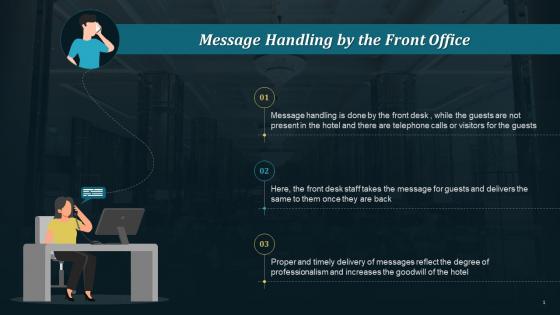
This slide contains information about message handling in hotel. Here, the front desk staff takes the message for guests and delivers it to them once they return.
People who downloaded this PowerPoint presentation also viewed the following :
Message Handling By The Front Office Training Ppt with all 19 slides:
Use our Message Handling By The Front Office Training Ppt to effectively help you save your valuable time. They are readymade to fit into any presentation structure.










FAQs for Message Handling By The Front
Effective message handling principles include clear prioritization, timely response protocols, accurate content interpretation, systematic routing processes, and comprehensive feedback mechanisms. These approaches streamline organizational communication by reducing response delays, minimizing miscommunication risks, and enhancing stakeholder engagement, with many enterprises finding that structured message workflows ultimately deliver improved operational efficiency and stronger customer relationships.
Message handling improves team collaboration by centralizing communications, prioritizing urgent requests, routing messages to appropriate team members, and maintaining clear audit trails of decisions. Through automated workflows and smart filtering, corporate teams experience faster project coordination, reduced email overload, and enhanced transparency across departments, ultimately delivering more efficient operations and stronger cross-functional partnerships.
Non-verbal communication significantly influences message handling by providing context, emotional cues, and relationship dynamics that complement verbal content. Through body language, facial expressions, and tone variations, professionals in healthcare, sales, and customer service enhance message clarity, build stronger rapport, and ultimately deliver more effective communication experiences that strengthen business relationships.
Cultural differences significantly impact message handling through varying communication styles, hierarchy expectations, time orientations, and contextual interpretations that can lead to misunderstandings or delays. International businesses increasingly adopt culturally adaptive communication protocols, multilingual support systems, and region-specific message formatting, with many global organizations finding that localized approaches enhance client relationships, streamline cross-border operations, and ultimately deliver competitive advantage in diverse markets.
Clear and concise messaging techniques include active voice usage, bullet point structuring, visual hierarchy implementation, audience-specific language adaptation, and redundancy elimination. These approaches streamline communication by reducing cognitive load, enhancing information retention, and accelerating decision-making processes, with many organizations finding that strategic message design ultimately delivers improved stakeholder engagement and operational efficiency.
Technology enhances message handling processes by automating routing and prioritization, implementing intelligent filtering systems, and providing real-time tracking capabilities. Through AI-powered solutions and cloud-based platforms, organizations streamline communication workflows, reduce response times, and minimize human error, with many businesses finding that automated message processing delivers faster customer service and improved operational efficiency.
Common barriers to effective message handling include inconsistent messaging protocols, inadequate staff training, outdated communication systems, poor cross-departmental coordination, and insufficient message prioritization frameworks. These challenges often result in delayed responses, miscommunication, and reduced customer satisfaction, with many organizations finding that streamlined message management systems significantly enhance operational efficiency and deliver faster, more reliable customer experiences across all communication channels.
Sensitive information should be handled through encryption during transmission and storage, access controls with role-based permissions, secure authentication protocols, regular audit trails, and data classification systems. These security measures streamline compliance requirements while minimizing breach risks, with many financial services and healthcare organizations finding that strategic information governance ultimately delivers enhanced customer trust and competitive advantage.
Strategies include establishing clear communication hierarchies, implementing centralized message validation systems, creating cross-departmental alignment protocols, and developing consistent messaging frameworks across all channels. These approaches streamline organizational communication by reducing contradictions, enhancing internal coordination, and ensuring unified external messaging, with many companies finding that structured message management significantly improves operational efficiency and stakeholder trust.
Feedback loops enhance message handling effectiveness by enabling real-time monitoring, identifying bottlenecks, and facilitating continuous optimization of communication processes. Through automated response tracking and performance analytics, organizations streamline workflows, reduce processing delays, and improve customer satisfaction rates, with many financial services and healthcare institutions finding that systematic feedback mechanisms ultimately deliver faster resolution times and enhanced operational efficiency.
Message overload significantly reduces employee productivity by fragmenting attention, increasing response time pressure, and creating cognitive fatigue from constant context switching. In knowledge-intensive sectors like financial services and consulting, organizations report up to 40% productivity losses, with employees spending excessive time managing communications rather than strategic work, ultimately hampering decision-making quality and operational efficiency.
Visuals enhance message handling through interactive dashboards, real-time flow diagrams, status indicators, error visualization tools, and comprehensive system maps. These visual elements streamline troubleshooting by displaying message queues, processing bottlenecks, and delivery statuses instantly, while enabling faster issue resolution and improved operational transparency, with many organizations finding that visual monitoring reduces response times significantly.
Crisis communication message handling best practices include establishing clear escalation protocols, maintaining consistent messaging across channels, implementing rapid response workflows, creating pre-approved templates, and designating trained spokesperson teams. These frameworks streamline communication during emergencies by ensuring accurate information dissemination, minimizing response delays, and maintaining stakeholder trust, with many organizations finding that proactive message coordination ultimately delivers faster crisis resolution and stronger reputation management.
Social media platforms revolutionize traditional message handling by enabling real-time broadcasting, multi-directional conversations, and instant global reach, replacing one-to-one communication with scalable, interactive engagement models. These platforms streamline customer service through automated responses, community management, and integrated analytics, with many businesses finding that social channels deliver faster resolution times, enhanced brand visibility, and deeper customer insights than conventional methods.
Message handling effectiveness metrics include response time, resolution rate, customer satisfaction scores, message volume trends, and escalation frequency. These measurements enable organizations to streamline communication workflows, optimize resource allocation, and enhance customer experiences, with many customer service teams finding that tracking these indicators delivers faster resolution times and ultimately provides significant competitive advantage in today's service-driven marketplace.
-
The Designed Graphic are very professional and classic.
-
Enough space for editing and adding your own content.