


Ml devops cycle it dashboard to machine learning model processing





Try Before you Buy Download Free Sample Product
 Impress Your
Audience
 100%
Editable
 Save Hours
of Time


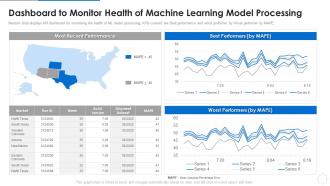
Mention slide displays KPI dashboard for monitoring the health of ML model processing. KPIs covered are Best performance and worst performer by Worst performer by MAPE.
People who downloaded this PowerPoint presentation also viewed the following :
Ml devops cycle it dashboard to machine learning model processing with all 7 slides:
Use our ML DevOps Cycle It Dashboard To Machine Learning Model Processing to effectively help you save your valuable time. They are readymade to fit into any presentation structure.





FAQs for Ml devops cycle it dashboard to machine
So the main thing is ML DevOps has to deal with data and model versioning on top of regular deployments - honestly it's a nightmare compared to just pushing code. Traditional DevOps is straightforward, but you're juggling datasets that keep changing, retraining models, monitoring when they start sucking. Your pipeline tracks data lineage, validates accuracy, rolls back when models tank in production. Oh and you need feature stores plus A/B testing different versions. I'd start by versioning your models and datasets like you would code - treat them as artifacts that need proper testing.
Okay so data versioning is basically like git but for your datasets. Track every change so you can reproduce any model version later. Trust me, you'll need this when your model randomly starts sucking and you're trying to figure out what went wrong (90% of the time it's the data). Also super helpful for rolling back to previous versions or showing stakeholders your results are actually valid. Without it, you're basically flying blind - technically doable but why torture yourself? Just set up automated versioning from the start instead of trying to recreate some magic dataset from months ago.
Docker's basically non-negotiable at this point - I can't imagine containerizing models any other way. Most teams I know use MLflow, Kubeflow, or AWS SageMaker for tracking experiments and versions. Kubernetes handles orchestration pretty well. For serving, you've got options like Seldon, BentoML, or just go with cloud stuff like Azure ML and Google AI Platform. Jenkins and GitLab CI/CD are solid for pipeline automation, though honestly Jenkins feels a bit dated sometimes. I'd say start with MLflow for tracking and Docker for packaging - way easier than jumping into the complex stuff right away.
So basically you gotta expand your normal CI/CD setup beyond just code stuff. Add data validation, model training, and performance checks too. Start with automating the model training part - that's the easiest win. Then build in validation tests for things like data drift and accuracy drops. Only deploy if everything hits your benchmarks. The annoying thing is ML models can totally break without any obvious errors! Set up monitoring so you'll actually know when performance tanks in production. Having a rollback plan saves your butt later. Honestly, I'd keep it simple at first - you can always layer on more validation steps once you've got the basic flow down.
Look, you'll want monitoring set up to catch drift before it bites you. Statistical tests help spot when new data looks weird compared to your training set - honestly saved my butt more times than I can count. Build alerts for accuracy drops and feature changes, then set clear thresholds for when to retrain automatically. Version control everything so you can roll back fast if things go sideways. The key is baking automated retraining into your pipeline from the start. Trust me, it's way better than scrambling to fix things later when your model's already performing like garbage.
Honestly, you've gotta version literally everything - code, data, model configs, the whole mess. DVC is clutch for data versioning, and Docker containers will save your sanity by locking down environments. Git hooks can automate some tracking too. Treat ML experiments like software releases where every input gets tagged. Don't skip the hyperparameters and random seeds either - learned that one the hard way when I couldn't recreate a model from last month. Those tiny details will absolutely wreck you later. Start with containerizing your training pipeline first, then build from there.
So you've got two buckets here - technical stuff and business impact. Technical metrics are your accuracy, precision, recall, plus how fast things are running. Data drift will absolutely wreck you if you're not watching it (real-world data changes constantly). Also track error rates and whether your predictions look normal. Business-wise, focus on what actually matters - conversion rates, engagement, whatever your model is supposed to move. Honestly, this part gets overlooked way too much. Set up alerts so you're not finding out about problems from angry users!
Honestly, compliance and ethics are like mandatory checkpoints you can't skip in your ML pipeline. Data lineage documentation, bias testing, approval processes - yeah it slows things down but there's no way around it. GDPR stuff for data, fairness validation for outputs, audit trails for everything your model decides. I learned this the hard way - build these checks in from the start instead of trying to add them later (trust me on this one). Figure out which regulations hit your use case first, then map where those checks actually fit into what you're already doing.
So feature engineering is where you take your messy raw data and turn it into something your model can actually work with. This step literally makes or breaks everything - I've seen perfectly good models fail because someone skipped this part. You're basically creating and transforming features that'll impact performance. In DevOps, automate these processes and version control them so you can reproduce results across different environments. Track your transformations too. When your model starts acting weird in production (and it will), you'll need to debug what changed. Bad features = garbage model performance, no matter how fancy your algorithm is.
Honestly, cloud platforms are a lifesaver for ML stuff. They handle all the annoying infrastructure setup - storage, training, deployment, monitoring. Auto-scaling is clutch when your models suddenly need more juice. The collaboration tools actually work well too, especially if your team's spread out everywhere. I'd pick one provider's ML suite first and slowly move your existing work over. Don't go crazy trying to rebuild everything at once (learned that the hard way). You'll end up focusing on what matters - making your models better instead of wrestling with servers.
Ugh, data inconsistency between environments will drive you crazy. Your pipeline breaks and suddenly nothing works. Production data never matches what you trained on - it's like they're from different planets. Schema changes come out of nowhere and wreck everything downstream. Version control? Good luck tracking where your data actually came from. Oh, and monitoring is a whole other headache, but you need it to catch problems before they spiral. Start with basic data validation checks first. Trust me on this - set up monitoring early even though it seems excessive. You'll thank yourself later.
Honestly, get those teams talking from the start - no more throwing stuff over the wall. Have your data scientists and DevOps folks sit down together for planning sessions. Data scientists can explain what their models actually need, while DevOps talks through infrastructure reality checks. Use something like MLflow or Kubeflow that both sides can work with (not just the data science team). Cross-train people on the basics of each other's work - doesn't have to be deep, just enough to communicate. Oh, and make deployment part of building the model, not some afterthought. Shared docs help too, obviously.
Dude, you literally can't do ML DevOps at scale without automation - I learned this the hard way. It handles all the tedious stuff like data pipelines, training, testing, and deployment so your models actually get to production instead of sitting in development hell. Catches bugs early too. Manual processes are just brutal when you're juggling multiple models. My advice? Pick your biggest pain point first - usually data prep or deployment - and automate that. Then keep building from there. Trust me, it's night and day once you get the workflow automated.
Honestly, start with Docker/Kubernetes for deployments - it'll save you so many headaches later. MLflow handles model versioning pretty well too. Break your inference into microservices and throw a load balancer in front. Quantization is clutch for reducing resource costs (seriously, ops teams love you for this). Monitor for model drift and set up A/B testing for rollouts. Oh, and don't try doing everything at once - pick whatever's causing you the biggest pain right now and tackle that first.
Automated testing pipelines are your best friend here - cover both code and model performance. Unit tests for data preprocessing and feature engineering are a must. Then add model validation tests checking accuracy, drift, and benchmarks on holdout datasets. Don't skip data quality checks either (learned that the hard way). CI should run these automatically when you push changes. Production models need A/B testing and monitoring dashboards to catch issues fast. Honestly, treat model validation just like regular software testing but with extra paranoia about data weirdness.
-
Understandable and informative presentation.
-
The content is very helpful from business point of view.