

Mobile app screens designing proposal powerpoint presentation slides




Try Before you Buy Download Free Sample Product
 Impress Your
 Audience
 100%
100% Editable
 Save Hours
 of Time


Our Mobile App Screens Designing Proposal Powerpoint Presentation Slides are topically designed to provide an attractive backdrop to any subject. Use them to look like a presentation pro.
People who downloaded this PowerPoint presentation also viewed the following :
Content of this Powerpoint Presentation
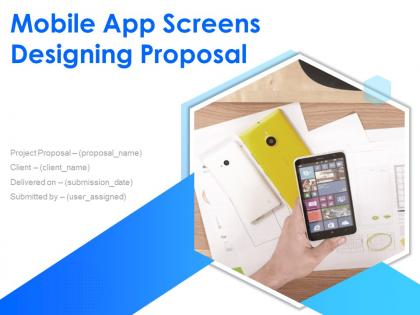
Slide 1: This slide introduces Mobile App Screens Designing Proposal. Mention Proposal name, Client name, Submission date.
Slide 2: This slide displays Cover Letter for Mobile App Screens Designing Services.
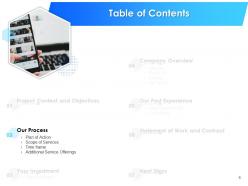
Slide 3: This slide displays Table of Contents.
Slide 4: This slide displays Table of Contents
Slide 5: This slide describes Project Context and Objectives for Mobile App Screens Designing Services
Slide 6: This slide displays Table of Contents.
Slide 7: This slide showcases Plan of Action for Mobile App Screens Designing Services
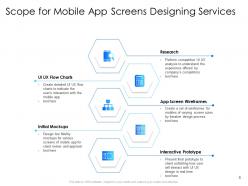
Slide 8: This slide depicts Scope for Mobile App Screens Designing Services
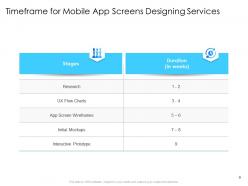
Slide 9: This slide represents Timeframe for Mobile App Screens Designing Services
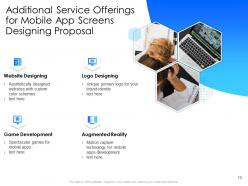
Slide 10: This slide represents Additional Service such as- Website Designing, Logo Designing, Augmented Reality, Game Development.
Slide 11: This slide displays Table of Contents.
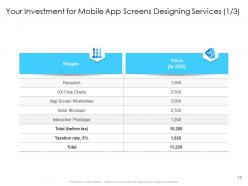
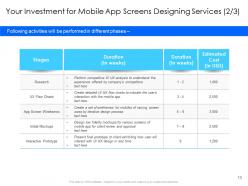
Slide 12: This slide depicts Investment details.
Slide 13: This slide depicts Investment details.
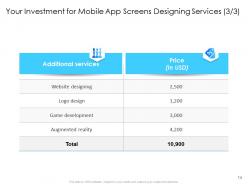
Slide 14: This slide showcases Additional services.
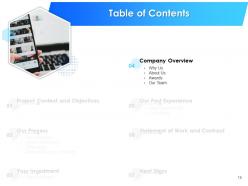
Slide 15: This slide shows Table of Contents.
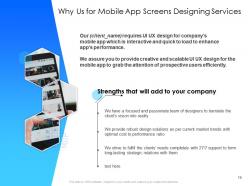
Slide 16: This slide explains Why Us for Mobile App Screens Designing Services
Slide 17: This is About Us slide to showcase Company specifications.
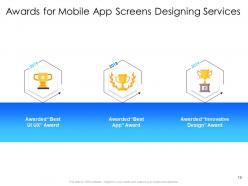
Slide 18: This slide depicts Awards for Mobile App Screens Designing Services
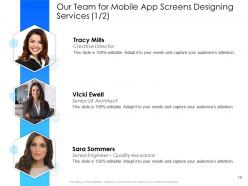
Slide 19: This is Our Team slide with Names and Designations.
Slide 20: This is Our Team slide with Names and Designations.
Slide 21: This slide shows Table of Contents.
Slide 22: This slide displays Client Testimonials for Mobile App Screens Designing Services.
Slide 23: This slide shows Client Testimonials.
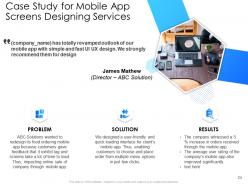
Slide 24: This slide displays Case Study.
Slide 25: This slide shows Table of Contents.
Slide 26: This slide presents Statement of Work and Contract.
Slide 27: This slide displays Table of Contents.
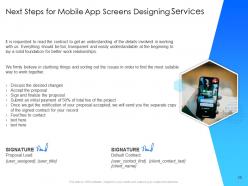
Slide 28: This slide showcases Next Steps for Mobile App Screens Designing Services.
Slide 29: This is Contact Us slide with Contact number, Email address and Address.
Slide 30: This is Icons Slide for Mobile App Screens Designing Proposal.
Slide 31: This slide is titled as Additional Slides
Slide 32: This is About us slide to Showcase Company Specifications.
Slide 33: This slide displays Vision and Mission statement.
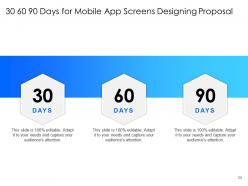
Slide 34: This is 30 60 90 Days plan slide.
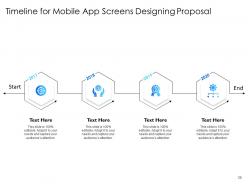
Slide 35: This slide shows Timeline process.
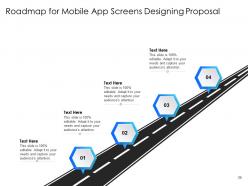
Slide 36: This slide depicts Roadmap process.
Mobile app screens designing proposal powerpoint presentation slides with all 36 slides:
Use our Mobile App Screens Designing Proposal Powerpoint Presentation Slides to effectively help you save your valuable time. They are readymade to fit into any presentation structure.









FAQs for Mobile app screens designing proposal
Key mobile app design principles include user-centered design, intuitive navigation, responsive layouts, accessibility compliance, and performance optimization. These principles streamline development by ensuring consistent user experiences, reducing development costs, and accelerating time-to-market, with many organizations finding that well-structured design proposals ultimately deliver higher user engagement and competitive advantage.
User-centered design enhances mobile app usability by prioritizing intuitive navigation, streamlined user flows, and responsive interface elements that adapt to user behaviors and preferences. Through extensive user research and iterative testing, organizations across retail, healthcare, and financial services create more engaging experiences, reduce user frustration, and ultimately deliver higher retention rates and customer satisfaction.
**INPUT**: What are the most crucial considerations for designing a mobile app for different screen sizes? **OUTPUT**: Crucial considerations include responsive layouts, scalable typography, flexible grid systems, touch-friendly interface elements, and optimized image resolution across devices. These design principles streamline user experiences by ensuring consistent functionality, readable content, and intuitive navigation, with many retail and banking organizations finding that adaptive design ultimately delivers higher engagement rates and broader market reach.
Identifying target audience involves demographic analysis, user behavior research, market segmentation studies, competitor analysis, and persona development through surveys and focus groups. These research methods enable designers to create detailed user profiles by analyzing age groups, usage patterns, and pain points, with many successful apps finding that precise audience definition ultimately streamlines development decisions and enhances user adoption rates.
Mobile app design proposals should prioritize user experience fundamentals, core functionality, performance optimization, security measures, and scalability features. These elements work together by ensuring intuitive navigation, seamless operations, and robust data protection, with many development teams finding that early prioritization of these features significantly reduces costs and accelerates time-to-market for competitive advantage.
Incorporating user feedback shapes mobile app design by identifying pain points, validating feature priorities, and revealing usage patterns through surveys, testing sessions, and analytics. This iterative approach enables designers to refine interfaces, optimize user flows, and enhance functionality based on real-world behavior, ultimately delivering more intuitive experiences and higher adoption rates.
Best practices for mobile app navigation include clear visual hierarchies, consistent navigation patterns, accessible touch targets, breadcrumb trails, and intuitive icon design. These approaches streamline user experiences by reducing cognitive load, minimizing navigation steps, and ensuring seamless interactions across devices, with many retail and banking apps finding that strategic navigation design ultimately delivers higher user engagement and improved conversion rates.
Color psychology influences mobile app design by affecting user emotions, behaviors, and decision-making through strategic color choices that enhance usability and engagement. Different colors evoke specific responses, with blue building trust in financial apps, red creating urgency in retail platforms, and green suggesting growth in investment tools, ultimately driving user actions, improving conversion rates, and strengthening brand recognition across diverse user demographics.
Modern mobile app design trends include minimalist interfaces, dark mode options, gesture-based navigation, micro-interactions, and voice user interfaces. These approaches enhance user experience by reducing cognitive load, improving accessibility, and creating intuitive interactions, with many organizations finding that streamlined designs significantly increase user engagement and retention rates while delivering competitive advantages in increasingly crowded app marketplaces.
Accessibility can be integrated through inclusive design principles, WCAG compliance standards, voice navigation capabilities, adjustable text sizing, and high contrast color schemes. These features streamline user experiences by accommodating diverse abilities, expanding market reach, and ensuring regulatory compliance, with many healthcare and financial services apps finding that accessibility enhancements ultimately deliver broader user adoption and competitive advantage.
Mobile app design success metrics include user engagement rates, task completion rates, app store ratings, retention percentages, and time-to-complete key actions. These measurements enable organizations to streamline user experiences, enhance interface effectiveness, and deliver competitive advantages, with many companies finding that combining usability analytics with business performance data ultimately drives higher conversion rates and customer satisfaction.
Performance optimization in mobile app design involves implementing efficient coding practices, optimizing images and assets, minimizing network requests, utilizing caching strategies, and conducting regular performance testing. Through strategic resource management and streamlined user interface design, organizations across retail, healthcare, and financial services enhance user experiences, reduce loading times, and improve app retention rates, ultimately delivering competitive advantage in an increasingly mobile-first marketplace.
Prototyping tools include Figma, Adobe XD, Sketch, InVision, and Marvel, enabling interactive wireframes, user flow mapping, and stakeholder collaboration. These platforms streamline the design process by facilitating real-time feedback, rapid iterations, and seamless handoffs to developers, with many organizations finding that comprehensive prototyping significantly reduces development costs and accelerates time-to-market.
Storytelling enhances mobile app design by creating emotional connections, guiding user journeys, and making interfaces more intuitive and memorable. Through narrative-driven onboarding, progressive disclosure, and contextual micro-interactions, apps like fitness trackers and banking platforms transform complex processes into engaging experiences, ultimately increasing user retention and satisfaction while reducing abandonment rates.
Effective ways include interactive prototypes showcasing core functionality, user journey maps highlighting pain point solutions, competitive analysis demonstrating unique advantages, and ROI projections with specific metrics. These elements work together by providing tangible proof of concept, clear differentiation from competitors, and quantifiable business benefits, with many organizations finding that visual demonstrations combined with data-driven projections significantly enhance stakeholder buy-in and project approval rates.
-
Visually stunning presentation, love the content.
-
Design layout is very impressive.
-
Very unique and reliable designs.