

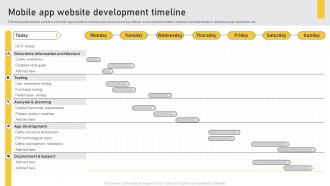
Mobile App Website Development Timeline





Try Before you Buy Download Free Sample Product
 Impress Your
Audience
 100%
Editable
 Save Hours
of Time


Following slide exhibits evolution of mobile app website to make people aware of services offered. It presents information related to conceptualization, designing user experience, etc.
People who downloaded this PowerPoint presentation also viewed the following :
Mobile App Website Development Timeline with all 6 slides:
Use our Mobile App Website Development Timeline to effectively help you save your valuable time. They are readymade to fit into any presentation structure.





FAQs for Mobile App
Mobile app development timelines encompass planning, design, development, testing, and deployment, presenting both challenges and opportunities. These phases streamline project management by defining clear deliverables, ensuring efficient resource allocation, and ultimately delivering a polished product ready for market launch. With many institutions finding that iterative development—incorporating user feedback—significantly enhances app success and user engagement.
Mobile app development typically spans three to nine months from conception to launch, encompassing planning, design, development, testing, and deployment. While timelines vary based on complexity, these phases streamline workflows by utilizing agile methodologies, iterative prototyping, and continuous integration. With many financial services and healthcare institutions finding that phased releases minimize risk and accelerate time-to-market, ultimately delivering enhanced user experiences and a competitive advantage.
Mobile app development timelines are influenced by factors including app complexity, platform (iOS, Android, or both), feature set, and integration with third-party services. While simpler apps can launch in weeks, those requiring extensive backend infrastructure, like banking or healthcare apps, present both challenges and opportunities. With many institutions finding that thorough planning, agile methodologies, and skilled developers ultimately deliver faster time-to-market and enhanced user experiences.
Mobile app development milestones include ideation, design, development, testing, and deployment, with each phase requiring focused effort. These stages streamline project management by enabling iterative progress, facilitating feedback, and ensuring quality, with many institutions finding that phased releases minimize risk and accelerate time-to-market, ultimately delivering enhanced user experiences and competitive advantage.
Project management methodologies optimize mobile app development timelines by streamlining workflows, enhancing collaboration, and minimizing risks through Agile, Waterfall, and Hybrid approaches. These frameworks facilitate efficient resource allocation, proactive issue resolution, and iterative development cycles, with many financial services and healthcare institutions finding that consistent sprints deliver faster time-to-market and improved app quality, ultimately delivering enhanced customer experiences and a competitive advantage.
User research plays a crucial role in the mobile app development timeline, encompassing user interviews, surveys, and usability testing throughout each phase. While seemingly extending initial timelines, it also minimizes costly rework by validating assumptions, identifying user needs, and ensuring product-market fit. With many financial services and healthcare institutions finding that early user input streamlines development, ultimately delivering enhanced customer experiences and accelerated time-to-market.
Design iterations significantly impact mobile app development timelines by introducing feedback loops, refinement stages, and potential rework, while also ensuring a user-centric final product. These cycles, incorporating user testing and stakeholder input, can extend project durations by 10-30%, with many financial services and healthcare institutions finding that thorough iteration minimizes costly post-launch fixes, ultimately delivering enhanced user experiences and a competitive advantage.
Mobile app development benefits from tools like React Native, Flutter, and Xamarin, alongside backend technologies such as Node.js and cloud platforms like AWS or Azure. These technologies streamline workflows by enabling cross-platform compatibility, automated testing, and efficient code reuse, ultimately delivering faster time-to-market and reduced development costs with many institutions finding that agile methodologies further enhance project velocity.
Mobile app development budgets per phase are estimated by considering factors like feature complexity, platform (iOS, Android), and backend requirements, presenting both challenges and opportunities. These estimations involve detailed resource allocation for design, development, testing, and deployment, with many institutions finding that accurate scoping delivers significant cost predictability. Ultimately delivering streamlined project management and enhanced return on investment, a phased approach enables better financial control and minimizes unforeseen expenses.
App testing and QA significantly impact the mobile app development timeline by identifying bugs, usability issues, and performance bottlenecks, requiring iterative fixes and re-testing. While thorough testing extends the schedule, it also minimizes post-launch issues, with banks and healthcare institutions finding that robust QA delivers enhanced user experiences and reduces costly remediation. Ultimately delivering a stable, reliable application and safeguarding brand reputation, these processes streamline long-term maintenance and accelerate user adoption.
Effective communication among stakeholders improves mobile app development timelines by streamlining feedback loops, clarifying requirements, and minimizing costly rework. Regular meetings, shared project management tools, and transparent progress updates enable faster decision-making across banking, healthcare, and retail, ultimately delivering projects on time and within budget with many institutions finding that proactive dialogue reduces delays significantly.
Mobile app development timelines often encounter challenges including scope creep, integration complexities, platform fragmentation, and ensuring robust security measures. These hurdles present both challenges and opportunities, requiring agile methodologies, meticulous planning, and continuous testing across iOS and Android. With many institutions finding that proactive risk management and clear communication streamline processes, ultimately delivering faster time-to-market and enhanced user experiences.
App feature complexity significantly impacts development timelines by necessitating more intricate coding, rigorous testing, and detailed design phases. While simpler apps can launch in weeks, those with advanced functionalities—like real-time data synchronization or AI integrations—often require months, with banks and healthcare institutions finding that robust security protocols further extend these periods. Ultimately delivering a polished, scalable product demands careful planning and phased implementation, enhancing user experiences and competitive advantage.
Feedback loops are significant in mobile app development as they enable iterative refinement through prototyping, user testing, and continuous integration. While demanding initial time investment, these loops streamline development by identifying and addressing usability issues, technical glitches, and feature misalignment early on. With many institutions finding that proactive feedback minimizes costly rework, ultimately delivering faster time-to-market and enhanced customer experiences.
Post-launch updates and maintenance are factored into the app development timeline by allocating 20-30% of the initial budget and timeframe for ongoing support, bug fixes, and feature enhancements. These technologies streamline iterative improvements by leveraging agile methodologies, continuous integration, and user feedback analysis, ultimately delivering enhanced customer experiences and sustained competitive advantage. With many institutions finding that proactive maintenance minimizes technical debt and ensures long-term scalability, consistent updates are crucial for user retention and evolving market demands.
-
I had them make a presentation for an office retirement party. They were very helpful in understanding what we wanted and delivered the perfect presentation. Highly recommended!
-
SlideTeam is my go-to resource for professional PPT templates. They have an exhaustive library, giving you the option to download the best slide!