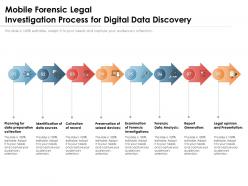
Mobile forensic legal investigation process for digital data discovery
Try Before you Buy Download Free Sample Product
Audience
Editable
of Time
Our Mobile Forensic Legal Investigation Process For Digital Data Discovery are topically designed to provide an attractive backdrop to any subject. Use them to look like a presentation pro.
People who downloaded this PowerPoint presentation also viewed the following :
Mobile forensic legal investigation process for digital data discovery with all 2 slides:
Use our Mobile Forensic Legal Investigation Process For Digital Data Discovery to effectively help you save your valuable time. They are readymade to fit into any presentation structure.
FAQs for Mobile forensic legal investigation process for
Mobile forensics differs from traditional computer forensics through specialized extraction methods, real-time data synchronization challenges, diverse operating systems, cloud integration complexities, and volatile memory structures. While traditional forensics examines static hard drives, mobile forensics requires advanced tools to bypass encryption, handle app-specific data formats, and recover evidence from fragmented storage, ultimately delivering faster investigative capabilities and more comprehensive digital evidence recovery for law enforcement agencies.
Mobile operating systems significantly impact forensic data recovery through different security architectures, file systems, and encryption protocols, with iOS using APFS and hardware-based encryption while Android employs EXT4 and software-based approaches. These differences require specialized tools and techniques for each platform, with forensic investigators finding that iOS devices present greater extraction challenges due to tighter security controls, while Android's open architecture often enables more comprehensive data recovery opportunities.
Essential mobile forensics tools include Cellebrite UFED, Oxygen Detective Suite, MSAB XRY, Magnet AXIOM, and EnCase Mobile Investigator. These platforms streamline data extraction by bypassing device locks, recovering deleted content, and analyzing communication patterns, with law enforcement agencies and corporate security teams finding that comprehensive toolsets ultimately deliver faster investigations and stronger digital evidence for legal proceedings.
Mobile forensics enables criminal investigators to extract crucial evidence from smartphones and tablets, including deleted messages, call logs, location data, app usage, and multimedia files. Law enforcement agencies utilize these techniques to solve cases involving fraud, cybercrime, drug trafficking, and violent crimes, with many departments finding that mobile evidence often provides the timeline and connections needed to build compelling cases and secure convictions.
Mobile forensics faces significant challenges when gathering encrypted data, including advanced encryption protocols, secure boot processes, hardware security modules, frequent OS updates, and anti-tampering mechanisms. These security measures, while protecting user privacy, create complex barriers for investigators in law enforcement and corporate security, requiring specialized tools and techniques to balance forensic needs with privacy protections.
Social media applications serve as critical evidence sources in mobile forensic investigations, containing messages, location data, timestamps, multimedia files, and user interactions that can establish timelines and connections. These apps often store cached data, deleted content fragments, and metadata that investigators can recover through specialized tools, with many law enforcement agencies finding that platforms like Facebook, Instagram, and WhatsApp provide crucial insights for criminal cases.
Mobile forensics examiners must prioritize data privacy, user consent, legal authorization, proportional evidence collection, and secure data handling throughout investigations. These ethical frameworks ensure investigators balance legitimate forensic needs with individual privacy rights, with law enforcement agencies, corporate security teams, and legal firms finding that transparent, consent-based approaches ultimately deliver more defensible evidence and maintain public trust.
Cloud storage significantly complicates mobile forensics by distributing evidence across multiple servers, requiring specialized tools for remote data acquisition, and introducing jurisdictional challenges for investigators. While traditional device-based extraction becomes limited, investigators increasingly leverage cloud forensics techniques, API-based data recovery, and cross-platform analysis tools, ultimately enabling more comprehensive digital investigations despite the distributed data landscape.
Data privacy legislation significantly impacts mobile forensic practices by establishing strict protocols for data collection, storage, and analysis, requiring explicit consent mechanisms and comprehensive audit trails. These regulations, including GDPR and CCPA, compel forensic teams to balance investigative needs with privacy rights through enhanced encryption standards, limited data retention periods, and transparent reporting processes, ultimately delivering more ethical investigations while maintaining legal compliance in an increasingly regulated digital landscape.
Forensic investigators counter remote wipes through immediate device isolation using Faraday bags, quick physical imaging before connectivity, and specialized recovery tools that reconstruct deleted data from unallocated storage sectors. Many law enforcement agencies now deploy rapid response protocols that prioritize device seizure within critical timeframes, while advanced forensic software increasingly enables partial data recovery even after factory resets, ultimately preserving crucial evidence.
Mobile forensics employs physical extraction, logical extraction, file system analysis, chip-off methods, and JTAG techniques to recover deleted data from smartphones and tablets. These approaches enable investigators to retrieve text messages, call logs, photos, and application data by bypassing device security, analyzing memory dumps, and reconstructing file fragments, ultimately delivering comprehensive digital evidence for legal proceedings.
The rise of 5G networks has significantly influenced mobile forensics by introducing faster data transmission speeds, increased device connectivity, and more complex network architectures that investigators must navigate. These advancements present both challenges and opportunities, with forensic professionals developing enhanced tools and methodologies to handle larger data volumes, analyze edge computing scenarios, and extract evidence from interconnected IoT devices, ultimately delivering more comprehensive digital investigations.
Artificial intelligence enhances mobile forensic investigations through automated data recovery, pattern recognition algorithms, predictive analysis capabilities, and intelligent search functions that rapidly process vast datasets. These AI-driven tools streamline evidence extraction by identifying deleted files, analyzing communication patterns, and detecting anomalies across multiple devices, ultimately delivering faster case resolution and more comprehensive digital evidence analysis for law enforcement agencies.
Biometric security features present both challenges and opportunities for mobile forensics, creating encryption barriers while potentially providing new evidence sources through stored biometric templates, authentication logs, and sensor data. These technologies complicate traditional extraction methods by strengthening device security, yet enable investigators to leverage fingerprint databases, facial recognition patterns, and behavioral analytics, ultimately delivering more comprehensive digital evidence when proper legal frameworks and technical capabilities align.
Chain of custody is absolutely critical in mobile forensic evidence handling, as it establishes legal authenticity, prevents tampering allegations, maintains evidence integrity throughout investigation processes, and ensures admissibility in court proceedings. Law enforcement agencies, corporate security teams, and legal professionals find that proper documentation, secure storage protocols, and detailed transfer records ultimately deliver credible prosecutions and successful litigation outcomes.
No Reviews