

Monitor key performance develop strategy translate strategy property strategy






Try Before you Buy Download Free Sample Product
 Impress Your
Audience
 100%
Editable
 Save Hours
of Time


Examine progress of a department or individual development plan with clear and simple template of monitor key performance strategy. This PowerPoint slide of monitor key performance can be used as an essential tool to measure success factors and strategy implementation. This KPIs indicator template allows you to measure how your business is performing and help you take right path towards your goals. This strategic performance management presentation helps you define effective KPI. Well-defined and quantifiable KPIs communicated throughout your organization is crucial to achieving your goal. With the help of this key performance indicator layout, you can describe various metrics like financial metrics, customer metrics, process metrics and people metrics. Identify the vital indicators of your company's success with this advantage and disadvantages of key performance indicator PPT slide. In this Strategic performance measurement PowerPoint slide you can define correct metrics with day-to-day operations for agile decision making. Download this layout and create a framework to measure performance through simple measures. Feelings of camaraderie get a huge boost due to our Monitor Key Performance Develop Strategy Translate Strategy Property Strategy. It helps foster bonhomie.
People who downloaded this PowerPoint presentation also viewed the following :
Content of this Powerpoint Presentation
Description:
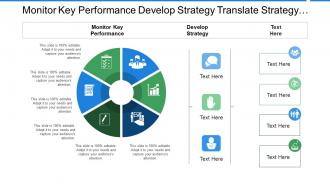
The image displays a PowerPoint slide titled "Monitor Key Performance Develop Strategy Translate Strategy," which likely serves as a framework for businesses to align their strategy with performance metrics. The slide is divided into two main sections:
On the left, there is a circular diagram segmented into four quadrants, each labeled with a different aspect of business strategy and performance:
1. Monitor Key Performance:
This section is likely to focus on tracking and analyzing key performance indicators (KPIs).
2. Develop Strategy:
This suggests a focus on formulating strategies based on the performance data.
On the right, there are four rectangular boxes with icons, each labeled "Text Here," suggesting that the slide is meant to be customized with specific strategies or performance metrics relevant to the user's organization.
Use Cases:
This slide could be used in various industries to illustrate and plan strategic actions based on performance monitoring:
1. Finance:
Use: Aligning financial strategies with performance metrics.
Presenter: Financial Analyst.
Audience: Management team, Stakeholders.
2. Healthcare:
Use: Monitoring and improving patient care strategies.
Presenter: Healthcare Administrator.
Audience: Medical staff, Hospital board.
3. Retail:
Use: Developing sales and marketing strategies.
Presenter: Retail Manager.
Audience: Sales team, Marketing department.
4. Education:
Use: Strategizing educational outcomes based on performance.
Presenter: Academic Coordinator.
Audience: Teachers, Education Administrators.
5. Technology:
Use: Software development lifecycle management.
Presenter: IT Project Manager.
Audience: Developers, Product Managers.
6. Manufacturing:
Use: Streamlining production processes.
Presenter: Operations Manager.
Audience: Production team, Quality assurance.
7. Marketing:
Use: Crafting marketing campaigns based on analytics.
Presenter: Marketing Director.
Audience: Marketing team, Creative department.
Monitor key performance develop strategy translate strategy property strategy with all 5 slides:
Elaborate on the benefits of introspection with our Monitor Key Performance Develop Strategy Translate Strategy Property Strategy. Explain how ideas for improvement are generated.
FAQs for Monitor key performance develop strategy translate
Key components of an effective performance management system include clear goal setting, regular feedback mechanisms, comprehensive performance evaluations, development planning, and recognition programs. These elements work together by aligning individual objectives with organizational goals, fostering continuous improvement, and enhancing employee engagement, with many companies finding that integrated systems ultimately deliver higher productivity and improved retention rates.
Organizations align individual goals with overall business objectives by establishing clear performance frameworks, implementing regular check-ins, utilizing OKRs or similar goal-setting methodologies, and creating transparent communication channels. Through strategic cascading of objectives, companies enable employees to understand their direct contribution to organizational success, ultimately driving engagement, accountability, and measurable business outcomes across all departments.
Feedback serves as a critical performance catalyst by providing employees with clear expectations, recognizing achievements, identifying improvement areas, and guiding skill development. Through regular feedback sessions, organizations enhance employee engagement, accelerate professional growth, and strengthen manager-employee relationships, with many companies finding that consistent feedback ultimately delivers higher productivity and better retention rates.
Performance reviews should be conducted quarterly or bi-annually for maximum impact, with monthly check-ins and continuous feedback sessions supporting formal evaluations. This strategic combination enables managers to address issues promptly, track progress consistently, and align employee development with business objectives, while many organizations finding that more frequent touchpoints significantly enhance employee engagement and ultimately deliver better retention rates.
Best practices for setting measurable performance indicators include establishing SMART criteria, aligning metrics with strategic objectives, incorporating both quantitative and qualitative measures, ensuring regular review cycles, and maintaining clear documentation. These approaches streamline evaluation processes by enhancing transparency, facilitating objective assessments, and enabling data-driven decisions, with many organizations finding that well-defined indicators ultimately deliver improved accountability and sustained performance growth.
Technology streamlines performance management through automated goal tracking, real-time feedback systems, data analytics for objective evaluations, and integrated communication platforms. These digital tools enable managers to monitor progress continuously, identify development opportunities faster, and make data-driven decisions, while employees receive timely coaching and transparent assessments, ultimately enhancing organizational productivity.
Performance issues can be addressed through clear goal setting, regular feedback sessions, targeted skills development programs, performance improvement plans, and mentoring initiatives. These strategies enhance employee engagement by identifying specific challenges, providing actionable solutions, and creating accountability frameworks, with many organizations finding that consistent coaching ultimately delivers improved productivity and employee retention.
Different performance management styles significantly impact employee engagement through varying approaches to feedback frequency, goal-setting methods, recognition practices, and development opportunities. Collaborative styles that emphasize regular check-ins and growth-focused conversations typically enhance engagement, while rigid, annual review-based approaches often diminish motivation, with many organizations finding that continuous feedback models deliver higher retention and productivity.
Continuous performance conversations enable real-time feedback, goal alignment, skill development identification, and career path planning, replacing traditional annual reviews with ongoing dialogue. Through regular check-ins, managers can address challenges immediately, recognize achievements promptly, and adjust development plans dynamically, with many organizations finding that employees show increased engagement and accelerated growth.
Organizations balance quantitative and qualitative metrics by establishing weighted scoring systems that combine measurable outcomes with behavioral assessments, peer feedback, and goal achievement evaluations. Through integrated performance dashboards, companies in sectors like consulting and healthcare track both revenue targets and collaboration skills, ultimately delivering comprehensive employee development while maintaining objective accountability standards.
Organizational culture significantly shapes performance management outcomes by influencing employee engagement, feedback receptivity, goal alignment, and accountability standards across all organizational levels. Companies with collaborative cultures often see higher performance ratings and retention rates, while hierarchical environments may struggle with transparency and continuous improvement, ultimately affecting productivity, talent development, and competitive advantage in their respective markets.
Performance management for remote teams requires structured digital frameworks, clear communication protocols, outcome-based metrics, regular virtual check-ins, and collaborative goal-setting platforms. Organizations are increasingly finding that remote performance management enhances transparency and accountability, with many companies discovering that digital tracking systems streamline feedback processes while enabling more frequent, meaningful conversations between managers and team members.
Performance appraisals must comply with employment laws, anti-discrimination regulations, data privacy requirements, and documentation standards while ensuring fairness and consistency across all employees. Organizations should maintain objective, job-related criteria, provide transparent feedback processes, and secure confidential records, with many companies finding that ethical performance management ultimately enhances employee trust and reduces legal risks.
Training and development integrate into performance management through skills gap identification during reviews, personalized development planning, and continuous learning opportunities aligned with performance goals. Many organizations streamline this by incorporating competency assessments, targeted training recommendations, and progress tracking directly into their review cycles, ultimately enhancing employee capabilities while driving measurable performance improvements.
Organizations can foster a growth mindset through development-focused feedback conversations, goal-setting that emphasizes learning objectives, peer collaboration assessments, and future-oriented coaching discussions rather than backward-looking ratings. These approaches enable continuous improvement by encouraging skill development, celebrating progress over perfection, and positioning challenges as opportunities, ultimately delivering enhanced employee engagement and organizational adaptability.
-
Illustrative design with editable content. Exceptional value for money. Highly pleased with the product.
-
Awesome presentation, really professional and easy to edit.