

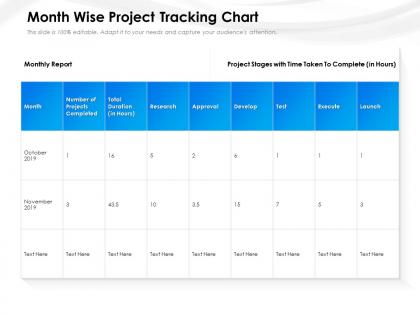
Month wise project tracking chart




Try Before you Buy Download Free Sample Product
 Impress Your
 Audience
 100%
100% Editable
 Save Hours
 of Time


Our Month Wise Project Tracking Chart are topically designed to provide an attractive backdrop to any subject. Use them to look like a presentation pro.
People who downloaded this PowerPoint presentation also viewed the following :
Month wise project tracking chart with all 2 slides:
Use our Month Wise Project Tracking Chart to effectively help you save your valuable time. They are readymade to fit into any presentation structure.
FAQs for Month wise
Project tracking tools deliver enhanced visibility, improved resource allocation, better deadline management, streamlined team collaboration, and real-time progress monitoring. These technologies enable organizations to reduce project overruns, accelerate delivery timelines, and enhance stakeholder communication, with many companies in sectors like construction, software development, and consulting finding that comprehensive tracking ultimately delivers higher success rates and competitive advantage.
Visual project tracking enhances team collaboration by providing shared visibility into project progress, deadlines, task dependencies, and resource allocation through dashboards, Gantt charts, and status boards. This transparency enables teams to identify bottlenecks quickly, coordinate efforts more effectively, and maintain alignment on priorities, ultimately delivering faster project completion and improved accountability across departments.
Essential project tracking metrics include schedule variance, budget variance, resource utilization, milestone completion rates, and quality indicators like defect rates. These metrics enable project managers to identify risks early, optimize resource allocation, and maintain stakeholder alignment, with many organizations finding that comprehensive tracking ultimately delivers improved project success rates and enhanced operational efficiency.
Agile emphasizes iterative development, flexibility, and continuous feedback, while Waterfall follows sequential phases with defined milestones and comprehensive documentation upfront. These methodologies serve different project needs, with Agile excelling in dynamic environments like software development and marketing campaigns, while Waterfall works best for structured projects in construction, manufacturing, and regulatory compliance initiatives.
Real-time data significantly enhances project tracking accuracy by providing instant visibility into progress, resource utilization, budget consumption, and potential bottlenecks as they occur. This immediate insight enables project managers to make informed decisions quickly, identify deviations early, and implement corrective measures proactively, ultimately delivering improved project outcomes and enhanced stakeholder confidence.
Project tracking software integrates with business management tools through APIs, cloud-based platforms, and enterprise resource planning systems, enabling seamless data synchronization across departments. These integrations streamline workflows by connecting project timelines with accounting software, CRM systems, and communication platforms, ultimately delivering enhanced operational efficiency and comprehensive business visibility.
Teams face challenges including resistance to change, inadequate training, choosing unsuitable tools, poor data quality, and integration difficulties with existing systems. While these obstacles can initially slow adoption, organizations increasingly find that addressing them through strategic planning, comprehensive training, and gradual implementation ultimately delivers enhanced visibility, improved accountability, and streamlined project management across departments.
Project tracking significantly enhances stakeholder engagement by providing real-time visibility into project progress, milestones, budget utilization, and potential risks through automated dashboards and regular status updates. This transparency enables more informed decision-making and proactive communication, with many organizations finding that consistent tracking data strengthens stakeholder confidence and facilitates more productive project discussions.
**INPUT**: What are the best practices for setting up a project tracking framework? **OUTPUT**: Best practices include establishing clear milestones, defining measurable KPIs, implementing regular checkpoint reviews, creating standardized reporting templates, and ensuring stakeholder visibility across all project phases. These frameworks streamline progress monitoring, enhance accountability, and enable proactive risk management, with many organizations finding that consistent tracking methodologies ultimately deliver improved project success rates and resource optimization. **Word count: 58 words**
Mobile project tracking applications enhance team productivity by enabling real-time updates, instant communication, seamless file sharing, and immediate task management from any location. These tools streamline workflows by reducing delays, eliminating information silos, and facilitating quick decision-making, with many organizations finding that field teams, remote workers, and traveling executives can maintain project momentum while delivering faster responses and improved collaboration.
Essential project tracking template features include task lists with status indicators, milestone tracking, resource allocation charts, timeline visualization, progress percentage displays, and budget monitoring sections. These elements streamline project oversight by enabling real-time status updates, identifying bottlenecks early, and facilitating stakeholder communication, with many organizations finding that comprehensive templates significantly enhance delivery predictability and team accountability.
Project tracking enables risk identification and mitigation by monitoring progress against timelines, budgets, and milestones while flagging deviations early. Through real-time dashboards and automated alerts, organizations in construction, software development, and manufacturing can anticipate resource constraints, schedule conflicts, and budget overruns, ultimately delivering projects on time and within scope.
Effective backlog management strategies include regular prioritization based on business value, maintaining clear user story definitions, conducting sprint planning sessions, implementing continuous stakeholder feedback loops, and establishing acceptance criteria standards. These approaches streamline project workflows by ensuring transparency, reducing scope creep, and enabling faster delivery cycles, with many development teams finding that structured backlog processes ultimately enhance resource allocation and project outcomes.
Cultural differences significantly impact project tracking in global teams through varying communication styles, reporting preferences, hierarchy expectations, and time orientations. Teams often find success by adapting tracking methods to accommodate direct versus indirect feedback cultures, flexible versus structured reporting schedules, and different comfort levels with real-time visibility, ultimately creating hybrid approaches that respect cultural nuances while maintaining project transparency.
Latest trends in project tracking technology include AI-powered analytics, real-time collaboration platforms, mobile-first dashboards, automated reporting systems, and integrated resource management tools. These technologies streamline project oversight by enhancing visibility, minimizing manual updates, and delivering predictive insights, with many organizations finding that automated tracking ultimately reduces project delays and improves resource allocation across teams.
No Reviews