

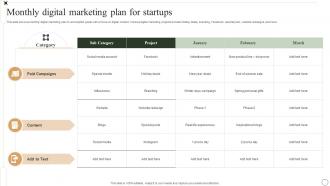
Monthly Digital Marketing Plan For Startups





Try Before you Buy Download Free Sample Product
 Impress Your
 Audience
 100%
100% Editable
 Save Hours
 of Time


This slide shows a monthly digital marketing plan to accomplish goals with a focus on digital content. Various digital marketing projects include holiday deals,branding,Facebook,special post,website redesigns,and more.
People who downloaded this PowerPoint presentation also viewed the following :
Monthly Digital Marketing Plan For Startups with all 6 slides:
Use our Monthly Digital Marketing Plan For Startups to effectively help you save your valuable time. They are readymade to fit into any presentation structure.





FAQs for Monthly Digital Marketing
A monthly digital marketing plan should include content calendar development, social media scheduling, email campaign strategies, SEO optimization tasks, and performance analytics review. These components work together by ensuring consistent brand messaging, targeted audience engagement, and data-driven decision making, with many organizations finding that this structured approach delivers improved conversion rates, enhanced customer relationships, and measurable competitive advantage in an increasingly crowded digital landscape.
Businesses can effectively set monthly digital marketing goals by establishing specific KPIs like lead generation targets, conversion rates, website traffic metrics, and social media engagement benchmarks aligned with quarterly objectives. Through analytics platforms like Google Analytics, social media insights, and CRM tracking, companies streamline performance monitoring, identify optimization opportunities, and adjust strategies in real-time, ultimately delivering measurable ROI and sustained growth momentum.
Google Analytics, SEMrush, Hootsuite, HubSpot, and Facebook Insights are essential tools for comprehensive monthly digital marketing analysis, tracking website traffic, social engagement, keyword performance, and campaign ROI. These platforms streamline reporting by consolidating data from multiple channels, email campaigns, and paid advertising, enabling marketers to identify trends, optimize strategies, and demonstrate measurable business impact to stakeholders.
Seasonal trends can be incorporated by analyzing historical data patterns, adjusting content calendars around peak periods, optimizing ad spend timing, and aligning product promotions with consumer behavior cycles. Retail brands, hospitality companies, and e-commerce platforms leverage these insights to increase engagement rates, maximize conversion opportunities during high-demand seasons, and ultimately deliver stronger ROI while staying competitive.
Startups should prioritize cost-effective strategies like social media marketing, content creation, email campaigns, and local SEO to build brand awareness and customer acquisition within limited budgets. Established businesses can focus on advanced analytics, paid advertising optimization, marketing automation, and omnichannel integration, with many finding that strategic combination of retention marketing and expansion campaigns ultimately delivers sustainable growth and competitive advantage.
Content should be updated continuously throughout the month, with social media posts refreshed daily, blog content published weekly, and email campaigns sent bi-weekly or weekly depending on audience engagement. This strategic approach ensures consistent brand visibility, maintains audience interest, and adapts to trending topics, with many retail and financial services companies finding that regular content refreshes significantly boost engagement rates and conversion outcomes.
Audience segmentation serves as the foundation for effective monthly digital marketing plans by enabling targeted messaging, personalized content creation, optimized channel selection, and strategic resource allocation across different customer groups. Through detailed demographic, behavioral, and psychographic analysis, businesses can tailor campaigns that resonate with specific segments like millennials, enterprise clients, or local consumers, ultimately delivering higher engagement rates and improved ROI.
Businesses can effectively allocate their monthly digital marketing budget by analyzing performance metrics, setting channel-specific goals, diversifying across paid search, social media, email marketing, and content creation. Through data-driven allocation strategies, companies across retail, healthcare, and financial services streamline their marketing spend, optimize customer acquisition costs, and ultimately deliver higher ROI while maintaining consistent brand presence across multiple touchpoints.
Key metrics include conversion rates, cost per acquisition, click-through rates, engagement metrics, and return on ad spend across all channels. These performance indicators enable marketers to identify underperforming campaigns, optimize budget allocation, and refine targeting strategies, with many organizations finding that monthly reviews deliver improved ROI and enhanced customer acquisition efficiency.
A monthly digital marketing plan adapts to unexpected market changes through flexible budget allocation, real-time performance monitoring, agile content strategies, and rapid channel optimization. These approaches enable organizations to pivot messaging, reallocate resources across platforms, and adjust targeting parameters within days, with many retail and financial services companies finding that maintaining contingency budgets and pre-approved creative assets ultimately delivers sustained competitive advantage.
Integrating social media scheduling into monthly digital marketing plans delivers consistent brand presence, improved content quality, better resource allocation, enhanced audience engagement, and comprehensive performance tracking. This strategic approach enables marketing teams to maintain regular posting across platforms, optimize content for peak engagement times, and allocate resources more efficiently, ultimately delivering stronger brand visibility and measurable ROI improvements.
Email marketing campaigns achieve optimal results through strategic timing that aligns with audience behavior patterns, monthly promotional cycles, and coordinated content calendars. By scheduling campaigns during peak engagement hours, coordinating with social media pushes, and spacing messages to avoid fatigue, businesses enhance open rates, click-through performance, and customer engagement, ultimately delivering higher conversions and stronger brand relationships.
Creating a content calendar requires strategic planning around audience preferences, platform-specific requirements, seasonal trends, brand messaging consistency, and performance analytics integration. Successful organizations balance evergreen content with timely campaigns, incorporate user-generated content opportunities, and maintain flexibility for real-time adjustments, ultimately delivering enhanced engagement rates and streamlined workflow efficiency across marketing teams.
Businesses can leverage user-generated content by incorporating customer reviews, social media posts, testimonials, and brand mentions into their monthly campaigns, email newsletters, and website features. This strategic approach enhances authenticity and trust while reducing content creation costs, with many retail and hospitality brands finding that UGC delivers higher engagement rates and builds stronger community connections than traditional branded content.
Collaboration techniques include shared project management platforms, regular cross-functional meetings, unified content calendars, real-time communication tools, and clearly defined role responsibilities. These approaches streamline coordination by centralizing campaign assets, facilitating transparent progress tracking, and enabling seamless information sharing, with many marketing teams finding that structured workflows ultimately deliver faster campaign execution and more cohesive brand messaging.
-
Requested a complete pitch deck. Delivered immediately and with high quality well researched content.
-
Unique research projects to present in meeting.