

Most Powerful Generative AI Architecture Layers Overview AI SS V





Try Before you Buy Download Free Sample Product
 Impress Your
Audience
 100%
Editable
 Save Hours
of Time


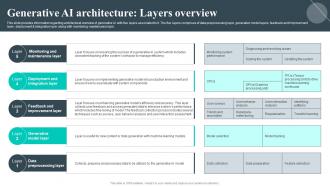
This slide provides information regarding architectural overview of generative AI with five layers associated to it. The five layers comprises of data preprocessing layer, generative model layers, feedback and improvement layer, deployment and integration layer along with monitoring-maintenance layer.
People who downloaded this PowerPoint presentation also viewed the following :
Most Powerful Generative AI Architecture Layers Overview AI SS V with all 9 slides:
Use our Most Powerful Generative AI Architecture Layers Overview AI SS V to effectively help you save your valuable time. They are readymade to fit into any presentation structure.








FAQs for Most Powerful Generative AI Architecture Layers Overview
Key components of generative AI architecture include neural networks, training datasets, computational infrastructure, model parameters, and inference engines. These technologies work together by processing vast amounts of data, learning complex patterns, and generating new content, with many organizations finding that strategic implementation across customer service, content creation, and product development ultimately delivers enhanced operational efficiency and competitive advantage.
Generative AI models learn to understand and recreate entire data distributions through unsupervised or self-supervised learning, while discriminative models focus on learning decision boundaries between classes using labeled data. This fundamental difference means generative models like GPT require significantly more computational resources and training time, but ultimately deliver broader capabilities for content creation, data augmentation, and creative applications across industries.
Neural network design fundamentally determines generative AI effectiveness by defining model capacity, training efficiency, and output quality through architectural choices like attention mechanisms, layer depth, and connection patterns. Different architectures excel in specific domains, with transformers revolutionizing language generation, GANs enhancing image synthesis, and diffusion models delivering superior visual quality, ultimately enabling organizations to achieve more accurate, scalable, and commercially viable AI solutions.
VAEs use encoder-decoder architecture with probabilistic latent spaces for stable, controllable generation, while GANs employ competing generator-discriminator networks for high-quality outputs. These approaches serve different business needs, with VAEs enabling reliable content variation in marketing and product design, and GANs delivering photorealistic imagery for media, gaming, and retail applications, ultimately providing organizations strategic advantages in automated content creation.
Ethical considerations include data privacy protection, bias mitigation, transparency in decision-making processes, content authenticity verification, and responsible output generation. These principles guide developers by ensuring fair representation, protecting user information, and maintaining accountability, with many organizations finding that proactive ethical frameworks ultimately deliver greater user trust and regulatory compliance.
Transfer learning enhances generative AI models by leveraging pre-trained knowledge from large datasets, reducing training time and computational requirements while improving output quality. This approach enables models to adapt existing learned patterns to new domains, allowing healthcare organizations to customize medical image generation or financial institutions to develop specialized document creation tools, ultimately delivering faster deployment and enhanced performance with limited data.
Generative AI applications span content creation, code generation, drug discovery, personalized recommendations, and automated design across industries. Healthcare organizations leverage it for medical imaging and treatment planning, financial services use it for risk modeling and fraud detection, while retail and manufacturing companies deploy generative AI for product design and customer personalization, ultimately delivering enhanced efficiency and competitive advantage.
Generative models handle high-dimensional data through dimensionality reduction techniques, latent space representations, hierarchical architectures, attention mechanisms, and progressive training approaches. These methods enable organizations to process complex datasets like images, text, and audio by compressing information into manageable representations, with sectors like healthcare and finance finding that strategic implementation delivers enhanced pattern recognition and operational efficiency.
Generative AI output quality is evaluated using metrics like BLEU scores for text coherence, perplexity for language modeling accuracy, inception scores for image realism, and human evaluation ratings for relevance and creativity. These assessment frameworks enable organizations to optimize model performance across applications like content generation, customer service automation, and creative design workflows, ultimately delivering more reliable AI-powered solutions and enhanced user experiences.
Generative AI integrates into software development workflows through automated code generation, intelligent debugging assistance, automated testing frameworks, documentation creation, and code review optimization. These technologies streamline development cycles by reducing manual coding time, enhancing quality assurance processes, and accelerating deployment timelines, with many development teams finding that AI-powered tools ultimately deliver faster project completion and improved code reliability.
Generative AI presents data privacy challenges including unauthorized data exposure, model training on sensitive information, potential data leakage through generated outputs, inadequate consent mechanisms, and regulatory compliance complexities. While these concerns require robust encryption, privacy-preserving techniques, and governance frameworks, many organizations find that implementing strategic safeguards enables them to leverage AI benefits while maintaining customer trust and competitive advantage.
Reinforcement learning techniques enhance generative AI outputs by using reward-based feedback systems, iterative model training, and quality optimization algorithms to refine content generation. Through human feedback integration and performance scoring mechanisms, organizations across healthcare, finance, and creative industries achieve more accurate, contextually relevant results, ultimately delivering improved user experiences and strategic competitive advantage.
Hardware advancements enabling sophisticated generative AI architectures include specialized GPUs with increased memory bandwidth, tensor processing units (TPUs), neuromorphic chips, quantum processors, and advanced cooling systems. These technologies streamline model training by accelerating computations, reducing energy consumption, and enabling larger parameter models, with major cloud providers and enterprises finding that enhanced processing capabilities ultimately deliver faster AI development cycles and more competitive intelligent applications.
Community input and open-source collaboration accelerate generative AI evolution by enabling rapid experimentation, diverse perspectives, and collective problem-solving across global developer networks. Through platforms like Hugging Face and GitHub, researchers share models, datasets, and techniques, while collaborative projects like Stable Diffusion demonstrate how community-driven development delivers innovative solutions faster than traditional proprietary approaches, ultimately democratizing AI advancement.
Future trends in generative AI architecture include multimodal integration, federated learning systems, edge computing deployment, neuromorphic processors, and autonomous model optimization. These innovations streamline computational efficiency, enhance privacy protection, and reduce latency, with financial services and healthcare organizations finding that distributed architectures deliver faster processing, lower operational costs, and improved scalability for enterprise applications.
-
Perfect template with attractive color combination.
-
Qualitative and comprehensive slides.